Understanding properties of polyelectrolytes gives control over responsive polymer microstructures
February 2, 2012 By Lee Swee Heng
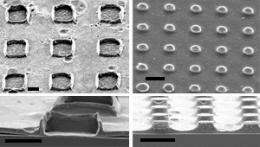
Scanning electron microscope images of (PDADMAC-PSS)10 films assembled on PMMA templates with ’microwells’ of 25 (left) and 7 (right) micrometers. Thinner films form inside larger microwells, and vice-versa. All scale bars: 10 μm.
Polymer films that undergo nanoscale structural transformations in response to external stimuli are key components of devices like biosensors and artificial membranes. One of the best materials for manufacturing such responsive materials is polyelectrolyte multilayers (PEMs) polymer chains bearing charged units that can assemble layer-by-layer onto solid surfaces. Maxim Kiryukhin at the A*STAR Institute of Materials Research and Engineering and co-workers1 have now gained new insights into PEM growth which may enable construction of three-dimensional microstructures for on-demand drug delivery.
The standard method of producing PEMs involves repeatedly dipping a flat substrate into positively and negatively charged polyelectrolyte solutions. Although this approach can generate large-scale coatings with precise vertical thicknesses, it is far more challenging to achieve similar control at confined dimensions. Previous studies have shown that PEMs grown onto micro-sized surface templates have non-uniform thicknesses that could severely compromise device performance.
Kiryukhin and co-workers systematically investigated a PEM assembled from poly(diallyldimethylammonium chloride)/poly(sodium 4-styrenesulfonate), or PDADMACPSS, to help resolve this problem. Unlike other multilayers, the PDADMACPSS system can shift from a linear layer-by-layer growth mode to one with exponentially increasing film thickness, simply by increasing the ionic strength of the polyelectrolyte dipping solution. By exploring these two regimes on templates containing differently sized microwells, the team hoped to discover the critical factors needed to produce consistent microstructures.
First, the researchers imprinted an array of microwells ranging from 2 to 25 micrometers onto a sacrificial plastic template made of poly(methyl methacrylate), or PMMA, and then coated the surface with a PDADMACPSS multilayer film. After transferring the PEM onto a silicon support, they dissolved away the PMMA template. Depending on the microwell pattern, the polyelectrolyte concentration, and number of multilayers, this technique generated numerous structures including hollow microchambers and solid microstubs (see image).
The team found that in exponential growth modes, aggregation of PDADMAC chains produced variable template coatings; thicker films could form inside the microwells and vice-versa, depending on the particular template shape. Weak bonds between the PDADMAC aggregates gave these films gel-like mechanical properties. In linear growth modes, the solvated polyelectrolyte exists as isolated chains that coat the template evenly and make the microstructures rigid and glass-like. Stable hollow microchambers formed in this mode when the PEM film was thicker than 400 nanometers.
According to Kiryukhin, the highly ordered arrays of sealed microchambers produced with this method could allow programmed release of tiny cargos from individual cavities opportunities that the team are currently pursuing.
More information: Research article in Langmuir
Provided by Agency for Science, Technology and Research (A*STAR)
-
From lemons to lemonade: Reaction uses carbon dioxide to make carbon-based semiconductor,
33 comments
-
Thioridazine kills cancer stem cells in human while avoiding toxic side-effects of conventional cancer treatments,
3 comments
-
SpaceX private rocket blasts off for space station (Update),
42 comments
-
Landmark calculation clears the way to answering how matter is formed,
55 comments
-
Research team claims to have found evidence Lake Cheko is impact crater for Tunguska Event,
18 comments
-
Did a 16 year old solve a centuries-old problem by Newton?
2 hours ago
-
Theoretical highest electric charge?
5 hours ago
-
Effect of Damping wave on vibration
5 hours ago
-
How does impulse relate to energy when the net force is zero?
5 hours ago
-
Calculating Saturation Vapor Pressure?
13 hours ago
-
Question about high electric charge.
17 hours ago
- More from Physics Forums - Classical Physics
More news stories
Computer model used to pinpoint prime materials for efficient carbon capture
When power plants begin capturing their carbon emissions to reduce greenhouse gases and to most in the electric power industry, it's a question of when, not if it will be an expensive undertaking.
12 hours ago |
not rated yet |
0
|
Scientists develop ultra-sensitive test that detects diseases in their earliest stages
Scientists have developed an ultra-sensitive test that should enable them to detect signs of a disease in its earliest stages, in research published today in the journal Nature Materials.
Chemistry / Analytical Chemistry
12 hours ago |
5 / 5 (1) |
0
|
New CO2-removing catalyst can take the heat
(Phys.org) -- The current method of removing the greenhouse gas carbon dioxide (CO2) from the flues of coal-fired power plants uses so much energy that no one bothers to use it. So says Roger Aines, principal ...
May 24, 2012 |
5 / 5 (9) |
11
|
High-speed method to aid search for solar energy storage catalysts
Eons ago, nature solved the problem of converting solar energy to fuels by inventing the process of photosynthesis.
May 25, 2012 |
5 / 5 (3) |
4
|
Researchers demonstrate possible primitive mechanism of chemical info self-replication
(Phys.org) -- When scientists think about the replication of information in chemistry, they usually have in mind something akin to what happens in living organisms when DNA gets copied: a double-stranded molecule ...
May 25, 2012 |
5 / 5 (4) |
2
|
Stunning image of smallest possible five-ringed structure
Scientists have created and imaged the smallest possible five-ringed structure about 100,000 times thinner than a human hair and you'll probably recognise its shape.
'Unzipped' carbon nanotubes could help energize fuel cells, batteries
Multi-walled carbon nanotubes riddled with defects and impurities on the outside could replace some of the expensive platinum catalysts used in fuel cells and metal-air batteries, according to scientists at ...
Change in developmental timing was crucial in the evolutionary shift from dinosaurs to birds: study
At first glance, it's hard to see how a common house sparrow and a Tyrannosaurus Rex might have anything in common. After all, one is a bird that weighs less than an ounce, and the other is a dinosaur that ...
T cells 'hunt' parasites like animal predators seek prey, study shows
By pairing an intimate knowledge of immune-system function with a deep understanding of statistical physics, a cross-disciplinary team at the University of Pennsylvania has arrived at a surprising finding: T cells use a movement ...
Yale study concludes public apathy over climate change unrelated to science literacy
Are members of the public divided about climate change because they don't understand the science behind it? If Americans knew more basic science and were more proficient in technical reasoning, would public consensus match ...
Land and sea species differ in climate change response: study
(Phys.org) -- Marine and terrestrial species will likely differ in their responses to climate warming, new research by Simon Fraser University and Australia’s University of Tasmania has found.