Polymer film loaded with antibodies that can capture tumor cells shows promise as a diagnostic tool
Cancer cells that break free from a tumor and circulate through the bloodstream spread cancer to other parts of the body. But this process, called metastasis, is extremely difficult to monitor because the circulating tumor cells (CTCs) can account for as few as one in every billion blood cells.
Research led by scientists at the RIKEN Advanced Science Institute in Wako, in collaboration with colleagues at the University of California, Los Angeles, and the Institute of Chemistry at the Chinese Academy of Sciences, Beijing, has produced a polymer film that can capture specific CTCs. With further development, the system could help doctors to diagnose an advancing cancer and assess the effectiveness of treatments.
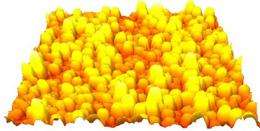
The researchers used a small electrical voltage to help deposit a conducting polymer film of poly(3,4-ethylenedioxythiophene) (PEDOT) bearing carboxylic acid groups on to a 2-centimeter-square glass base (Fig. 1). The polymer formed nanodots, tiny bumps that measure 100 to 300 nanometers across, depending on the voltage used (1–1.4 V).
Adding a chemical linker to the film allowed it to bind a protein called streptavidin; this protein then joined to an antibody. In turn, the antibody could latch on to an antigen called epithelial cell adhesion molecule (EpCAM), which is produced by most tumor cells. In this way, the film could grab tumor cells from just a few milliliters of a blood sample.
The team tested several types of tumor cells on films with various sizes and densities of nanodots, and used a microscope to observe how well they captured the cells. The most effective film, with nanodots measuring about 230 nanometers across and containing about 8 dots per square micrometer, captured roughly 240 breast-cancer cells per square millimeter of film. In contrast, it caught fewer than 30 cervical cancer cells that do not express EpCAM, proving that the antibody used on the film is highly selective. A smooth PEDOT-carboxylic acid film with the same antibody captured only 50 or so breast cancer cells.
The film’s efficiency depends on the size and spacing of the nanodots, and the presence of the capturing antibody. Since these can be easily modified, the same method could be used to make films that sense other types of cells.
The next step is to “further optimize the nanostructures of the conducting polymers and understand in more detail the cell-capturing mechanism,” says RIKEN unit leader Hsiao-hua Yu. “We are also currently working on a direct electrical readout of the captured cells, without needing to use a microscope.”
More information: Sekine, J., et al. Functionalized conducting polymer nanodots for enhanced cell capturing: the synergistic effect of capture agents and nanostructures. Advanced Materials 23, 4788–4792 (2011)
Provided by RIKEN


