Physicists discover evidence of rare hypernucleus, a component of strange matter
February 17, 2012 by Lisa Zyga feature

Physicists discover evidence of rare hypernucleus, a component of strange matter

Enlarge

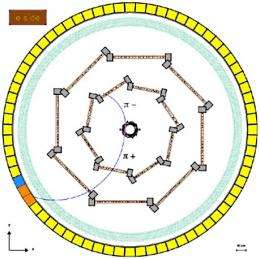
A view of one of the three events found by FINUDA: a schematic frontal view of the apparatus is shown, and the two blue lines represent the two 'pi' mesons moving along opposite bent trajectories in the magnetic field of the apparatus. Image credit: FINUDA collaboration

(PhysOrg.com) -- Physicists in Italy have discovered the first evidence of a rare nucleus that doesn’t exist in nature and lives for just 10-10 seconds before decaying. It’s a type of hypernucleus that, like all nuclei, contains an assortment of neutrons and protons. But unlike ordinary nuclei, hypernuclei also contain at least one hyperon, a particle that consists of three quarks, including at least one strange quark. Hypernuclei are thought to form the core of strange matter that may exist in distant parts of the universe, and could also allow physicists to probe the inside of the nucleus.

The particular hypernucleus investigated here, called "hydrogen six Lambda" (6ΛH), was first predicted to exist in 1963. Now, in a study published in a recent issue of , physicists working in the FINUDA experiment at the Istituto Nazionale di Fisica Nucleare - Laboratori Nazionali di Frascati (INFN-LNF) in Frascati, Italy, have reported finding the first evidence for the particle. The FINUDA collaboration’s analysis of millions of events has turned up three events for the rare hypernucleus.

Strange properties

As its name suggests, 6ΛH is a large type of hydrogen that consists of six particles: four neutrons, one proton, and one Lambda (Λ) hyperon. Since an ordinary hydrogen nucleus contains one proton and no neutrons, hydrogen nuclei that contain one or more neutrons are sometimes called “heavy hydrogen.” The most common types of heavy hydrogen are deuterium (which has one neutron) and tritium (which has two neutrons). Since 6ΛH has four neutrons plus a L hyperon, physicists refer to it as “heavy hyperhydrogen.”

The L hyperon, which consists of one up, one down, and one strange quark, does an even more interesting thing to 6ΛH: it increases its lifetime from 10-22 seconds (the lifetime of the hypernucleus core 5H without L) to 10-10 seconds. When scientists first discovered the L hyperon in 1947, they observed a similarly longer lifetime than predicted for this “strange” object. That observation led to the idea of the existence of the strange quark, with strangeness being the property that causes the quark to live so long.

Detection

Without the L hyperon, it would likely be impossible for physicists to directly observe a hydrogen nucleus with four neutrons, since such a heavy isotope is very difficult to produce and has a very short lifetime. Another hypernucleus, 4ΛH, which has two neutrons instead of four, is more easily produced than 6ΛH in similar experiments and has been detected many times. But detecting evidence of 6ΛH is much more difficult. The 27 million collision events analyzed by the FINUDA collaboration represents about one full year of continuous data-taking from an experiment that spanned several years. Theoretically, the formation probability of 6ΛH is at least 100 times smaller than that of 4ΛH.

The FINUDA experiment is located at one of the two interaction points of the DAFNE collider at INFN-LNF. As Elena Botta, a lead collaborator in the study, explained, DAFNE produces electron and positron beams. When these beams collide nearly head-on, they produce the phi meson (Φ), which decays with a 50% probability into a charged pair of K and anti-K mesons.

FINUDA’s interaction point contains an octagonal prism with eight targets along the sides. When the anti-K meson interacts with a lithium nucleus in one of these targets, it can simultaneously produce a 6ΛH hypernucleus and a π+ meson of a particular energy. If scientists detect this particular meson, they’ve detected a signature of the strange nucleus formation. As Botta explained, 6ΛH production involves a two-step mechanism to decrease the number of protons in the lithium isotope, 6Li, from three to one, which produces hydrogen. Once produced, the neutron-rich 6ΛH hypernuclei slow down inside the target, and after 10-10 seconds they decay at rest into a π- meson and a 6He nucleus. The π- meson also has a particular energy, and scientists can easily detect it to give the signature of the decay. So both the formation and the decay of 6ΛH hypernuclei can be detected by searching for events with the presence of these particular π+ and π- mesons.

Strange matter

As the first evidence for 6ΛH hypernuclei, the results could shed light on strange matter, which is hypothesized to exist at the center of ultra-dense neutron stars. The physicists hope to investigate strange matter further by producing strange nuclear systems.

“Hypernuclei can be interpreted as the core of strange matter,” Botta told PhysOrg.com. “In particular, the possibility to produce strange nuclear systems containing two Λ particles will allow us to study the interaction between strange particles.”

Hypernuclei could also serve as a useful tool to investigate the current model of nuclear structure, in which protons and neutrons are arranged in a stable configuration.

“The fact that a hypernucleus has a strange quark does give it interesting characteristics compared to normal nuclei, since it allows the component L particle to act as a probe that can go very deep into the nucleus to test the description that the single particle shell model gives of nuclear matter,” Botta said. “In this respect, the study of hypernuclear physics allows us to get information not directly accessible otherwise.”

She added that other hypernuclei with large neutron-to-proton ratios could exist in a stable state, even though ordinary neutron-rich nuclei are theoretically unstable. Neutron-rich hypernuclei seem to be an exception because of the way they modify the structure of a nucleus and increase its lifetime.

During an upcoming experiment at the Japan Proton Accelerator Research Complex (J-PARC), plan to search for 6ΛH as well as for other neutron-rich hypernuclei, such as lithium 10 Lambda (10ΛLi).

More information: M. Agnello, et al. “Evidence for Heavy Hyperhydrogen 6ΛH.” Physical Review Letters 108, 042501 (2012) DOI: 10.1103/PhysRevLett.108.042501

Journal reference: Physical Review Letters search and more info website

Copyright 2012 PhysOrg.com.
All rights reserved. This material may not be published, broadcast, rewritten or redistributed in whole or part without the express written permission of PhysOrg.com.

4.7 /5 (39 votes)  

Filter


Move the slider to adjust rank threshold, so that you can hide some of the comments.


Display comments: newest first

baudrunner
Feb 17, 2012

Rank: 5 / 5 (1)
By lifetime you're still talking on the order of 10^-10, and we now know that decay produces predictable sometimes stable sometimes unstable elemental structures, and we'll never keep those neclui around for longer than that, but marks for applying some creativity to the function of those electron and proton beams, fellows.

And by the way, by the standards of Entity Reality, do these particles actually exist, since we're really only inferring their existence from what we *think* we know?
jscroft
Feb 17, 2012

Rank: 4.9 / 5 (8)
10^-22 seconds. If one second were as long as the age of the Universe, this period would STILL be less than 40 microseconds long.

Daaaaamn.
Deathclock
Feb 17, 2012

Rank: 3 / 5 (13)
And by the way, by the standards of Entity Reality, do these particles actually exist, since we're really only inferring their existence from what we *think* we know?


Particles don't exist... It is a simplification/approximation to think of things as particles. Everything is energy, but what is energy? Energy is what it is, it can't be defined by comparing it to something else, because it is everything.

Regardless of whether or not you believe this, you must acknowledge that at the lowest fundamental level that which exists must be accepted as it is and will be impossible to explain or define through comparison.
Modernmystic
Feb 17, 2012

Rank: 1.3 / 5 (3)
Isn't strange matter potentially incredibly dangerous?
baudrunner
Feb 17, 2012

Rank: not rated yet
Deathclock: the scientific method precludes ascribing the state of existance to anything that cannot be observed or manipulated.

Entity Reality is the philosophical arm of quantum physics. By the standards of Entity Reality W bosons don't exist, for example. But that is just meat for discussion.
Resonance
Feb 17, 2012

Rank: not rated yet
We *KNOW* from experiment that quantum particles have both wave and particle properties. The higher the energy of a particle, the smaller its wavelength- this is given by the deBroglie wavelength equation and scales inversely to momentum.
Strange matter is not any more dangerous than any other type of radioactive matter.
dschlink
Feb 17, 2012

Rank: 5 / 5 (4)
And I thank Richard Feynman for making this understandable.
fmfbrestel
Feb 17, 2012

Rank: 5 / 5 (6)
There are a few specific hypothetical combinations of strange matter which under extremely tight limits (which are similarly extremely unlikely to actually exist) could be dangerous.

I've had this debate before and will not engage in it again. Particle accelerators cannot destroy the earth. And that is the last I'm going to say. Debating stranglets is worse than debating religion.
Bowler_4007
Feb 17, 2012

Rank: 1 / 5 (4)
if a particle accelerate creates something that destroys the earth in your lifetime you're going to regret saying that with such certainty, the fact is we can only guess at what nature might throw our way and if something dangerous does pop up things will get a lot more interesting to say the least
Johannes_H_Larsen
Feb 17, 2012

Rank: not rated yet
By lifetime you're still talking on the order of 10^-10, and we now know that decay produces predictable sometimes stable sometimes unstable elemental structures, and we'll never keep those neclui around for longer than that, but marks for applying some creativity to the function of those electron and proton beams, fellows.

And by the way, by the standards of Entity Reality, do these particles actually exist, since we're really only inferring their existence from what we *think* we know?

Aren't you forgetting time dillation? We could increase their lifetime relative to us by order of magnitudes by speeding them up
antialias_physorg
Feb 17, 2012

Rank: 5 / 5 (7)
if a particle accelerate creates something that destroys the earth in your lifetime you're going to regret saying that with such certainty

In that case, certainly not.

But the universe keeps throwing particles at Earth with FAR greater Energies than FINUDA or the LHC can. If object-destroying stranglets were produced even only once every billion years then the entire universe would have long ceased to exist.

If cosmic rays aren't strong enough for you then think about the stuff that is going on inside the sun. And it's still there.
fmfbrestel
Feb 17, 2012

Rank: 1 / 5 (3)
But the universe keeps throwing particles at Earth with FAR greater Energies than FINUDA or the LHC can. If object-destroying stranglets were produced even only once every billion years then the entire universe would have long ceased to exist.

If cosmic rays aren't strong enough for you then think about the stuff that is going on inside the sun. And it's still there.


this
eigenbasis
Feb 18, 2012

Rank: not rated yet
doesn't exist in nature


I believe that these would exist at the core of neutron stars, white dwarfs, and near black holes.
Blakut
Feb 18, 2012

Rank: not rated yet

If cosmic rays aren't strong enough for you then think about the stuff that is going on inside the sun. And it's still there.


Actually the temperature inside the sun, being 10^9 or something K, corresponds to an energy below 100KeV, far lower than cosmic rays or the LHC.
antialias_physorg
Feb 18, 2012

Rank: 5 / 5 (3)
That's average. Not peak.

Anyways we have already detected particles with energies far above what the LHC (by a factor of up to 40 million if you count total energy or a factor of 50 if you count possible interaction energy with a particle here on Earth) from elsewhere in the sky.
http://en.wikiped..._history
Blakut
Feb 18, 2012

Rank: not rated yet
Rohitasch
Feb 19, 2012

Rank: not rated yet
if a particle accelerate creates something that destroys the earth in your lifetime you're going to regret saying that with such certainty, the fact is we can only guess at what nature might throw our way and if something dangerous does pop up things will get a lot more interesting to say the least

A single solar flare produces more energetic particles than all the particle accelerators on earth produce. And when these flares sometimes hit earth, you see pretty auroras and sometimes power failures in the high latitudes. Forget flares - a single thundercloud produces more energ... blah blah blah.
Kinedryl
Feb 20, 2012

Rank: 1 / 5 (2)
The particle beams from colliders differs from cosmic rays in many aspects. It's the similar difference like difference between fission reactor and fission bomb - the quality is the same, but the quantitative factors are very different. The particle beams are highly collimated and concentrated. They do collide in underground at small distance from dense material of Earth. The cosmic rays are slowing down trough sparse layers of atmosphere, so that even when black hole is occasionally formed, it has enough time to evaporate. http://www.aip.or...4-2.html
What's worse, the particle beams collide in head to head collisions with potentially zero momentum toward Earth. It increases the possibility of mutual interaction of black hole formed with material of Earth. The black holes formed in the upper layers of atmosphere will have high speed with respect to Earth, so they will pass trough it faster, than the speed of their interaction with Earth.
Bowler_4007
Feb 20, 2012

Rank: not rated yet
i know that solar flares are more energetic that our particle acceleraters my statement was conditional as indicated by the "if", and i know the chances of some weird/strange matter popping out and doing catastrophic damage is extremely extremely small but if it does happen (i'm not going to repeat myself)

btw i'm replying to antialias & Rohitasch
antialias_physorg
Feb 20, 2012

Rank: 5 / 5 (1)
Even if that probability is small: we should be seeing tons of strange matter cinders floating around the universe. Unless these cinders are the famed 'dark matter' there's not much chance of that happening.

And anyways: The human race has taken chances on much higher probability estimates (I believe the estimate that the first hydrogen bomb would turn the entire Earth's atmosphere into an unbreathable ammonia mix and kill all life within 20 minutes through a nitrogen-cascade was deemed to be 10:1 before ignition. Of course the tests went ahead as scheduled. No way that the US was gonig to NOT show that they had a bigger peni...erm...bomb than the Russkis)
Bowler_4007
Feb 20, 2012

Rank: not rated yet
i wasn't thinking outside of acceleraters (except for mentioning solar flares) so i am aware of this stuff i was just clarifying my original comment
vacuum-mechanics
Feb 21, 2012

Rank: 1 / 5 (1)
And I thank Richard Feynman for making this understandable.


Yes, but there is still remain problem, i.e. how and why particle have both wave and particle properties. May be this could give some hint,

http://www.vacuum...id=17=en
Osiris1
Feb 25, 2012

Rank: 1 / 5 (1)
Since fundamental particles have associated fields or the capability of same, could it be that strange quark containing matter may have the ability to generate anti-gravitic waves and/or fields.
Rank 4.7 /5 (39 votes)
Relevant PhysicsForums posts

More news stories

Landmark calculation clears the way to answering how matter is formed

(Phys.org) -- An international collaboration of scientists, including Thomas Blum, associate professor of physics, is reporting in landmark detail the decay process of a subatomic particle called a kaon – ...

Physics / General Physics

created May 25, 2012 | popularity 4.3 / 5 (24) | comments 55 | with audio podcast

Is a classical electrodynamics law incompatible with special relativity?

(Phys.org) -- The laws of classical electromagnetism that were developed in the 19th century are the same laws that scientists use today. They include Maxwell’s four equations along with the Lorentz la ...

Physics / General Physics

created May 24, 2012 | popularity 4.7 / 5 (18) | comments 43 | with audio podcast feature

Lying in wait for WIMPs: Researchers seek to dramatically increase sensitivity of Large Underground Xenon detector

Although it's invisible, dark matter accounts for at least 80 percent of the matter in the universe. No one knows what it is, but most scientists would bet on weakly interacting massive particles, or WIMPs.

Physics / General Physics

created May 23, 2012 | popularity 4 / 5 (7) | comments 19 | with audio podcast

Hawaii lab turns laser-powered bubbles into microrobots

(Phys.org) -- A team of scientists from the University of Hawaii are working on microrobots created from bubbles of air in a saline solution. The bubbles take on their title of “robots” as a laser ...

Physics / General Physics

created May 23, 2012 | popularity 5 / 5 (4) | comments 2 | with audio podcast weblog

Sound increases the efficiency of boiling

Scientists at the Georgia Institute of Technology achieved a 17-percent increase in boiling efficiency by using an acoustic field to enhance heat transfer. The acoustic field does this by efficiently removing vapor bubbles ...

Physics / Soft Matter

created May 24, 2012 | popularity 5 / 5 (2) | comments 2


Stunning image of smallest possible five-ringed structure

Scientists have created and imaged the smallest possible five-ringed structure – about 100,000 times thinner than a human hair – and you'll probably recognise its shape.

'Unzipped' carbon nanotubes could help energize fuel cells, batteries

Multi-walled carbon nanotubes riddled with defects and impurities on the outside could replace some of the expensive platinum catalysts used in fuel cells and metal-air batteries, according to scientists at ...

Change in developmental timing was crucial in the evolutionary shift from dinosaurs to birds: study

At first glance, it's hard to see how a common house sparrow and a Tyrannosaurus Rex might have anything in common. After all, one is a bird that weighs less than an ounce, and the other is a dinosaur that ...

Computer model used to pinpoint prime materials for efficient carbon capture

When power plants begin capturing their carbon emissions to reduce greenhouse gases – and to most in the electric power industry, it's a question of when, not if – it will be an expensive undertaking.

T cells 'hunt' parasites like animal predators seek prey, study shows

By pairing an intimate knowledge of immune-system function with a deep understanding of statistical physics, a cross-disciplinary team at the University of Pennsylvania has arrived at a surprising finding: T cells use a movement ...

Yale study concludes public apathy over climate change unrelated to science literacy

Are members of the public divided about climate change because they don't understand the science behind it? If Americans knew more basic science and were more proficient in technical reasoning, would public consensus match ...