Outstanding in the cold
February 20, 2012 By Brian Murphy

Outstanding in the cold

Enlarge

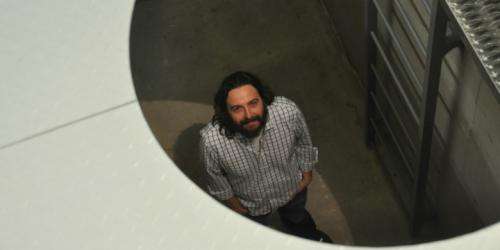
Physicist John P. Davis stands in the site of what will be Canada's coldest laboratory.

Physicist John P. Davis is counting the days until he takes delivery of equipment that will give the University of Alberta the distinction of having the coldest laboratory in Canada.  

Davis’s U of A research focuses on low-temperature physics and the refrigeration unit he’s expecting in March can get just about as low as you can go on this planet: minus-273˚C.

“That kind of temperature gives us access to superconductivity research, which is the transmission of electric current with absolutely no resistance,” Davis says.

The fact that electrical flow is improved by lower temperatures has been known and studied since the early 1900s. Many Canadians have noticed that during deep cold snaps their indoor lights may suddenly shine more brightly. The reason, say, is that the chill dramatically reduces the electrical resistance in the power lines outside their homes.

Davis says superconductivity results in the complete elimination of resistance, which requires extremely low temperatures. “The dilution refrigerator on order from England is about 10 feet long and, towards the bottom, has a small compartment in which we’ll place new materials we want to test,” Davis says.

The equipment looks nothing like the refrigerator in your kitchen. It’s a three-metre long tube suspended by a hoist and hanging in a special compartment beneath the basement floor of the university’s Centennial Centre for Interdisciplinary Science. “The compartment is completely separate from the building,” Davis says. “That eliminates the vibration and electrical or magnetic interference that affects the rest of CCIS.”

Davis says one goal of superconductivity experiments is to find materials that one day could be made to work with zero electrical resistance at more practical temperatures. 

“The holy grail of superconductivity is to find a material that eliminates at room temperature,” Davis says. “That’s when superconductivity could have applications for everyday life.”

Davis has been working closely with technicians at Oxford Instruments, a maker of high-tech tools and systems for research and industry, on the final design of the dilution refrigerator. If the work and projected delivery times stay on schedule, he expects that he and his students will be running low-temperature experiments by late this summer.

While some researchers are looking at futuristic applications such as magnetic levitation devices, Davis envisions something with a wider benefit. He says that superconductors on large-scale power grids could dramatically reduce world power consumption. “And that technology is within sight.” 

Provided by University of Alberta search and more info website

3.3 /5 (3 votes)  

Filter


Move the slider to adjust rank threshold, so that you can hide some of the comments.


Display comments: newest first

Counterindigo
Feb 20, 2012

Rank: 5 / 5 (1)
Cool.
Rank 3.3 /5 (3 votes)
Relevant PhysicsForums posts

More news stories

Landmark calculation clears the way to answering how matter is formed

(Phys.org) -- An international collaboration of scientists, including Thomas Blum, associate professor of physics, is reporting in landmark detail the decay process of a subatomic particle called a kaon – ...

Physics / General Physics

created May 25, 2012 | popularity 4.3 / 5 (24) | comments 55 | with audio podcast

Is a classical electrodynamics law incompatible with special relativity?

(Phys.org) -- The laws of classical electromagnetism that were developed in the 19th century are the same laws that scientists use today. They include Maxwell’s four equations along with the Lorentz la ...

Physics / General Physics

created May 24, 2012 | popularity 4.7 / 5 (18) | comments 43 | with audio podcast feature

Lying in wait for WIMPs: Researchers seek to dramatically increase sensitivity of Large Underground Xenon detector

Although it's invisible, dark matter accounts for at least 80 percent of the matter in the universe. No one knows what it is, but most scientists would bet on weakly interacting massive particles, or WIMPs.

Physics / General Physics

created May 23, 2012 | popularity 4 / 5 (7) | comments 19 | with audio podcast

Hawaii lab turns laser-powered bubbles into microrobots

(Phys.org) -- A team of scientists from the University of Hawaii are working on microrobots created from bubbles of air in a saline solution. The bubbles take on their title of “robots” as a laser ...

Physics / General Physics

created May 23, 2012 | popularity 5 / 5 (4) | comments 2 | with audio podcast weblog

Sound increases the efficiency of boiling

Scientists at the Georgia Institute of Technology achieved a 17-percent increase in boiling efficiency by using an acoustic field to enhance heat transfer. The acoustic field does this by efficiently removing vapor bubbles ...

Physics / Soft Matter

created May 24, 2012 | popularity 5 / 5 (2) | comments 2


Stunning image of smallest possible five-ringed structure

Scientists have created and imaged the smallest possible five-ringed structure – about 100,000 times thinner than a human hair – and you'll probably recognise its shape.

'Unzipped' carbon nanotubes could help energize fuel cells, batteries

Multi-walled carbon nanotubes riddled with defects and impurities on the outside could replace some of the expensive platinum catalysts used in fuel cells and metal-air batteries, according to scientists at ...

Change in developmental timing was crucial in the evolutionary shift from dinosaurs to birds: study

At first glance, it's hard to see how a common house sparrow and a Tyrannosaurus Rex might have anything in common. After all, one is a bird that weighs less than an ounce, and the other is a dinosaur that ...

Computer model used to pinpoint prime materials for efficient carbon capture

When power plants begin capturing their carbon emissions to reduce greenhouse gases – and to most in the electric power industry, it's a question of when, not if – it will be an expensive undertaking.

T cells 'hunt' parasites like animal predators seek prey, study shows

By pairing an intimate knowledge of immune-system function with a deep understanding of statistical physics, a cross-disciplinary team at the University of Pennsylvania has arrived at a surprising finding: T cells use a movement ...

Yale study concludes public apathy over climate change unrelated to science literacy

Are members of the public divided about climate change because they don't understand the science behind it? If Americans knew more basic science and were more proficient in technical reasoning, would public consensus match ...