NASA looking for more space taxis
February 8, 2012 By Nancy Atkinson, Universe Today

NASA looking for more space taxis

Enlarge

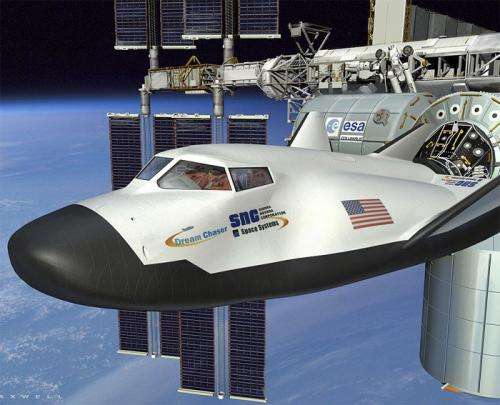
Artist concept of Sierra Nevada’s Dream Chaser docked to the ISS. Credit: Sierra Nevada

NASA is looking for more ways to get astronauts to the International Space Station. The space agency put out a call today for commercial space companies to submit bids as part of the latest round of the Commercial Crew Program, now called Commercial Crew Integrated Capability (CCICap). NASA plans to select at least two potential providers for “safe, reliable, and cost effective human access to space” and they expects to make multiple awards this summer, with values ranging from $300 – $500 million. Those winning the bids will need to develop an integrated system that includes both a crew vehicle and launch system, with work to be completed May 31, 2014.

NASA currently relies on Russian Soyuz vehicles to bring crews to the station, at a cost of $63 million per seat. The Soyuz has experienced unprecedented recent problems with both the Soyuz rocket and now a delay in the next two Soyuz flights to the ISS due to a leak of the capsule during testing.

NASA’s Commercial Crew Program manager Ed Mango spoke at a forum this morning, prior to NASA’s official CCICap announcement and said the hopes are that an initial crewed demonstration flight to low Earth orbit will take place in 2015-2016, with regular commercially operated flights to the ISS beginning around 2017.

The projected timing and funding all hinges on whether Congress approves NASA’s budget request; Legislators provided $406 million for Commercial Crew in 2012, less than half of what the agency requested.

“President Obama is working hard to create an American economy built to last,” NASA Administrator Charles Bolden said in a NASA press releases. “NASA’s support of commercial innovation to reach low Earth orbit is helping to support these efforts by spurring new technological development and creating jobs and economic benefits for years to come.”

The companies will also need to provide ground operations and mission control, and to meet certain milestones in the development in of a crewed orbital demonstration flight.

Current companies receiving funds from for commercial crew are Boeing, Sierra Nevada, SpaceX, and Blue Origin. Companies have until March 23, 2012 to submit their proposals.

Source: Universe Today

4.4 /5 (12 votes)  

Filter


Move the slider to adjust rank threshold, so that you can hide some of the comments.


Display comments: newest first

dschlink
Feb 08, 2012

Rank: 3 / 5 (2)
SpaceX will proceed, regardless. Musk wouldn't mind owning manned space travel.
rbengineer
Feb 08, 2012

Rank: 5 / 5 (1)
What about Lockheed Martin with their Orion space vehicle? Are they out of the race?
Xbw
Feb 08, 2012

Rank: 1.7 / 5 (6)
What about using non chemical rocket means to launch? For example, electromagnetic sleds.
ShotmanMaslo
Feb 08, 2012

Rank: not rated yet
What about Lockheed Martin with their Orion space vehicle? Are they out of the race?


No, but I believe they are not part of the commercial crew program.

My bet is that Blue Origin spacecraft will not be chosen, and it is possible that either Sierra Nevada or Boeing will be discarded if only two providers are to fly.
antialias_physorg
Feb 08, 2012

Rank: 4 / 5 (4)
What about using non chemical rocket means to launch? For example, electromagnetic sleds.

Do the math. You would have to dig hundreds of kilometers down to get a rail long enough so that g forces would be tolerable during liftoff.

And having a horizontal rail and then angling it up - like in the movies - will kill your astronauts instantly. Go to an amusement park ride. These things do 70km/h and produce up to 6g on the turns. For ballistic liftoff you need at least 11km PER SECOND.
Xbw
Feb 08, 2012

Rank: 1 / 5 (1)
It's not entirely impossible. It would just take some major engineering but would provide big time launch assistance and reduce the fuel needed to boost into space substantially http://en.wikiped...s_driver

I have also read some recommendations to build one of these going up the side of a mountain.
fmfbrestel
Feb 09, 2012

Rank: not rated yet
You are still limited by g forces. Manned chemical rockets are already limited to some degree by max G's. Plus you dont just need 11km/s you need 11k/s without any friction losses. Ever opened the car window going 70mph?
People aren't the only thing sensitive to G's either, you cant just expect a state of the art com sat to take more than 10-20 g's. Savings in fuel weight is eaten up by requiring a much more robust vehicle capable of surviving the launch.

ShotmanMaslo
Feb 09, 2012

Rank: 5 / 5 (1)
reduce the fuel needed to boost into space substantially


But fuel cost for rocket launch is negligible.
antialias_physorg
Feb 09, 2012

Rank: 4.2 / 5 (5)
I have also read some recommendations to build one of these going up the side of a mountain.

The highest mountain is less than 9km high.
At 6g (which is barely tolerable for well trained humans for the approx. 3 minutes you'd need to accelerate) you need a rail that is 1000km long. WITHOUT any bends whatsoever after the first few kilometers.
A mountain just isn't high enough for this (even going down into the oceans isn't nearly enough.)
Egleton
Feb 12, 2012

Rank: not rated yet
At the South Pole there is desending air and ice.
Place a circular rail on the ice. Build a bridge over the rail on the diameter. Make the diameter as large as possible.
The bridge is on wheels and rotates about the centre of the circle.
Water is sprayed from the bridge to build a giant convex lens of clear ice.
The lens is polished to perfection.
Aluminium is sprayed on the Ice.
Carbon fibres are sprayed onto the aluminium. Piezo crystals are placed on the carbon layer.
A supporting frame of your choice is laid over the crystals.
A current is passed through the aluminium to heat it and separate it from the ice.
Hydrogen is forced between the aluminium and the ice.
The structure floats away and is guided to the side, where it is allowed to flip over and settles on the surface.

Repeat the process.
The next structure is not allowed to flip over but is brought down onto the first and the edges are sealed with a gentle explosive paste..
Two linear accelerators and rocket are attached to
Egleton
Feb 12, 2012

Rank: not rated yet
Two linear accelerators and rocket are attached to the outside.
The construction is filled with hydrogen.

It is floated to the edge of space. The rocket takes the structure up to an altitude where the linear accelerator's thrust is sufficient to overcome atmospheric drag.
The steady thrust of the accelerator takes the vessel out of Earth's gravitational well, where the gentle explosive separates the construction. The two halves then go to L4 and L5.

A camera is placed at the focal point of the lens. Distortions are corrected by the piezo electric crystals.
The direction of the two giant lenses is co-ordinated to yield binocular views of exoplanets.

This information is presented in an auditorium on the earth as a halographic model.
Rank 4.4 /5 (12 votes)
Relevant PhysicsForums posts
  • Distance of planets from stars and revolution
    created12 hours ago
  • revamping general concept and cosmological principle
    createdMay 25, 2012
  • Transiting Exoplanet Light Curve
    createdMay 25, 2012
  • Math behind Theoretical Physics
    createdMay 24, 2012
  • Do we know whats at the center of galaxies yet?
    createdMay 23, 2012
  • Structure of the Milky Way?
    createdMay 20, 2012
  • More from Physics Forums - General Astronomy

More news stories

Yale study concludes public apathy over climate change unrelated to science literacy

Are members of the public divided about climate change because they don't understand the science behind it? If Americans knew more basic science and were more proficient in technical reasoning, would public consensus match ...

Space & Earth / Environment

created 12 hours ago | popularity 4.8 / 5 (6) | comments 29 | with audio podcast

Land and sea species differ in climate change response: study

(Phys.org) -- Marine and terrestrial species will likely differ in their responses to climate warming, new research by Simon Fraser University and Australia’s University of Tasmania has found.

Space & Earth / Environment

created 10 hours ago | popularity 4 / 5 (5) | comments 9 | with audio podcast

10 million years needed to recover from mass extinction

It took some 10 million years for Earth to recover from the greatest mass extinction of all time, latest research has revealed.

Space & Earth / Earth Sciences

created 12 hours ago | popularity 4.2 / 5 (5) | comments 5 | with audio podcast

Sophisticated simulations predict future warming

The chances of our planet being hit by a global warming of 3 degrees Celsius by 2050 is as likely as it being hit by an increase of 1.4 degrees, new research shows. Presented in the journal Nature Geoscience, the British study ...

Space & Earth / Earth Sciences

created May 22, 2012 | popularity 3.8 / 5 (11) | comments 51

Kyoto Protocol architect 'frustrated' by climate dialogue

UN climate talks are going nowhere, as politicians dither or bicker while the pace of warming dangerously speeds up, one of the architects of the Kyoto Protocol told AFP.

Space & Earth / Environment

created May 23, 2012 | popularity 3.4 / 5 (8) | comments 44


Stunning image of smallest possible five-ringed structure

Scientists have created and imaged the smallest possible five-ringed structure – about 100,000 times thinner than a human hair – and you'll probably recognise its shape.

'Unzipped' carbon nanotubes could help energize fuel cells, batteries

Multi-walled carbon nanotubes riddled with defects and impurities on the outside could replace some of the expensive platinum catalysts used in fuel cells and metal-air batteries, according to scientists at ...

Change in developmental timing was crucial in the evolutionary shift from dinosaurs to birds: study

At first glance, it's hard to see how a common house sparrow and a Tyrannosaurus Rex might have anything in common. After all, one is a bird that weighs less than an ounce, and the other is a dinosaur that ...

Computer model used to pinpoint prime materials for efficient carbon capture

When power plants begin capturing their carbon emissions to reduce greenhouse gases – and to most in the electric power industry, it's a question of when, not if – it will be an expensive undertaking.

T cells 'hunt' parasites like animal predators seek prey, study shows

By pairing an intimate knowledge of immune-system function with a deep understanding of statistical physics, a cross-disciplinary team at the University of Pennsylvania has arrived at a surprising finding: T cells use a movement ...

Browser wars flare in mobile space

The browser wars are heating up again, but this time the fight is for dominance of the mobile Internet.