NASA map sees Earth's trees in a new light
Feb 20, 2012 By Alan Buis
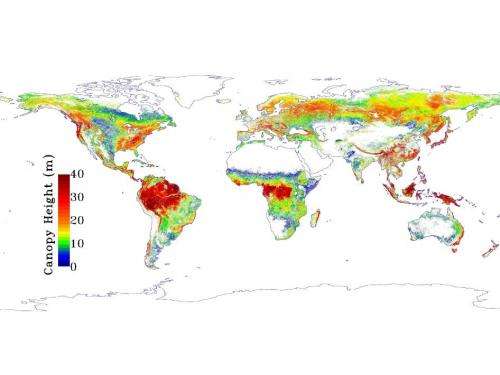
Global map of forest height produced from NASA's ICESAT/GLAS, MODIS and TRMM sensors. The map will advance our understanding of Earth's forest habitats and their role in Earth's carbon cycle. Credit: NASA/JPL-Caltech

A NASA-led science team has created an accurate, high-resolution map of the height of Earth's forests. The map will help scientists better understand the role forests play in climate change and how their heights influence wildlife habitats within them, while also helping them quantify the carbon stored in Earth's vegetation.

Scientists from NASA's Jet Propulsion Laboratory, Pasadena, Calif.; the University of Maryland, College Park; and Woods Hole Research Center, Falmouth, Mass., created the using 2.5 million carefully screened, globally distributed laser pulse measurements from space. The light detection and ranging (lidar) data were collected in 2005 by the Geoscience System instrument on NASA's Ice, Cloud and land Elevation Satellite (ICESat).

"Knowing the height of Earth's forests is critical to estimating their biomass, or the amount of carbon they contain," said lead researcher Marc Simard of JPL. "Our map can be used to improve global efforts to monitor carbon. In addition, forest height is an integral characteristic of Earth's habitats, yet is poorly measured globally, so our results will also benefit studies of the varieties of life that are found in particular parts of the forest or habitats."

The map, available at http://lidarradar.jpl.nasa.gov , depicts the highest points in the . Its spatial resolution is 0.6 miles (1 kilometer). The map was validated against data from a network of nearly 70 ground sites around the world.

The researchers found that, in general, forest heights decrease at higher elevations and are highest at low latitudes, decreasing in height the farther they are from the tropics. A major exception was found at around 40 degrees south latitude in southern in Australia and New Zealand, where stands of eucalyptus, one of the world's tallest , tower much higher than 130 feet (40 meters).

The researchers augmented the ICESat data with other types of data to compensate for the sparse , the effects of topography and cloud cover. These included estimates of the percentage of global tree cover from NASA's Moderate Resolution Imaging Spectroradiometer on NASA's Terra satellite, elevation data from NASA's Shuttle Radar Topography Mission, and temperature and precipitation maps from NASA's Tropical Rainfall Measuring Mission and the WorldClim database. WorldClim is a set of freely available, high-resolution global climate data that can be used for mapping and spatial modeling.

In general, estimates in the new map show forest heights were taller than in a previous ICESat-based map, particularly in the tropics and in boreal forests, and were shorter in mountainous regions. The accuracy of the new map varies across major ecological community types in the forests, and also depends on how much the forests have been disturbed by human activities and by variability in the forests' natural height.

"Our map contains one of the best descriptions of the height of Earth's forests currently available at regional and global scales," Simard said. "This study demonstrates the tremendous potential that spaceborne lidar holds for revealing new information about Earth's forests. However, to monitor the long-term health of Earth's forests and other ecosystems, new Earth observing satellites will be needed." 

Results of the study were published recently in the Journal of Geophysical Research - Biogeosciences.

Explore further: Bold action, big money needed to curb Asia floods

Related Stories

New approach to measuring carbon in forests

Mar 26, 2008

CSIRO is collaborating in a NASA-funded project, using a CSIRO-designed instrument, to help develop new methods of measuring forest carbon stores on a large scale.

NASA, Japan Release Improved Topographic Map of Earth

Oct 18, 2011

(PhysOrg.com) -- NASA and Japan released a significantly improved version of the most complete digital topographic map of Earth on Monday, produced with detailed measurements from NASA's Terra spacecraft.

Recommended for you

Bold action, big money needed to curb Asia floods

10 hours ago

Asia's flood-prone megacities should fund major drainage, water recycling and waste reduction projects to stem deluges and secure clean supply for their booming populations, experts said Sunday.

Heat-related deaths in Manhattan projected to rise

12 hours ago

Residents of Manhattan will not just sweat harder from rising temperatures in the future, says a new study; many may die. Researchers say deaths linked to warming climate may rise some 20 percent by the 2020s, ...

Dire outlook despite global warming 'pause': study

12 hours ago

A global warming "pause" over the past decade may invalidate the harshest climate change predictions for the next 50 to 100 years, a study said Sunday—though levels remain in the danger zone.

China 'will not accept' carbon tax on EU flights: report

15 hours ago

China will not pay for CO2 emissions by its airlines on flights within Europe, a top civil aviation official reportedly said after the European Commission warned eight Chinese firms face fines for nonpayment.

Chinese, Indian airlines face EU pollution fines

May 18, 2013

Eight Chinese and two Indian airlines face fines of up to several million euros for not paying for their greenhouse gas emissions during flights within the bloc, the European Commission said on Friday.

User comments : 3

Adjust slider to filter visible comments by rank

Display comments: newest first

baudrunner
not rated yet Feb 20, 2012
Monitoring the health of our forests involves little more than watching man's destructive impact on them. They should model the Earth's climate change for a scenario in which all of the rain forests in Brazil cease to exist. I think we would be shocked to see into that scary future.
hyongx
not rated yet Feb 20, 2012
This makes me want to go to the rainforest.
Howhot
not rated yet Feb 21, 2012
It really make you appreciate the Brazilian rain forests. And I thought Yosemite was big.

More news stories

Heat-related deaths in Manhattan projected to rise

Residents of Manhattan will not just sweat harder from rising temperatures in the future, says a new study; many may die. Researchers say deaths linked to warming climate may rise some 20 percent by the 2020s, ...

Mice, gerbils perish in Russia space flight

A number of mice and eight gerbils sent into space in a Russian capsule destined to find out how well organisms can withstand extended flights perished during their journey, scientists said Sunday as the ...

Honeybees trained in Croatia to find land mines

(AP)—Mirjana Filipovic is still haunted by the land mine blast that killed her boyfriend and blew off her left leg while on a fishing trip nearly a decade ago. It happened in a field that was supposedly ...

Kinks and curves at the nanoscale

One of the basic principles of nanotechnology is that when you make things extremely small—one nanometer is about five atoms wide, 100,000 times smaller than the diameter of a human hair—they are going ...