Building mountains in a bottle
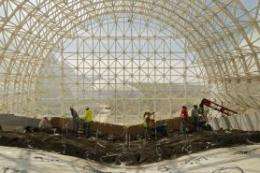
(PhysOrg.com) -- Scientists are preparing to launch a 10-year project to study water resources, gas exchange and carbon cycling in three man-made landscapes built in a half-acre laboratory at the University of Arizona’s Biosphere 2.
Sunlight streams through the arched glass ceiling of an enclosure the size of an aircraft hanger, where 650 tons of crushed volcanic rocks from northern Arizona were unloaded last week through a 10-foot by 10-foot opening: Material to build the first of three mountains inside Biosphere 2.
"We think of them as three ships in a bottle," said Stephen DeLong, an assistant research professor at Biosphere 2 with a joint appointment in the UA's department of geosciences and lead scientist on the project.
It's the first and only experiment that will be able to reproduce the complex natural systems that control how water flows through the ground and how gases circulate in our atmosphere.
Funded by the Philecology Foundation, the Landscape Evolution Observatory, or LEO, will contain mountain slopes interlaced with a network of sensors that will allow the scientists to measure with greater precision than ever before everything from the speed with which water flows through the soil to exchange of gases through the leaves of plants.
Mountain or hill slopes are a vital part of the landscape, especially in the Desert Southwest, said DeLong. "Water and nutrients and plant life all occur on mountain slopes. They're especially important for humans because that's where water resources come from in the southwest – from the high elevation, mountain-sloped areas."
The idea for the project had its origins when the UA began managing Biosphere 2 in 2007. "There was a conscious decision to only take on the challenge of managing Biosphere 2 if scientists here at the UA could figure out a really neat, really new project," said DeLong. "A new use for the facility that really couldn't be done anywhere else in the world."
"Right now we can make observations of the natural world, which are obviously very important, but the natural world is very complicated," he added. "We're building this intermediate scale in the biosphere. These hills approach a natural scale, and they have some of the complexities of a natural system.
"This is also an opportunity to get lots of different scientists together to tackle things like how climate change will affect ecology and water availability in the future and how we might be able to improve the models and theory for how water moves through landscapes and how carbon and energy and all these very complicated systems work together."
The measurements the researchers record at LEO will bridge the gap between small-scale controlled experiments and observational studies of hydrology, atmospheric cycling and climate change on a global scale.
"In a laboratory you can really control an experiment and understand everything that goes in and out, but it doesn't really tell you much about how big systems interact," said DeLong. "Here we can see how big systems interact."
Currently under construction, LEO is expected to be operational by the end of 2012. "We're building three identical slopes," said DeLong. "First we'll run them as replicates, and then perhaps we can diverge them and run them at different climates or with different plants."
All of the materials for building the steel framework, the sensors and the slopes themselves have to be carried through the 10-foot by 10-foot opening.
"We're putting the soil on now and next we will build a crane system that allows the researchers to access different points without disturbing the surface," said DeLong. "We've designed a rain system that can simulate everything from a light winter rain to a fairly heavy monsoon storm."
Ability to control temperature and rain will allow the scientists to study how climate change will impact atmospheric chemistry, water resources and plant and microbial life in the soil.
"We're going to start out with a very homogenous, even soil material," said DeLong. "Crushed volcanic rock, material that erupted out of a volcano in northern Arizona about 100,000 years ago. It's very young, like yesterday to a geologist."
The scientists decided to use volcanic rock because of its unique chemical composition: The minerals that make up the rocks are relatively unstable and will weather and change during the lifetime of the experiment. "In the 10 years or so of the experiment, we'll see these volcanic minerals turned into things like clays and that will affect how water moves through the soil, so we'll see realistic hydrology," said DeLong. "That allows us to see how soil evolves in real time."
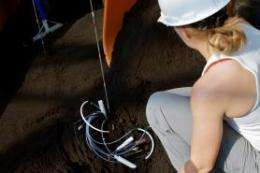
A network of about 1,800 sensors and samplers arrayed through each slope will take measurements of the amount of water in the soil at a particular point, the soil chemistry and temperature, the types of gases released from the soil and other parameters. "It's a relatively controlled environment within the facility where we can make a lot of measurements of trace gases, carbon dioxide and oxygen levels," said DeLong.
The researchers will be able to draw gas and water out from the soil through a network of samplers connected to the structure. "We'll be able to see what's going on chemically and biologically and we won't have to dig into the soil and disturb it," said DeLong. "We can just pump the gas and the water out and run analyses on them."
According to DeLong, "Once we introduce plants to the environment, water will be transpired through the plants, they're going to put organic material into the soil and encourage a lot of biologic activity and things are really going to change."
DeLong stressed the advantage of running different climate scenarios," said DeLong. "We can really understand the hydrology well, understand how water moves through with different rain scenarios, understand how the plants feedback, and then run a big drought. And then we can run a second drought that's somewhat warmer and start to see how these changes really affect the landscape."
The data from LEO will help to improve regional and global climate models by providing the researchers with real evidence of how the changing climate will affect movement of water, ecology and how the atmosphere interacts with the soil.
"We know that here in the southwest there's a massive die-off of pine trees," said DeLong. "We don't fully understand it but we understand that it's related to drought, to climate change and to invasive species. We can get at this in our model system and really understand the different controls on some of these phenomena."
Through a two-story glass wall at Biosphere 2, visitors can view the construction of LEO, and at the end of 2012 they will be able to see the model mountainsides. "Visitors also get a chance to talk to me and other researchers and technicians in an informal way, which is a nice way for the public to learn more about how science is done," said DeLong.
Like the global climate and landscape interactions that it reflects, LEO is an evolving and ever-changing study. "We're always open to new ideas. Getting new scientists and new students involved over the years will really guide the project," said DeLong. "There are going to be a lot of opportunities scientifically."
Provided by University of Arizona


