Low-cost instrument developed by students could aid weather research
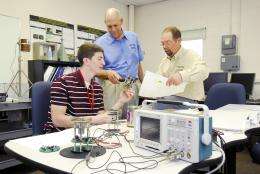
On a recent blustery afternoon, scientists gathered on a rooftop at the Georgia Tech Research Institute (GTRI) to observe two atmospheric electric field-mill devices monitor the buildup of electrical charge in nearby clouds. The larger device was a commercial model costing about $5,000. The smaller one, built by five Georgia high-school students using a coffee can, electrical components and a motorcycle battery, cost about $200.
The accuracy of the field mills’ readings of electrostatic charge -- a critical measure of lightning potential -- was comparable.
"If we could put 25 of these low-cost field mills on high schools around Georgia, the resulting array would let us measure charge buildup in storm clouds and help answer important questions involving lightning activity," said John Trostel, a senior research scientist who is director of GTRI's Severe Storms Research Center. "We'd also be offering a unique educational opportunity to Georgia science students -- the chance to build a precision scientific instrument and then see it in operation."
Building an accurate field mill, Trostel explained, is not a trivial task. The present device is the result of several semesters of work by four students from Kennesaw Mountain High School in Kennesaw, Ga., and another student from The Walker School in Marietta, Ga.
Under the guidance of Georgia Tech personnel, each student worked a semester during his senior year as a research intern in the Severe Storms Research Center at GTRI's Cobb County Research Facility. For the Kennesaw Mountain students, the work at GTRI represented a capstone project completing four years in that school's Academy of Math and Science Magnet Program.
"We've been fortunate to have students working at GTRI for six years now," said Kelly Ingle, a science teacher who supervises the Magnet Research and Internship Program at the high school. "It's a real win-win situation, because the students are gaining experience that will help launch them on their college and professional careers, and they're also doing something beneficial for the mentoring facility."
A Team Effort
The five students -- David Brinkmann, Matthew Bond, Alex Hale and Andrew Brinkmann from Kennesaw Mountain and Stephen Pfohl from The Walker School -- each tackled part of the research and design effort required to build a working field mill, explained Tom Perry, a GTRI electrical engineer who played a major supervising role.
Starting in 2008, David Brinkmann spent a semester researching and building a prototype. His task was to demonstrate that it was indeed possible for high school students to build an inexpensive but accurate field mill.
David Brinkmann -- now a student at the U.S. Coast Guard Academy -- considered several options before choosing a field-mill concept from a German website. He developed a cylinder-shaped device, consisting of handmade circuit boards held together by nuts and bolts that fit snugly into a coffee can. The total cost was about $90.
.jpg "John Trostel, Matthew Bond and Tom Perry adjust a student-designed field mill operating on the roof of GTRI’s Cobb County Research Facility. To the left is a commercially made field mill. Credit: Gary Meek")
In 2009, Bond spent his spring semester improving David Brinkmann's model by adding electrical components, including a data-logging function for detecting voltages and a voltage regulator that ensures uniform performance of a rotating blade that spins above the sensing elements, inducing alternating positive and negative charges.
He then tackled the challenge of calibrating the field mill, which involves correlating voltage readings with field strengths in the atmosphere.
"I built a 10 foot by 10 foot structure -- basically a capacitor -- out of wood and aluminum foil," recalled Bond, now a student in mechanical engineering at Mississippi State University. The mill was then inserted into the gap between the two capacitor plates. "We ran different field strengths across the capacitor and then did a regression on the data. That gave us the equation we needed to translate the voltages we were seeing to actual field strengths, which are the useful data that we wanted."
In 2010, Hale used CAD design software to develop a final circuit-board design that could be fabricated commercially. Now at the University of Alabama, Hale also built a field-mill mockup to demonstrate that fabricated boards would fit correctly, and he improved the device's electrical characteristics.
"We used several professional-level computer programs to improve the layout and develop a final design that could be sent to a fabricator," Perry said. "Alex did all the CAD work that went into the final board design. At each step I showed him partially how to do it. Then I would erase my work, and he would go on to complete it."
The field mill currently being tested by GTRI employs a commercially fabricated circuit board that was made using Hale's design. The robustness of the $200 field mill is still under study. Device accuracy is excellent, but issues include long-term calibration consistency and materials lifespan.
"Before we actually distribute any field mills to schools, we're calibrating several of them and comparing their operation with commercial field mills over time," Trostel said.
Continuing the project, during the summer of 2011 Pfohl was tasked with constructing five copies of this successful design to be used in comparison and for stability testing. Andrew Brinkmann, David’s younger brother, then spent the fall semester of 2011 testing and comparing the outputs of the five devices. This testing led to numerous improvements in the mill design that should make them both more reliable and more robust.
Field Mill Kits
Trostel explained that with commercial circuit boards and other parts now easily available, it may soon be possible to take the next step: distribution of low-cost, standardized field mill kits and operational procedures to leading Georgia high schools. That step would allow students around the state to investigate local electric field effects. Mounted on the school's roof, the device would send lightning data via a wired connection to a computer in the school.
Having 25 or so field mills around the state would allow Georgia schools to participate in an extensive field-mill array capable of making large-scale electric field measurements. Such an array could make a real contribution to lightning research by supporting investigation into such research problems as the initiation and cessation of lightning during a storm.
"An array of field mills over an extensive area would give us more insight into when lightning first begins during a storm, and when it ends," Trostel said. "When we know more about when these points are reached, it will help us establish dependable guidelines on lightning dangers."
Also under study are the best methods for supplying power to the device. Solar power shows promise, and its use would make the student field mill more portable than commercial models, which require connection to power lines. But a solar panel adds to the overall cost, and researchers must still solve the problem of storing enough solar energy to outlast sunless periods in winter.
Many U.S. high schools are already part of existing weather networks that integrate weather data into classroom learning, Trostel said. The GTRI team wants to work cooperatively with such a network, enabling a Georgia field-mill array to connect to an existing Internet-based system.
"It would be really valuable to have high school students be part of this kind of cutting-edge, real-world experiment," Trostel said. "It would help get them excited about science."
Provided by Georgia Institute of Technology


