Large Hadron Collider to run at 4 TeV per beam in 2012
Feb 14, 2012
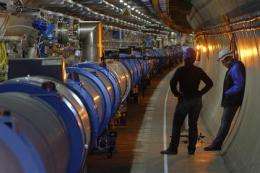
Large Hadron Collider. Image courtesy of CERN.

(PhysOrg.com) -- CERN today announced that the Large Hadron Collider will run with a beam energy of 4 TeV this year, 0.5 TeV higher than in 2010 and 2011. This decision was taken by CERN management following the annual performance workshop held in Chamonix last week and a report delivered today by the external CERN Machine Advisory Committee (CMAC). It is accompanied by a strategy to optimise LHC running to deliver the maximum possible amount of data in 2012 before the LHC goes into a long shutdown to prepare for higher energy running. The data target for 2012 is 15 inverse femtobarns for ATLAS and CMS, three times higher than in 2011. Bunch spacing in the LHC will remain at 50 nanoseconds.

“When we started operating the LHC for in 2010, we chose the lowest safe consistent with the physics we wanted to do,” said CERN’s Director for Accelerators and Technology, Steve Myers. “Two good years of operational experience with beam and many additional measurements made during 2011 give us the confidence to safely move up a notch, and thereby extend the physics reach of the experiments before we go into the LHC’s first long shutdown.”

The LHC’s excellent performance in 2010 and 2011 has brought tantalising hints of new physics, notably narrowing the range of masses available to the Higgs particle to a window of just 16 GeV. Within this window, both the and CMS experiments have seen hints that a Higgs might exist in the mass range 124-126 GeV. However, to turn those hints into a discovery, or to rule out the Standard Model Higgs particle altogether, requires one more year’s worth of data. The LHC is scheduled to enter a long technical stop at the end of this year to prepare for running at its full design of around 7 TeV per beam.

“By the time the LHC goes into its first long stop at the end of this year, we will either know that a Higgs particle exists or have ruled out the existence of a Standard Model Higgs,” said ’s Research Director, Sergio Bertolucci. “Either would be a major advance in our exploration of nature, bringing us closer to understanding how the fundamental particles acquire their mass, and marking the beginning of a new chapter in particle physics."
 
The schedule announced today foresees beams back in the LHC next month, and running through to November. There will then be a long technical stop of around 20 months, with the restarting close to its full design energy late in 2014 and operating for physics at the new high energy in early 2015.

Explore further: New X-ray method shows how frog embryos could help thwart disease

Related Stories

Large Hadron Collider sets world record beam intensity

Apr 22, 2011

(PhysOrg.com) -- Around midnight this night CERN's Large Hadron Collider set a new world record for beam intensity at a hadron collider when it collided beams with a luminosity of 4.67 x 1032cm-2s-1. This exceeds the previous world ...

LHC experiments eliminate more Higgs hiding spots (Update)

Aug 22, 2011

(PhysOrg.com) -- Two experimental collaborations at the Large Hadron Collider, located at CERN laboratory near Geneva, Switzerland, announced today that they have significantly narrowed the mass region in which the Higgs ...

Large Hadron Collider 7 TeV experiment on March 30

Mar 23, 2010

(PhysOrg.com) -- With beams routinely circulating in the Large Hadron Collider at 3.5 TeV, the highest energy yet achieved in a particle accelerator, CERN has set the date for the start of the LHC research ...

CERN continues the hunt for the Higgs

Jan 31, 2011

(PhysOrg.com) -- It has just been decided that CERN will run for the next two years without a break. The Higgs could be within reach sooner than previously thought so all researchers are keen to continue t ...

Recommended for you

Breakthrough calls time on bootleg booze

20 hours ago

(Phys.org) —Using a laser, the St Andrews scientists can now carry out detailed analysis of a spirit sample no bigger than a teardrop and can even confirm whether it is toxic or not. It's hoped the testing ...

Bringing life into focus

May 17, 2013

Spinning-disk confocal microscopy is an optical imaging technique that can be used to generate detailed three-dimensional fluorescence images of living cells and their contents. Although a powerful tool for ...

World's smallest droplet

May 17, 2013

(Phys.org) —Physicists may have created the smallest drops of liquid ever made in the lab. That possibility has been raised by the results of a recent experiment conducted by Vanderbilt physicist Julia Velkovska and her ...

User comments : 5

Adjust slider to filter visible comments by rank

Display comments: newest first

El_Nose
5 / 5 (1) Feb 14, 2012
wow -- if i am not mistaken : and i might be : it took Cern a few years to get 1 inverse femtobarn and now we are doing 15 in one yr . wow
Noumenon
2.6 / 5 (5) Feb 14, 2012
wow -- if i am not mistaken : and i might be : it took Cern a few years to get 1 inverse femtobarn and now we are doing 15 in one yr . wow


You have to realize that 13 inverse femtobarns's of it, is porn.
jagatpalv
not rated yet Feb 15, 2012
wow that means higgs boson will be found in coming months
ant_oacute_nio354
2.3 / 5 (3) Feb 16, 2012
The Higgs doesn't exist because the mass is the electric dipole moment.
ant_oacute_nio354
3 / 5 (2) Feb 16, 2012
Antonio Jose Saraiva

m = e.k /x (1-pi^3.alpha^2 /2)

m-mass or electric dipole moment;e-electron charge;
k-Boltzmann constant (square meter);
x-Compton wavelength; pi=3.1415927;
alpha-fine structure constant

More news stories

Lab sets a new record for creating heralded photons

(Phys.org) —Entanglement, by general consensus of physicists, is the weirdest part of quantum science. To say that two particles, A and B, are entangled means that they are actually two parts of an inseparable ...

Competition in the quantum world

Innsbruck physicists led by Rainer Blatt and Peter Zoller experimentally gained a deep insight into the nature of quantum mechanical phase transitions. They are the first scientists that simulated the competition ...

Breakthrough calls time on bootleg booze

(Phys.org) —Using a laser, the St Andrews scientists can now carry out detailed analysis of a spirit sample no bigger than a teardrop and can even confirm whether it is toxic or not. It's hoped the testing ...

New principle may help explain why nature is quantum

Like small children, scientists are always asking the question 'why?'. One question they've yet to answer is why nature picked quantum physics, in all its weird glory, as a sensible way to behave. Researchers ...

No new H7N9 cases in China for a week

No new human cases of the H7N9 virus have been recorded in China for a week, national health authorities said, for the first time since the outbreak began in March.

Slow pokes: Acupuncture helps hypothermic turtles

Two endangered sea turtles that are shells of their former selves after getting stranded on Cape Cod during a cold spell are getting some help easing back into the wild—from an acupuncturist.