Japan planned review of tsunami risk, but too late
February 15, 2012 By YURI KAGEYAMA , Associated Press

Japan planned review of tsunami risk, but too late (AP)

Enlarge

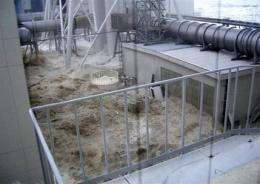
In this March 11, 2011 file photo released by Tokyo Electric Power Co. (TEPCO), tsunami waves gush into a complex near the Unit 4 reactor at the Fukushima Dai-ichi nuclear complex in Okuma twon, Fukushima Prefecture, northeastern Japan. Just four days after a meeting by Japan's government regulators and utility officials about a worst-case scenario, the towering tsunami swept across the plant, destroying backup generators, sending reactors into meltdown and setting off the world's nuclear disaster since Chernobyl. (AP Photo/Tokyo Electric Power Co., File) EDITORIAL USE ONLY

(AP) -- Four days before a tsunami devastated a Japanese nuclear plant, its operator promised a fuller assessment of the risk of such a disaster - but not for seven months.

The disclosure in a three-page briefing paper obtained by The Associated Press raises questions about whether the utility and regulators were too complacent about studies that suggested a tsunami could overwhelm the defenses at the 40-year-old Fukushima Dai-ichi plant.

It also highlights Japan's slow pace of decision-making on an issue that experts had been warning about for at least 20 months.

"If they had made the decision earlier, then they could have been prepared on March 11," said Hideyuki Hirakawa, an Osaka University expert on governance and the sciences. "There is absolutely nothing you can do in four days."

On March 11, 2011, a 9.0-magnitude offshore earthquake triggered a tsunami that killed about 19,000 people along Japan's northeastern coast. The surge of water knocked out power at the coastal Fukushima plant, leading to the worst since Chernobyl. Tens of thousands have had to leave the area, and it's unclear whether some will ever be able to move back.

Power Co. presented the briefing paper, stamped "handle with care," at a meeting with Japan's Nuclear and Industrial Safety Agency on March 7. The agency released the document to the AP under a public records request.

The paper summarized studies that suggested a tsunami as high as 33 feet (10 meters) might hit the plant, much higher than the 20-foot (six-meter) surge it had been designed to withstand. The actual tsunami was even higher: 45 feet (14 meters).

TEPCO, as the Tokyo-based utility is commonly known, said it would review tsunami preparedness at all its plants by mid-April and present a new assessment of the Fukushima plant by October - dates listed on the bottom of the first page under "plans for the future."

Masaru Kobayashi, who heads the agency's earthquake-safety section, said he saw the estimates for the first time at the March 7 meeting. "I told them that a speedy response was necessary, if these numbers are true," he said.

But TEPCO spokeswoman Ai Tanaka noted that the government did not order any immediate action. "None of the findings were conclusive," she added.

The report cited 2010 research at the government's National Institute of Advanced Industrial Science and Technology as saying that two to three more years would be needed to reassess the tsunami risks for northeastern Japan.

However the researcher, Yuichi Namegaya, told the AP that while more time was needed to determine the extent of the risk, the danger was evident. "The studies on a Fukushima tsunami were clear, even before my research," he said.

As early as June 2009, Yukinobu Okamura, a tsunami expert at the same government institute, warned about the need to look more closely at new evidence that a major tsunami called Jogan had hit northeastern Japan in the 9th Century.

"I would like to ask why you have not touched on this at all," Okamura demanded of a panel on nuclear regulatory policy. "I find it unacceptable."

Kobayashi, the regulator, said he called for the March 7 meeting after hearing about research on the Jogan tsunami.

He described the meeting as a polite, perfunctory affair at his agency that lasted 30, maybe 40, minutes.

The document included three diagrams. One was TEPCO's estimate of the maximum tsunami risk, based on 2002 guidelines from the Japan Society of Civil Engineers that were the government-approved standards. The other two were more recent academic projections that suggested the possibility of the higher tsunami.

Kobayashi recalled the meeting after the March 11 . "The numbers I saw were bigger than what we had earlier assessed," he said. "It had happened, and I felt bad."

©2012 The Associated Press. All rights reserved. This material may not be published, broadcast, rewritten or redistributed.


Rank not rated yet
Relevant PhysicsForums posts

More news stories

Browser wars flare in mobile space

The browser wars are heating up again, but this time the fight is for dominance of the mobile Internet.

Technology / Software

created 20 hours ago | popularity 4 / 5 (4) | comments 3

Probability of contamination from severe nuclear reactor accidents is higher than expected: study

Catastrophic nuclear accidents such as the core meltdowns in Chernobyl and Fukushima are more likely to happen than previously assumed. Based on the operating hours of all civil nuclear reactors and the number ...

Technology / Energy & Green Tech

created May 22, 2012 | popularity 3.6 / 5 (25) | comments 56 | with audio podcast

HyperSolar shows dirty water no barrier to power world

(Phys.org) -- The Santa Barbara, California, company, HyperSolar, is set to transparently share the ups and downs of its research experiences toward the company’s ultimate vision, successfully producing ...

Technology / Energy & Green Tech

created May 24, 2012 | popularity 4.8 / 5 (16) | comments 17 | with audio podcast report

Tesla to launch electric sedan in US on June 22

Tesla Motors said Tuesday it would begin deliveries of "the world's first premium electric sedan" on June 22, slightly ahead of schedule.

Technology / Energy & Green Tech

created May 22, 2012 | popularity 4.5 / 5 (12) | comments 18

SpotterRF debuts Radar Backpack Kit (w/ Video)

(Phys.org) -- SpotterRF has announced a special radar backpack kit designed to enhance situational awareness for soldiers on the ground. The company says its special radar is designed for warfighters as part ...

Technology / Hi Tech & Innovation

created May 26, 2012 | popularity 5 / 5 (5) | comments 13 | with audio podcast report


Stunning image of smallest possible five-ringed structure

Scientists have created and imaged the smallest possible five-ringed structure – about 100,000 times thinner than a human hair – and you'll probably recognise its shape.

'Unzipped' carbon nanotubes could help energize fuel cells, batteries

Multi-walled carbon nanotubes riddled with defects and impurities on the outside could replace some of the expensive platinum catalysts used in fuel cells and metal-air batteries, according to scientists at ...

Change in developmental timing was crucial in the evolutionary shift from dinosaurs to birds: study

At first glance, it's hard to see how a common house sparrow and a Tyrannosaurus Rex might have anything in common. After all, one is a bird that weighs less than an ounce, and the other is a dinosaur that ...

Computer model used to pinpoint prime materials for efficient carbon capture

When power plants begin capturing their carbon emissions to reduce greenhouse gases – and to most in the electric power industry, it's a question of when, not if – it will be an expensive undertaking.

T cells 'hunt' parasites like animal predators seek prey, study shows

By pairing an intimate knowledge of immune-system function with a deep understanding of statistical physics, a cross-disciplinary team at the University of Pennsylvania has arrived at a surprising finding: T cells use a movement ...

Yale study concludes public apathy over climate change unrelated to science literacy

Are members of the public divided about climate change because they don't understand the science behind it? If Americans knew more basic science and were more proficient in technical reasoning, would public consensus match ...