Italian professor launches challenge to Google
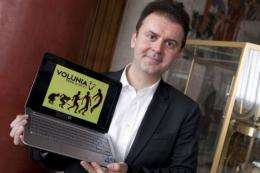
Italian computer science professor Massimo Marchiori poses with a laptop showing his new site entitled "Volunia" at Padova's university. Marchiori, whose research helped inspire Google, launched a new search engine and social media network on Monday that he hopes will challenge the US technology giant.
An Italian computer science professor whose research helped inspire Google launched a new search engine and social media network on Monday that he hopes will challenge the US technology giant.
The new site entitled "Volunia" allows users to view the components of particular websites to find the subject of interest more quickly and to interact with registered users who might be looking at the same web pages.
"The web is a living place," said Massimo Marchiori, who came up with the algorithm for the Internet page ranking service "HyperSearch" in the 1990s and used to teach at the Massachusetts Institute of Technology (MIT).
"There is information but there are also people. The social dimension is already present, it just has to emerge," he said in an online demonstration.
Marchiori said he believed the functions available on Volunia would soon become normal on all the major search engines including Google and Yahoo!
He has been working on the project for four years and has been praised by Italian commentators for giving up a more high-profile career in the United States to return to Italy, where his salary is 2,000 euros ($2,600) a month.
Marchiori teaches at the University of Padua in northeast Italy.
He has been quoted as saying that future Google founder Larry Page approached him after a conference in which he presented HyperSearch.
Page "was fascinated by it and asked if he could use it. Since it was not patented, he used it in the best possible way," Marchiori said.
Volunia, which has a US copyright, was only launched to selected users on Monday and will be rolled out more widely and in 12 languages including Arabic, English, Japanese and Russian over the coming days.
Organisers said they hoped to fund it by selling advertising space.
(c) 2012 AFP
-
From lemons to lemonade: Reaction uses carbon dioxide to make carbon-based semiconductor,
33 comments
-
Thioridazine kills cancer stem cells in human while avoiding toxic side-effects of conventional cancer treatments,
3 comments
-
SpaceX private rocket blasts off for space station (Update),
42 comments
-
Landmark calculation clears the way to answering how matter is formed,
55 comments
-
Research team claims to have found evidence Lake Cheko is impact crater for Tunguska Event,
18 comments
-
Ideas to mitigate risk of 911 calls being misdirected
May 24, 2012
-
Live scribe pen?
May 10, 2012
-
Shallow water flow simulation
May 07, 2012
-
Tablet for taking notes?
May 05, 2012
-
Best fit tablet for me?
May 05, 2012
-
Measure of Informaton
May 04, 2012
- More from Physics Forums - Computing & Technology
More news stories
Browser wars flare in mobile space
The browser wars are heating up again, but this time the fight is for dominance of the mobile Internet.
20 hours ago |
4 / 5 (4) |
3
Probability of contamination from severe nuclear reactor accidents is higher than expected: study
Catastrophic nuclear accidents such as the core meltdowns in Chernobyl and Fukushima are more likely to happen than previously assumed. Based on the operating hours of all civil nuclear reactors and the number ...
Technology / Energy & Green Tech
May 22, 2012 |
3.6 / 5 (25) |
56
|
HyperSolar shows dirty water no barrier to power world
(Phys.org) -- The Santa Barbara, California, company, HyperSolar, is set to transparently share the ups and downs of its research experiences toward the companys ultimate vision, successfully producing ...
Tesla to launch electric sedan in US on June 22
Tesla Motors said Tuesday it would begin deliveries of "the world's first premium electric sedan" on June 22, slightly ahead of schedule.
Technology / Energy & Green Tech
May 22, 2012 |
4.5 / 5 (12) |
18
SpotterRF debuts Radar Backpack Kit (w/ Video)
(Phys.org) -- SpotterRF has announced a special radar backpack kit designed to enhance situational awareness for soldiers on the ground. The company says its special radar is designed for warfighters as part ...
Stunning image of smallest possible five-ringed structure
Scientists have created and imaged the smallest possible five-ringed structure about 100,000 times thinner than a human hair and you'll probably recognise its shape.
'Unzipped' carbon nanotubes could help energize fuel cells, batteries
Multi-walled carbon nanotubes riddled with defects and impurities on the outside could replace some of the expensive platinum catalysts used in fuel cells and metal-air batteries, according to scientists at ...
Change in developmental timing was crucial in the evolutionary shift from dinosaurs to birds: study
At first glance, it's hard to see how a common house sparrow and a Tyrannosaurus Rex might have anything in common. After all, one is a bird that weighs less than an ounce, and the other is a dinosaur that ...
Computer model used to pinpoint prime materials for efficient carbon capture
When power plants begin capturing their carbon emissions to reduce greenhouse gases and to most in the electric power industry, it's a question of when, not if it will be an expensive undertaking.
T cells 'hunt' parasites like animal predators seek prey, study shows
By pairing an intimate knowledge of immune-system function with a deep understanding of statistical physics, a cross-disciplinary team at the University of Pennsylvania has arrived at a surprising finding: T cells use a movement ...
Yale study concludes public apathy over climate change unrelated to science literacy
Are members of the public divided about climate change because they don't understand the science behind it? If Americans knew more basic science and were more proficient in technical reasoning, would public consensus match ...