Human and humanoid robot shake hands in space 1st
February 15, 2012 By MARCIA DUNN , AP Aerospace Writer

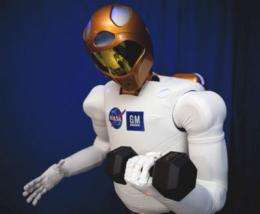
Robonaut 2

Enlarge

The Robonaut 2.

Astronauts and robots have united in space with a healthy handshake.

The commander of the , Daniel Burbank, shook hands Wednesday with Robonaut. It's the first handshake ever between a human and a in space.

NASA's Robonaut was launched aboard last February. Crews have been testing it to see how it one day might help astronauts perform space station chores.

On Wednesday, ground controllers activated computer software that enabled the robot to extend its right hand, fingers outstretched. Burbank took the mechanical hand and pumped it up and down, as the robot's fingers tightened around his hand.

"The first human-humanoid handshake in space," Burbank proclaimed.

A cheer went up in the control room in Huntsville, Ala.

"For the record, it was a firm handshake," Burbank radioed. "Quite an impressive robot."

Robonaut - the first humanoid in space, built from the waist up - said via that it was an awesome experience, then followed up with some sign language.

"The handshake was definitely one of the highlights of the day, but I'm not done yet," Robonaut said in a tweet. (A NASA spokeswoman actually files the under the handle AstroRobonaut.)

"Did you catch that? I don't have a voice, but I sent you a message -- Hello world ... in sign language!" Robonaut tweeted. "What a day! I passed my tests with flying colors!!!"

Dutch space station astronaut Andre Kuipers couldn't resist a little robot humor.

"Now let's hope he's never heard of HAL9000, Skynet or Cylons," Kuipers wrote in a tweet.

HAL was the conspiring computer in "2001: A Space Odyssey." The people-hating Skynet is from the "Terminator" films, while Cylons are cyber-warriors from "Battleship Gallactica."

spends most of its time in hibernation aboard the space station. The astronauts bring the humanoid out every so often for testing; it was awakened in space last August and made its first motion in October. A future model could venture outside for spacewalks, saving its human companions time and keeping them safe.

More information: NASA: http://robonaut.jsc.nasa.gov/default.asp

©2012 The Associated Press. All rights reserved. This material may not be published, broadcast, rewritten or redistributed.

4.2 /5 (5 votes)  

Rank 4.2 /5 (5 votes)
Relevant PhysicsForums posts
  • Distance of planets from stars and revolution
    created12 hours ago
  • revamping general concept and cosmological principle
    createdMay 25, 2012
  • Transiting Exoplanet Light Curve
    createdMay 25, 2012
  • Math behind Theoretical Physics
    createdMay 24, 2012
  • Do we know whats at the center of galaxies yet?
    createdMay 23, 2012
  • Structure of the Milky Way?
    createdMay 20, 2012
  • More from Physics Forums - General Astronomy

More news stories

Yale study concludes public apathy over climate change unrelated to science literacy

Are members of the public divided about climate change because they don't understand the science behind it? If Americans knew more basic science and were more proficient in technical reasoning, would public consensus match ...

Space & Earth / Environment

created 12 hours ago | popularity 4.8 / 5 (6) | comments 29 | with audio podcast

Land and sea species differ in climate change response: study

(Phys.org) -- Marine and terrestrial species will likely differ in their responses to climate warming, new research by Simon Fraser University and Australia’s University of Tasmania has found.

Space & Earth / Environment

created 10 hours ago | popularity 4 / 5 (5) | comments 9 | with audio podcast

10 million years needed to recover from mass extinction

It took some 10 million years for Earth to recover from the greatest mass extinction of all time, latest research has revealed.

Space & Earth / Earth Sciences

created 12 hours ago | popularity 4.2 / 5 (5) | comments 5 | with audio podcast

Sophisticated simulations predict future warming

The chances of our planet being hit by a global warming of 3 degrees Celsius by 2050 is as likely as it being hit by an increase of 1.4 degrees, new research shows. Presented in the journal Nature Geoscience, the British study ...

Space & Earth / Earth Sciences

created May 22, 2012 | popularity 3.8 / 5 (11) | comments 51

Kyoto Protocol architect 'frustrated' by climate dialogue

UN climate talks are going nowhere, as politicians dither or bicker while the pace of warming dangerously speeds up, one of the architects of the Kyoto Protocol told AFP.

Space & Earth / Environment

created May 23, 2012 | popularity 3.4 / 5 (8) | comments 44


Stunning image of smallest possible five-ringed structure

Scientists have created and imaged the smallest possible five-ringed structure – about 100,000 times thinner than a human hair – and you'll probably recognise its shape.

'Unzipped' carbon nanotubes could help energize fuel cells, batteries

Multi-walled carbon nanotubes riddled with defects and impurities on the outside could replace some of the expensive platinum catalysts used in fuel cells and metal-air batteries, according to scientists at ...

Change in developmental timing was crucial in the evolutionary shift from dinosaurs to birds: study

At first glance, it's hard to see how a common house sparrow and a Tyrannosaurus Rex might have anything in common. After all, one is a bird that weighs less than an ounce, and the other is a dinosaur that ...

Computer model used to pinpoint prime materials for efficient carbon capture

When power plants begin capturing their carbon emissions to reduce greenhouse gases – and to most in the electric power industry, it's a question of when, not if – it will be an expensive undertaking.

T cells 'hunt' parasites like animal predators seek prey, study shows

By pairing an intimate knowledge of immune-system function with a deep understanding of statistical physics, a cross-disciplinary team at the University of Pennsylvania has arrived at a surprising finding: T cells use a movement ...

Browser wars flare in mobile space

The browser wars are heating up again, but this time the fight is for dominance of the mobile Internet.