Global warming could kill off snails
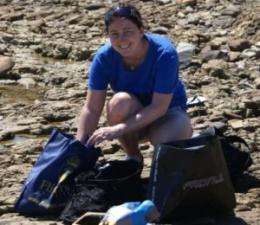
Ms Coraline Chapperon
(PhysOrg.com) -- Climate change models must be reworked in a bid to save some of the worlds smallest and slimiest creatures from extinction, a Flinders University PhD candidate warns.
Biological Sciences postgraduate student Coraline Chapperon says any future policies for global warming must consider mobile organisms on rocky beaches such as snails and their capacity to survive the predicted rise in extreme conditions such as heatwaves.
She said the majority of current global warming research is mistakenly driven by air temperature which does not reflect the body temperature of most animals.
A lot of current global warming research uses air temperature as a proxy for animal body temperature so if its 31 degrees at the beach theyd say all the animals at the beach are 31 degrees but thats not the case, Ms Chapperon said.
Even the same rock surface varies in temperature at a very small spatial scale at one time which is more pertinent to the biology and ecology of intertidal animals than air temperature, she said.
As such, we need to consider factors like rock temperature and the individual physiology and behaviour of animals in our climate change models, and look at it on a much smaller scale.
To prove how crucial individual animal body temperatures are to global warming policies, Ms Chapperon has spent the past three years investigating the temperature and behaviour of snails and their ability to cope in extreme conditions.
As part of her research she took a series of thermal images of marine snails and rocks in two topographically different habitats, a rock platform and a boulder field, over the course of a summer and autumn at Marino Rocks to quantify variances in body temperature and snail behaviour.
She found that temperatures between microhabitats separated by just a few centimetres, such as crevices and underneath rocks, actually varied more than habitats separated by up to 250 metres, and that rock and snail temperatures were strongly connected, suggesting snail body temperatures are largely determined by the temperatures of the rocks they are crawling on.
Ms Chapperon said that while snails have limited physiological abilities to adapt any further to climate as they have already reached the upper limit of their thermal tolerance window, her research suggests they may be able to modify their actions in order to survive locally.
However, she said more research was needed to determine whether these thermoregulatory behaviours could actually buffer the warming climate.
Despite their limited physiological abilities, snails have certain behavioural qualities that help them cool down when it is warm, such as aggregating or moving underneath rocks.
But this is a relatively unknown area of research and thats why further studies are needed to see whether their ability to find refuge in cooler microhabitats could compensate for their lack of physiological ability.
Provided by Flinders University
-
From lemons to lemonade: Reaction uses carbon dioxide to make carbon-based semiconductor,
32 comments
-
Thioridazine kills cancer stem cells in human while avoiding toxic side-effects of conventional cancer treatments,
3 comments
-
SpaceX private rocket blasts off for space station (Update),
42 comments
-
Climate scientists say they have solved riddle of rising sea,
31 comments
-
Landmark calculation clears the way to answering how matter is formed,
55 comments
-
osmotic pressure vs diffusion
3 hours ago
-
What would stain as translucent on light-coloured fabric?
May 26, 2012
-
How do I identify different bacteria on culture plates?
May 26, 2012
-
Why Do Dogs do Strange things...
May 25, 2012
-
What does exophillic and endophillic mean in terms of mosquito and their control?
May 24, 2012
-
Semen stains glows under black lights (uv light)?
May 23, 2012
- More from Physics Forums - Biology
More news stories
Manufacturing genes to attack flu virus
An international research team has manufactured a new protein that can combat deadly flu epidemics.
11 hours ago |
not rated yet |
0
|
Scientist: Evolution debate will soon be history
(AP) -- Richard Leakey predicts skepticism over evolution will soon be history. Not that the avowed atheist has any doubts himself.
May 26, 2012 |
3.4 / 5 (21) |
98
More plant species responding to global warming than previously thought
(Phys.org) -- Far more wild plant species may be responding to global warming than previous large-scale estimates have suggested.
May 22, 2012 |
4.6 / 5 (14) |
18
|
For monogamous sparrows, it doesn't pay to stray (but they do it anyway)
It's quite common for a female song sparrow to stray from her breeding partner and mate with the male next door, but a new study shows that sleeping around can be costly.
May 22, 2012 |
5 / 5 (2) |
8
|
Thousands of shellfish found dead in Peru
Thousands of crustaceans were found dead off the coast of Lima following the mystery mass death of dolphins and pelicans, the Peruvian Navy said Friday.
May 26, 2012 |
4.7 / 5 (7) |
7
'Unzipped' carbon nanotubes could help energize fuel cells, batteries
Multi-walled carbon nanotubes riddled with defects and impurities on the outside could replace some of the expensive platinum catalysts used in fuel cells and metal-air batteries, according to scientists at ...
Change in developmental timing was crucial in the evolutionary shift from dinosaurs to birds: study
At first glance, it's hard to see how a common house sparrow and a Tyrannosaurus Rex might have anything in common. After all, one is a bird that weighs less than an ounce, and the other is a dinosaur that ...
Computer model used to pinpoint prime materials for efficient carbon capture
When power plants begin capturing their carbon emissions to reduce greenhouse gases and to most in the electric power industry, it's a question of when, not if it will be an expensive undertaking.
T cells 'hunt' parasites like animal predators seek prey, study shows
By pairing an intimate knowledge of immune-system function with a deep understanding of statistical physics, a cross-disciplinary team at the University of Pennsylvania has arrived at a surprising finding: T cells use a movement ...
Yale study concludes public apathy over climate change unrelated to science literacy
Are members of the public divided about climate change because they don't understand the science behind it? If Americans knew more basic science and were more proficient in technical reasoning, would public consensus match ...
Land and sea species differ in climate change response: study
(Phys.org) -- Marine and terrestrial species will likely differ in their responses to climate warming, new research by Simon Fraser University and Australia’s University of Tasmania has found.
Feb 07, 2012
Rank: 5 / 5 (1)
The headline is contrary to the article.