Global permafrost zones in high-resolution images on Google Earth
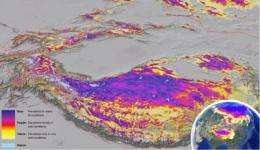
The thawing of permafrost soil and rock is likely to have serious consequences for people in Central Asia, Tibet, the Himalayas and Karakorum. The new permafrost map clearly shows the large permafrost regions in these often densely populated mountain ranges. Credit: UZH
Thawing permafrost will have far-reaching ramifications for populated areas, infrastructure and ecosystems. A geographer from the University of Zurich reveals where it is important to confront the issue based on new permafrost maps -- the most precise global maps around. They depict the global distribution of permafrost in high-resolution images and are available on Google Earth.
Unstable cable-car and electricity pylons and rock fall Alpine countries like Switzerland have already had first-hand experience of thawing permafrost as a result of climate change. If temperatures continue to rise, the problem will intensify in many places. Permafrost, namely rock or soil with a negative temperature for at least two years, occurs in the subsurface and therefore cannot be mapped directly. The existing maps are thus fraught with major uncertainties that have barely been studied or formulated. Furthermore, due to the different modeling methods used the maps are difficult to compare.
The most precise global permafrost maps
Now, however, glaciologist Stephan Gruber from the University of Zurich has modeled the global permafrost zones for the first time in high resolution and using a consistent method. In his study recently published in The Cryosphere, the scientist estimates the global permafrost regions at 22 million square kilometers a sixth of the world's exposed land surface. With a grid resolution of one square kilometer, Gruber's maps are the most precise permafrost maps in the world..
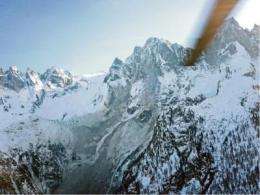
The major rock avalanche in the Bregaglia after Christmas 2011 could be a result of temperature rise in permafrost areas. Credit: Heli Bernina 2011
Approximation of permafrost patchworkA large proportion of the permafrost zones lie outside the areas that exhibit continuous permafrost in the subsurface. At relatively small distance, permafrost can here occur right next to non-permafrost ground. In other words, the spatial distribution of permafrost resembles a patchwork quilt, which makes it extremely difficult to identify zones with permafrost in such areas. This is where Gruber's innovative permafrost maps come in: They are based on high-resolution air temperature and elevation data. Moreover, they reveal an index that indicates the probability of permafrost. The permafrost areas are depicted in grades from dark blue for near-continuous permafrost to yellow for areas with little permafrost. In contrast to previous permafrost maps, which show clearly defined zones, Gruber's maps also illustrate the uncertainty of the state of research.
The scientist explains his motivation with the urgency of the matter: "As a result of climate change, areas with permafrost have great potential for unpleasant surprises. That is why it is all the more important for politics and the public to be aware of the problem of thawing permafrost. My maps visualize the otherwise barely visible phenomenon of permafrost."
More information: Global Permafrost Zonation Index Map: http://www.geo.uzh … IndexMap.kmz
Publication: http://www.the-cry … e.net/6/221/
Stephan Gruber. Derivation and analysis of a high-resolution estimate of global permafrost zonation. The Cryosphere 6, 221-233, 2012, doi: 10.5194/tc-6-221-2012
Provided by University of Zurich
-
From lemons to lemonade: Reaction uses carbon dioxide to make carbon-based semiconductor,
32 comments
-
Thioridazine kills cancer stem cells in human while avoiding toxic side-effects of conventional cancer treatments,
3 comments
-
SpaceX private rocket blasts off for space station (Update),
42 comments
-
Climate scientists say they have solved riddle of rising sea,
31 comments
-
Landmark calculation clears the way to answering how matter is formed,
55 comments
-
Hypothetical desert earth
May 26, 2012
-
More human population = greater mass?
May 25, 2012
-
Conversion from aircraft bearing to normal degrees
May 23, 2012
-
Interpretation/Analysis of the Lab results(HEPA filter)
May 22, 2012
-
Has anyone here attended the The Urbino Summer School in Paleoclimatology?
May 22, 2012
-
Earthquakes: Mag 6 N. Italy and Mag 5.6 W. Bulgaria
May 21, 2012
- More from Physics Forums - Earth
More news stories
Yale study concludes public apathy over climate change unrelated to science literacy
Are members of the public divided about climate change because they don't understand the science behind it? If Americans knew more basic science and were more proficient in technical reasoning, would public consensus match ...
11 hours ago |
4.8 / 5 (6) |
27
|
Land and sea species differ in climate change response: study
(Phys.org) -- Marine and terrestrial species will likely differ in their responses to climate warming, new research by Simon Fraser University and Australia’s University of Tasmania has found.
9 hours ago |
4 / 5 (5) |
6
|
10 million years needed to recover from mass extinction
It took some 10 million years for Earth to recover from the greatest mass extinction of all time, latest research has revealed.
Space & Earth / Earth Sciences
11 hours ago |
4.2 / 5 (5) |
2
|
Sophisticated simulations predict future warming
The chances of our planet being hit by a global warming of 3 degrees Celsius by 2050 is as likely as it being hit by an increase of 1.4 degrees, new research shows. Presented in the journal Nature Geoscience, the British study ...
Space & Earth / Earth Sciences
May 22, 2012 |
3.8 / 5 (11) |
51
Kyoto Protocol architect 'frustrated' by climate dialogue
UN climate talks are going nowhere, as politicians dither or bicker while the pace of warming dangerously speeds up, one of the architects of the Kyoto Protocol told AFP.
May 23, 2012 |
3.4 / 5 (8) |
42
'Unzipped' carbon nanotubes could help energize fuel cells, batteries
Multi-walled carbon nanotubes riddled with defects and impurities on the outside could replace some of the expensive platinum catalysts used in fuel cells and metal-air batteries, according to scientists at ...
Change in developmental timing was crucial in the evolutionary shift from dinosaurs to birds: study
At first glance, it's hard to see how a common house sparrow and a Tyrannosaurus Rex might have anything in common. After all, one is a bird that weighs less than an ounce, and the other is a dinosaur that ...
Computer model used to pinpoint prime materials for efficient carbon capture
When power plants begin capturing their carbon emissions to reduce greenhouse gases and to most in the electric power industry, it's a question of when, not if it will be an expensive undertaking.
T cells 'hunt' parasites like animal predators seek prey, study shows
By pairing an intimate knowledge of immune-system function with a deep understanding of statistical physics, a cross-disciplinary team at the University of Pennsylvania has arrived at a surprising finding: T cells use a movement ...
Stunning image of smallest possible five-ringed structure
Scientists have created and imaged the smallest possible five-ringed structure about 100,000 times thinner than a human hair and you'll probably recognise its shape.
Browser wars flare in mobile space
The browser wars are heating up again, but this time the fight is for dominance of the mobile Internet.

Feb 21, 2012
Rank: 5 / 5 (1)
Feb 21, 2012
Rank: 1 / 5 (2)
The question should be 'how much new land will be made arable by the thaw?'
Feb 21, 2012
Rank: 5 / 5 (1)
Also a good question. Hopefully more than is lost to desertification and sea level rise.
Feb 21, 2012
Rank: 1 / 5 (2)
Seriously? Sea level rise? In Tibet? LOL.
Seriously? Sea level rise? Do you ou mean the 150 meters in the last 15000 years? Or the inch, or six, or twelve, predicted for the next hundred?
Feb 21, 2012
Rank: 5 / 5 (2)
Feb 22, 2012
Rank: 3.7 / 5 (3)