Hunting could hurt genetic diversity of sandhill cranes, research suggests
February 9, 2012 By Nicole Miller
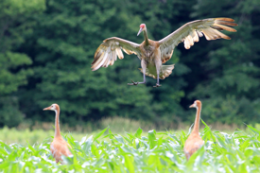
Research using DNA fingerprinting suggests that hunting sandhill cranes like these could harm their genetic diversity.
(PhysOrg.com) -- As Wisconsin lawmakers debate whether to establish a hunting season for sandhill cranes, they may want to consider more than just the sheer number of birds, suggests a University of Wisconsin-Madison specialist in avian genetics.
A recent analysis of the crane's eastern population -- which includes birds that spend their summers from the Midwest to the East Coast -- indicates it also may be important to take into account the distribution of the bird's genetic diversity across the landscape.
"Wisconsin sandhill cranes went through a genetic bottleneck in the 1930s when they almost went extinct, and now we're starting to see a rapid increase in their population density and that's great," says Mark Berres, an assistant professor of animal sciences, who led the study. "But the genetic structure of the entire population is anything but uniform. We're finding that there are a lot of distinct breeding populations, including some in Wisconsin. These are unique sub-populations that are genetically distinct from all others."
With funding from the U.S. Fish and Wildlife Service, Berres used DNA fingerprinting to assess the genetic makeup of cranes across the Eastern population's range. While he found a surprisingly good amount of genetic diversity throughout the population and quite a bit of genetic mixing, there were also a significant number of isolated sub-populations.
The unique genes in these populations could prove vital to the survival of the overall sandhill crane population down the line, perhaps giving the birds the ability to survive new diseases or adapt to changing environmental conditions, Berres explains. But because these sub-populations are relatively small, they are more vulnerable to hunting pressure.
"If people start harvesting them, I'm not sure how stable these populations will be," says Berres. "It's possible that if hunters are allowed to take 20 percent of the overall population, they could inadvertently take 99 percent of a particular sub-population."
From a low of just 25 mating pairs in the late 1930s, as estimated by famed naturalist Aldo Leopold, Wisconsin's sandhill crane population has rebounded thanks to a number of factors, including habitat conservation, increased farm acreage and hunting regulations. There are now more than 20,000 birds in the state, although this number is still significantly lower than historical levels.
"We have a pretty good understanding of why the birds are doing so well, but we're really just starting to figure out the population's breeding structure," says Berres. "To me it screams 'don't touch them.'"
Provided by
University of Wisconsin-Madison
-
From lemons to lemonade: Reaction uses carbon dioxide to make carbon-based semiconductor,
32 comments
-
Thioridazine kills cancer stem cells in human while avoiding toxic side-effects of conventional cancer treatments,
3 comments
-
SpaceX private rocket blasts off for space station (Update),
42 comments
-
Climate scientists say they have solved riddle of rising sea,
31 comments
-
Landmark calculation clears the way to answering how matter is formed,
55 comments
-
osmotic pressure vs diffusion
3 hours ago
-
What would stain as translucent on light-coloured fabric?
May 26, 2012
-
How do I identify different bacteria on culture plates?
May 26, 2012
-
Why Do Dogs do Strange things...
May 25, 2012
-
What does exophillic and endophillic mean in terms of mosquito and their control?
May 24, 2012
-
Semen stains glows under black lights (uv light)?
May 23, 2012
- More from Physics Forums - Biology
More news stories
Manufacturing genes to attack flu virus
An international research team has manufactured a new protein that can combat deadly flu epidemics.
11 hours ago |
not rated yet |
0
|
Scientist: Evolution debate will soon be history
(AP) -- Richard Leakey predicts skepticism over evolution will soon be history. Not that the avowed atheist has any doubts himself.
May 26, 2012 |
3.4 / 5 (21) |
98
More plant species responding to global warming than previously thought
(Phys.org) -- Far more wild plant species may be responding to global warming than previous large-scale estimates have suggested.
May 22, 2012 |
4.6 / 5 (14) |
18
|
For monogamous sparrows, it doesn't pay to stray (but they do it anyway)
It's quite common for a female song sparrow to stray from her breeding partner and mate with the male next door, but a new study shows that sleeping around can be costly.
May 22, 2012 |
5 / 5 (2) |
8
|
Thousands of shellfish found dead in Peru
Thousands of crustaceans were found dead off the coast of Lima following the mystery mass death of dolphins and pelicans, the Peruvian Navy said Friday.
May 26, 2012 |
4.7 / 5 (7) |
7
'Unzipped' carbon nanotubes could help energize fuel cells, batteries
Multi-walled carbon nanotubes riddled with defects and impurities on the outside could replace some of the expensive platinum catalysts used in fuel cells and metal-air batteries, according to scientists at ...
Change in developmental timing was crucial in the evolutionary shift from dinosaurs to birds: study
At first glance, it's hard to see how a common house sparrow and a Tyrannosaurus Rex might have anything in common. After all, one is a bird that weighs less than an ounce, and the other is a dinosaur that ...
Computer model used to pinpoint prime materials for efficient carbon capture
When power plants begin capturing their carbon emissions to reduce greenhouse gases and to most in the electric power industry, it's a question of when, not if it will be an expensive undertaking.
T cells 'hunt' parasites like animal predators seek prey, study shows
By pairing an intimate knowledge of immune-system function with a deep understanding of statistical physics, a cross-disciplinary team at the University of Pennsylvania has arrived at a surprising finding: T cells use a movement ...
Yale study concludes public apathy over climate change unrelated to science literacy
Are members of the public divided about climate change because they don't understand the science behind it? If Americans knew more basic science and were more proficient in technical reasoning, would public consensus match ...
Land and sea species differ in climate change response: study
(Phys.org) -- Marine and terrestrial species will likely differ in their responses to climate warming, new research by Simon Fraser University and Australia’s University of Tasmania has found.