Gases drawn into smog particles stay there, study reveals
Feb 21, 2012
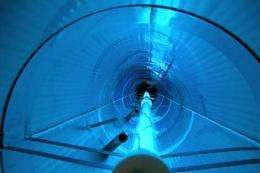
AirUCI researchers simulated smog compounds in the lab by mixing common household chemicals and outdoor air in this 26-foot-long “aerosol flow tube.” Credit: Veronique Perraud / AirUCI

Airborne gases get sucked into stubborn smog particles from which they cannot escape, according to findings by UC Irvine and other researchers published today in the Proceedings of the National Academy of Sciences.

The results could explain a problem identified in recent years: Computer models long used by the U.S. , California air regulators and others significantly underestimate organic aerosols – the major component of smog particles. Such pollution blocks views of mountains and has been linked to everything from asthma to heart attacks. It is also the largest unknown in climate change calculations.

"You can't have a lot of confidence in the predicted levels right now," said lead author Veronique Perraud, assistant project scientist to pioneering UCI air chemist Barbara Finlayson-Pitts. "It's extremely important, because if the models do a bad job of predicting particles, we may be underestimating the effects on the public."

An independent expert who reviewed the research for PNAS agreed.

"The conclusions are highly significant," said Purdue University atmospheric chemist Paul Shepson. "This paper should – and, I expect, will – have a big impact. We've known for nearly a decade that there's a huge difference between what's in the models and what's actually in the air. Thanks to this paper, we have a much better idea of why."

Scientists at UCI, a U.S. Department of Energy laboratory and Portland State University combined pinene, a common ingredient in household cleaners such as Pine Sol and outdoor emissions, with oxides of nitrogen and ozone to mimic smog buildup.

Models used by regulators for decades have assumed that in such pollution form liquid droplets that quickly dissolve potentially unhealthy . But the new work found that once gases are sucked into a particle, they get buried deeper and deeper.

"They check in, and they don't check out. They cannot escape. The material does not readily evaporate and may live longer and grow faster in total mass than previously thought," Finlayson-Pitts said. "This is consistent with related studies showing that may be an extremely viscous tar."

Perraud noted that broader study needs to be done: "The next logical step is to straighten the models out. We need enough follow-up data to do so."

Sophisticated tools made it easier to pinpoint the exact characteristics of chemical compounds in air. The scientists used a 26-foot-long "aerosol flow tube" at the AirUCI unit and a one-of-a-kind, 900-pound instrument known as SPLAT (a single particle laser ablation time-of-flight mass spectrometer) at the Pacific Northwest National Laboratory.

Explore further: Astonishing hi-resolution satellite views of the destruction from the Moore, Oklahoma tornado

Related Stories

Chemists discover ozone-boosting reaction

Jul 20, 2009

(PhysOrg.com) -- Burning of fossil fuels pumps chemicals into the air that react on surfaces such as buildings and roads to create photochemical smog-forming chlorine atoms, UC Irvine scientists report in ...

Refining atmospheric climate models

Feb 01, 2011

(PhysOrg.com) -- A long, frustrating search for the source of "extra" aerosols seen in field experiments but not in models might have come to an end when scientists at Pacific Northwest National Laboratory ...

Sunlight changes aerosols in clouds

Oct 12, 2011

(PhysOrg.com) -- Today's climate models regard organic aerosols as static carbon-based molecules, but scientists at Pacific Northwest National Laboratory and the University of California, Irvine showed that ...

Recommended for you

Strong earthquake at exceptional depth

May 24, 2013

This morning at 05:45 CEST, the earth trembled beneath the Okhotsk Sea in the Pacific Northwest. The quake, with a magnitude of 8.2, took place at an exceptional depth of 605 kilometers. Because of the great ...

Marine forecasting on the horizon for Indian Ocean Rim

May 24, 2013

Nearly all of the member countries of the Indian Ocean Rim Association for Regional Cooperation (IOR-ARC) will attend the week-long workshop to further cooperation and understanding on international ocean ...

Russia evacuates drifting Arctic research station

May 23, 2013

Russia has ordered the urgent evacuation of the 16-strong crew of a drifting Arctic research station after ice floe that hosts the floating laboratory began to disintegrate, officials said Thursday.

User comments : 2

Adjust slider to filter visible comments by rank

Display comments: newest first

tadchem
1 / 5 (2) Feb 21, 2012
So the particulate pollution acts to diminish the concentration of gaseous pollutants? As they grow in mass the pollutant particles would increase their settling speed, falling out of the air faster, and this negative feedback would enforce an upper limit on their size.
The particles collect toxic gases, fall out of the air, and leave the air cleaner.
Shootist
1 / 5 (2) Feb 21, 2012
So the particulate pollution acts to diminish the concentration of gaseous pollutants? As they grow in mass the pollutant particles would increase their settling speed, falling out of the air faster, and this negative feedback would enforce an upper limit on their size.
The particles collect toxic gases, fall out of the air, and leave the air cleaner.


Don't get excited. They never publish these things unless the news is bad.

More news stories

Galaxies fed by funnels of fuel

(Phys.org) —Computer simulations of galaxies growing over billions of years have revealed a likely scenario for how they feed: a cosmic version of swirly straws.

Century-old science helps confirm global warming

(Phys.org) —Ocean measurements taken more than 135 years ago during the scientific expedition of HMS Challenger have provided further confirmation of human-produced global warming over the past century.