Fused genes tackle deadly Pierce's disease in grapevines
Feb 20, 2012
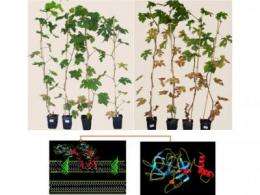
Expression of a hybrid protein blocks Pierce's disease in a grapevine. The hybrid protein (shown at the bottom right) creates pores in the membrane of the Gram-negative bacterium, Xf, that causes PD. The transgenic grapevine expressing the hybrid protein shows little or no leaf scorching as PD symptom upon Xf infection (top left) whereas the non-transgenic without the hybrid protein shows severe leaf scorching (top right). Credit: Los Alamos National Laboratory

A gene fusion research project led by a University of California, Davis, plant scientist delivers a one-two punch to Pierce's disease, a deadly threat to California's world-renowned wine industry.

The study is set for publication the week of Feb. 20 in the early edition of the .

"Many disease-causing microbes can evade one defensive action by a host plant, but we believe that most microbes would have difficulty overcoming a combination of two immune-system defenses," said UC Davis plant sciences professor Abhaya Dandekar, the lead researcher.

He and his colleagues tested this hypothesis on Xylella fastidiosa, the bacteria responsible for Pierce's disease in . Strains of the bacteria also attack and damage other , including citrus, stone fruits, almonds, oleander, and certain shade trees, such as oaks, elms, maples and sycamores.

The findings further strengthen UC Davis' standing as a world leader in the science of plant improvement through advances in genetics, genomics, plant breeding and biodiversity.

First noted in California near Anaheim around 1884, Pierce's disease in grapevines is now known to exist in 28 California counties. From 1994 to 2000, the disease destroyed more than 1,000 acres of northern California grapevines, causing $30 million in damages. There is currently no known cure for Pierce's disease.

In grapevines, Xylella fastidiosa is carried from plant to plant by half-inch-long insects known as sharpshooters. The bacteria infect and clog the plant's water-transporting tissue, or xylem. Grapevines with Pierce's disease develop yellow and brown leaves and die within a few years.

To block such infections, the researchers engineered a hybrid gene by fusing together two genes that are responsible for two key functions of the plant's : recognizing Xylella fastidiosa as a bacterial invader and destroying its , causing the bacteria to die.

The researchers then inserted this hybrid gene into grapevines.

They found that sap from plants genetically engineered with the hybrid gene effectively killed Xylella fastidiosa in the laboratory. And grapevines engineered to carry the hybrid gene had significantly less leaf scorching and xylem clogging, indicating resistance to Pierce's disease.

Explore further: Researchers identify new target to boost plant resistance to insects and pathogens

Provided by University of California - Davis

5 /5 (3 votes)

Related Stories

Tiny Wasp Saves Pacific Island Paradise

Jun 21, 2006

It was a tourist bureau’s nightmare. A plant-killing invasive insect establishes a beachhead on a Pacific island paradise and quickly spreads, leaving tourists and locals who stroll down tree-lined promenades ...

Virus-resistant grapevines

Jul 02, 2009

Viruses can cost winegrowers an entire harvest. If they infest the grapevines, even pesticides are often no use. What's more, these chemicals are harmful to the environment. Researchers are growing plants ...

Recommended for you

Fast new, one-step genetic engineering technology

May 22, 2013

A new, streamlined approach to genetic engineering drastically reduces the time and effort needed to insert new genes into bacteria, the workhorses of biotechnology, scientists are reporting. Published in ...

100K Pathogen Genome Project maps first genomes

May 22, 2013

(Phys.org) —Striking a blow at foodborne diseases, the 100K Pathogen Genome Project at the University of California, Davis, today announced that it has sequenced the genomes of its first 10 infectious microorganisms, including ...

User comments : 0

More news stories

Scientists discover how rapamycin slows cell growth

University of Montreal researchers have discovered a novel molecular mechanism that can potentially slow the progression of some cancers and other diseases of abnormal growth. In the May 23 edition of the prestigious journal ...

Future doctors unaware of their obesity bias

Two out of five medical students have an unconscious bias against obese people, according to a new study by researchers at Wake Forest Baptist Medical Center. The study is published online ahead of print in the Journal of ...

WHO: Scientific red tape mars efforts vs. virus

International efforts to combat a new pneumonia-like virus that has now killed 22 people are being slowed by unclear rules and competition for the potentially profitable rights to disease samples, the head ...