To make better fuel cells, study the defects
Feb 20, 2012 By Bill Steele
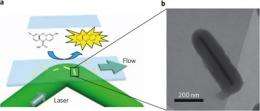
When Amplex Red connects with a gold catalyst the structure is changed to make a fluorescent molecule that immediately emits a flash of light, showing where the catalytic event took place. Right, electron microphoto of a single gold nanorod, encased in a poirus silica shell. The shell keeps rods from clumping together and allows experimenters to use heat to clean away a coating that forms when the rods are created. Image: Chen Lab

Engineers trying to improve fuel-cell catalysts may be looking in the wrong place, according to new research at Cornell.

There is growing interest in forming the catalysts that break down fuel to generate electricity into . Nanoparticles provide a larger surface area to speed reactions, and in some cases, materials that are not catalytic in bulk become so at the .

These nanoparticles, typically just a few tens of nanometers (nm) wide, are not neat little , but rather jagged chunks, like microscale gravel, and researchers have found that they can correlate with information about the number and type of their surface facets. But they may be looking at the forest and ignoring the trees.

"People measure the activity of a sample and then try to understand by using facet information," said Peng Chen, associate professor of chemistry and . "The message we want to deliver is that surface defects [on the facets] dominate the ."

Chen's research is reported Feb. 19 in the online edition of the journal Nature Nanotechnology.

Instead of particles, Chen's research group studied catalytic events on gold "nanorods" up to 700 nm long, effectively letting them see how activity varies over a single facet. Gold acts as a to convert a chemical called Amplex Red into resorufin, which is fluorescent.

Each time a catalytic event occurs, the newly created molecule of resorufin emits a flash of light that is detected by a digital camera looking through a microscope. A flash typically appears as several pixels, and additional averages their brightness to pinpoint the actual event to within a few nanometers. The researchers call the technique "super-resolution microscopy." After flooding a field of nanorods with a solution of Amplex Red, they made a "movie" with one frame every 25 milliseconds.

The researchers found more catalytic events near the middle of a rod, tapering off toward the ends and a jump back up at the ends. They also found variation in the amount of activity from one rod to another, even though all the rods have the same types of facets.

To explain the results, they proposed that activity is higher in areas where there are more surface defects. The nanorods are made by growing gold crystals from a small "seed" crystal, growing outward from the center to the ends, Chen explained, and more defects form at the beginning of the process.

"Knowledge of the surface facets ... is insufficient to predict reactivity," the researchers said in their paper. "Surface defects … can also play a dominant role."

The findings with a gold catalyst and fluorescent molecules should be equally applicable to other catalysts, including those used in fuel cells and for pollution remediation, Chen said.

Explore further: Hybrid material as gold-leaf substitute

Related Stories

Pinpointing catalytic reactions on carbon nanotubes

Apr 17, 2009

(PhysOrg.com) -- Among their many other interesting properties, carbon nanotubes have been found to act as catalysts for some important chemical reactions, including some that could be used to make cleaner ...

Platinum nanocatalyst could aid drugmakers

Aug 31, 2009

(PhysOrg.com) -- Nanoparticles combining platinum and gold act as superefficient catalysts, but chemists have struggled to create them in an industrially useful form. Rice University chemists have answered the call this week ...

Improving catalysis

Jun 14, 2011

(PhysOrg.com) -- Cardiff University research may help to improve the way that metal nanoparticles are used in catalysis – the process of making chemical reactions go faster.

Purdue finding could help develop clean energy technology

Mar 16, 2005

Chemical engineers at Purdue University have made a discovery that may help to improve a promising low-polluting energy technology that combusts natural gas more cleanly than conventional methods. The finding revolves aro ...

Recommended for you

Hybrid material as gold-leaf substitute

Jun 18, 2013

(Phys.org) —A team of researchers headed by Professor Raffaele Mezzenga has created a hybrid material out of gold and milk proteins that looks like a wafer-thin gold leaf. Thanks to its properties, it could ...

Antioxidant with a long shelf life

Jun 17, 2013

(Phys.org) —Scientists from ETH Zurich have developed a nanomaterial that protects other molecules from oxidation. Unlike many such active substances in the past, the ETH-Zurich researchers' antioxidant ...

Fast pollutant degradation by nanosheets

Jun 17, 2013

(Phys.org) —Waste from textile and paint industries often contains organic dyes such as methylene blue as pollutants. Photocatalysis is an efficient means of reducing such pollution, and molybdenum trioxide ...

Unzipped nanotubes unlock potential for batteries

Jun 13, 2013

(Phys.org) —Researchers at Rice University have come up with a new way to boost the efficiency of the ubiquitous lithium ion (LI) battery by employing ribbons of graphene that start as carbon nanotubes.

Nanoparticle opens the door to clean-energy alternatives

Jun 13, 2013

(Phys.org) —Cheaper clean-energy technologies could be made possible thanks to a new discovery. Research team members led by Raymond Schaak, a professor of chemistry at Penn State University, have found ...

User comments : 1

Adjust slider to filter visible comments by rank

Display comments: newest first

Isaacsname
not rated yet Feb 20, 2012
Well, you'd think that capitalizing on defects is the most effective way to improve a system, no ?

More news stories

3D printing tiny batteries

(Phys.org) —3D printing can now be used to print lithium-ion microbatteries the size of a grain of sand. The printed microbatteries could supply electricity to tiny devices in fields from medicine to communications, ...

Future looks bright for carbon nanotube solar cells

(Phys.org) —In an approach that could challenge silicon as the predominant photovoltaic cell material, University of Wisconsin-Madison materials engineers have developed an inexpensive solar cell that exploits ...

Hybrid material as gold-leaf substitute

(Phys.org) —A team of researchers headed by Professor Raffaele Mezzenga has created a hybrid material out of gold and milk proteins that looks like a wafer-thin gold leaf. Thanks to its properties, it could ...

World's most powerful microscope ready for research

(Phys.org) —The world's most powerful microscope, which resides in a specially constructed room at the University of Victoria, has now been fully assembled and tested, and has a lineup of scientists and businesses eager ...

Dish won't submit revised bid for Sprint

Satellite TV operator Dish Network Corp. said Tuesday it would not submit a revised bid for Sprint, leaving the path open for the wireless carrier to accept what it already considers a superior offer from Japan's Softbank.

Cape Wind gets $200M investment from Danish fund

The Cape Wind offshore wind project has secured a $200 million investment from a Danish pension fund in what the wind farm's president said Tuesday is a milestone for the long-delayed project.