ESA's Fifth ATV named after Georges Lemaitre
February 17, 2012

Fifth ATV named after Georges Lemaître

Enlarge

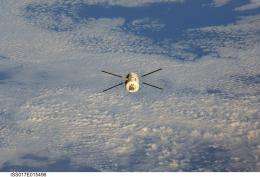
Backdropped by a blanket of clouds, ESA’s Automated Transfer Vehicle Jules Verne (lower left) departs from the International Space Station. The ATV undocked from the aft port of the Zvezda module at 21:29 GMT on 5 September 2008 and was placed in a parking orbit for three weeks, scheduled to be deorbited on 29 September when lighting conditions are correct for ESA imaging of reentry. Credits: NASA

ESA’s Automated Transfer Vehicles (ATVs) are an essential contribution by Europe to running the International Space Station. Naming the fifth after Belgian scientist Georges Lemaître continues the tradition of drawing on great European visionaries to reflect Europe’s deep roots in science, technology and culture.

The first (ATV), which made a flawless flight in 2008, was named after French science fiction writer Jules Verne.

It was followed in 2011 by ATV-2, named in honour of German mathematician and astronomer Johannes Kepler.

It will be the turn of the third ATV, named after the Italian physicist and space pioneer Edoardo Amaldi, to head towards the on 9 March.

ATV-4, aiming for launch in early 2013, carries the name of Albert Einstein.  

Naming the last vehicle of the family, ATV-5, after Belgian physicist Georges Lemaître, father of the Big Bang theory, continues this approach.
Fifth ATV named after Georges Lemaître
Enlarge

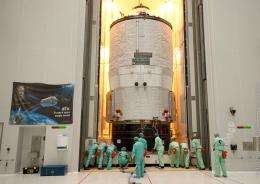
Automated Transfer Vehicle Edoardo Amaldi is moved to the Ariane integration building in Europe’s Spaceport in Kourou, French Guiana. From there it will be loaded onto an Ariane 5 rocket for launch in March 2012. ESA’s third automated space freighter will carry about two tonnes of dry cargo, 285 kg of water and more than three tonnes of propellants to the International Space Station. Credits: ESA/CNES/Arianespace/Optique Video du CSG - P.Baudon

The name, proposed by Belgium’s delegation to ESA, was endorsed on 14–15 February by the ESA Programme Board responsible for Space Station matters during a meeting at ESA Headquarters in Paris.

On that occasion, ESA Director General Jean-Jacques Dordain said: “Belgium has been a key participant in the European space adventure since its very beginning.

“Its contribution to ESA programmes and activities in general, and to the International Space Station in particular, has been a success for both Belgium and ESA.

“By naming ATV-5 after Georges Lemaître, we honour a world-class Belgian scientist who was instrumental in expanding our knowledge of the origins of the Universe.”

The Belgian Minister responsible for Space, Paul Magnette, noted: “I am extremely happy that the great Belgian scientist George Lemaître, born in my hometown, is honoured in this way.

“This shows that his work and achievements have not been forgotten and are still relevant so many decades on.

“Clearly, Belgium’s involvement in space in Europe has deep roots and is based on a long tradition.

“The ATV “Georges Lemaître” will carry supplies to the ISS, allowing today’s – equally excellent – Belgian researchers to carry out experiments and research on the ISS, thus pushing the boundaries of human knowledge forward in the tradition of Georges Lemaître.”

The Space Station depends on regular deliveries of experiment equipment and spare parts, as well as food, air and water for its crew.

Since 2008, every year and a half, an ATV has delivered about 6 tonnes of cargo some 400 km above Earth.

After launch on an Ariane 5 from Europe’s Spaceport in French Guiana, ATV automatically navigates to a precision docking with the Station’s Russian Zvezda module.

It remains attached to the ISS for up to six months before reentering the atmosphere and deliberately burning up together with several tonnes of Station waste.

Provided by European Space Agency search and more info website


Rank not rated yet
Relevant PhysicsForums posts
  • Distance of planets from stars and revolution
    created11 hours ago
  • revamping general concept and cosmological principle
    createdMay 25, 2012
  • Transiting Exoplanet Light Curve
    createdMay 25, 2012
  • Math behind Theoretical Physics
    createdMay 24, 2012
  • Do we know whats at the center of galaxies yet?
    createdMay 23, 2012
  • Structure of the Milky Way?
    createdMay 20, 2012
  • More from Physics Forums - General Astronomy

More news stories

Yale study concludes public apathy over climate change unrelated to science literacy

Are members of the public divided about climate change because they don't understand the science behind it? If Americans knew more basic science and were more proficient in technical reasoning, would public consensus match ...

Space & Earth / Environment

created 11 hours ago | popularity 4.8 / 5 (6) | comments 27 | with audio podcast

Land and sea species differ in climate change response: study

(Phys.org) -- Marine and terrestrial species will likely differ in their responses to climate warming, new research by Simon Fraser University and Australia’s University of Tasmania has found.

Space & Earth / Environment

created 9 hours ago | popularity 4 / 5 (5) | comments 6 | with audio podcast

10 million years needed to recover from mass extinction

It took some 10 million years for Earth to recover from the greatest mass extinction of all time, latest research has revealed.

Space & Earth / Earth Sciences

created 11 hours ago | popularity 4.2 / 5 (5) | comments 2 | with audio podcast

Sophisticated simulations predict future warming

The chances of our planet being hit by a global warming of 3 degrees Celsius by 2050 is as likely as it being hit by an increase of 1.4 degrees, new research shows. Presented in the journal Nature Geoscience, the British study ...

Space & Earth / Earth Sciences

created May 22, 2012 | popularity 3.8 / 5 (11) | comments 51

Kyoto Protocol architect 'frustrated' by climate dialogue

UN climate talks are going nowhere, as politicians dither or bicker while the pace of warming dangerously speeds up, one of the architects of the Kyoto Protocol told AFP.

Space & Earth / Environment

created May 23, 2012 | popularity 3.4 / 5 (8) | comments 42


'Unzipped' carbon nanotubes could help energize fuel cells, batteries

Multi-walled carbon nanotubes riddled with defects and impurities on the outside could replace some of the expensive platinum catalysts used in fuel cells and metal-air batteries, according to scientists at ...

Change in developmental timing was crucial in the evolutionary shift from dinosaurs to birds: study

At first glance, it's hard to see how a common house sparrow and a Tyrannosaurus Rex might have anything in common. After all, one is a bird that weighs less than an ounce, and the other is a dinosaur that ...

Computer model used to pinpoint prime materials for efficient carbon capture

When power plants begin capturing their carbon emissions to reduce greenhouse gases – and to most in the electric power industry, it's a question of when, not if – it will be an expensive undertaking.

T cells 'hunt' parasites like animal predators seek prey, study shows

By pairing an intimate knowledge of immune-system function with a deep understanding of statistical physics, a cross-disciplinary team at the University of Pennsylvania has arrived at a surprising finding: T cells use a movement ...

Stunning image of smallest possible five-ringed structure

Scientists have created and imaged the smallest possible five-ringed structure – about 100,000 times thinner than a human hair – and you'll probably recognise its shape.

Browser wars flare in mobile space

The browser wars are heating up again, but this time the fight is for dominance of the mobile Internet.