Three days of NASA infrared images show System 92S tropically developing
Feb 27, 2012
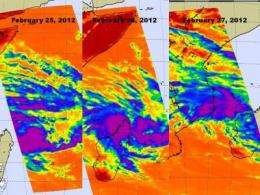
The AIRS instrument on NASA's Aqua satellite captured infrared imagery on developing System 92S in the Mozambique Channel (Indian Ocean). On February 25 at 0941 UTC, System 92S was moving west toward Madagascar. By February 26 at 10:23 UTC System 92S was over northwestern Madagascar. On February 27 at 1105 UTC had moved into the Mozambique Channel and appeared to be heading for a landfall in Mozambique. Credit: Credit: NASA/JPL, Ed Olsen

NASA satellites have been watching the low pressure area called System 92S for days, and infrared imagery from NASA's Aqua satellite showed cloud temperatures were cooling, indicating the storm was getting more organized after it moved over northern Madagascar. Now it may be headed for landfall in Mozambique.

The Atmospheric Infrared Sounder (AIRS) instrument on NASA's Aqua satellite captured on developing System 92S as it moved from the Southern Indian Ocean, west across northern Madagascar and into the Mozambique Channel. On February 25 at 0941 UTC, System 92S appeared as a rounded low pressure area with the strongest storms (and highest, coldest cloud tops on AIRS infrared imagery) south of the center of circulation. It was still in the open waters of the Southern Indian Ocean and was moving west toward Madagascar. By February 26 at 10:23 UTC System 92S was raining on northern Madagascar. On February 27 at 1105 UTC had moved into the Mozambique Channel and appeared to be heading for a landfall in Mozambique. On the 27th, the strongest thunderstorms and coldest appeared in two areas, north and east of the storm's center.

On February 27, the center of System 92S was located in the Mozambique Channel, near 13.5 South and 48.5 East, about 345 nautical miles north-northeast of Antananarivo, Madagascar. AIRS infrared imagery indicated that the low had weakened because of its interaction with land, as it moved over northern Madagascar.

Now that the center of System 92S is over the warm waters of the , it is expected to redevelop quickly. The area of strong thunderstorms east of center, as seen on AIRS imagery is a band of thunderstorms.

The Joint gives this system a high chance for developing further into a tropical cyclone in the next 24 hours.

Explore further: Alaska volcano shoots ash 15,000 feet into the air

add to favorites email to friend print save as pdf

Related Stories

Recommended for you

Alaska volcano shoots ash 15,000 feet into the air

20 hours ago

(AP)—One of Alaska's most restless volcanoes has shot an ash cloud 15,000 feet into the air in an ongoing eruption that has drawn attention from a nearby community but isn't expected to threaten air traffic.

NASA sees Cyclone Mahasen hit Bangladesh

May 17, 2013

NASA's Tropical Rainfall Measuring Mission satellite known as TRMM measured Cyclone Mahasen's rainfall rates from space as it made landfall on May 16. Mahasen has since dissipated over eastern India.

Rapid climate change ruled out ice age trees

May 17, 2013

Short, sharp fluctuations in the Earth's climate throughout the last ice age may have stopped trees from getting a foothold in Europe and northern Asia, scientists say.

Earth's iron core is surprisingly weak, researchers say

May 17, 2013

The massive ball of iron sitting at the center of Earth is not quite as "rock-solid" as has been thought, say two Stanford mineral physicists. By conducting experiments that simulate the immense pressures deep in the planet's ...

User comments : 0

More news stories

Galaxy's Ring of Fire

Johnny Cash may have preferred this galaxy's burning ring of fire to the one he sang about falling into in his popular song. The "starburst ring" seen at center in red and yellow hues is not the product of ...

Alaska volcano shoots ash 15,000 feet into the air

(AP)—One of Alaska's most restless volcanoes has shot an ash cloud 15,000 feet into the air in an ongoing eruption that has drawn attention from a nearby community but isn't expected to threaten air traffic.

Chinese, Indian airlines face EU pollution fines

Eight Chinese and two Indian airlines face fines of up to several million euros for not paying for their greenhouse gas emissions during flights within the bloc, the European Commission said on Friday.

Morocco to harness the wind in energy hunt

Morocco is ploughing ahead with a programme to boost wind energy production, particularly in the southern Tarfaya region, where Africa's largest wind farm is set to open in 2014.

US seizes Bitcoin operator accounts

US authorities seized the accounts of a Bitcoin digital currency exchange operator, claiming it was functioning as an "unlicensed money service business," court documents showed Friday.