New comet discovered by amateur astronomer
February 14, 2012 by Jason Major, Universe Today

New comet discovered by amateur astronomer

Enlarge

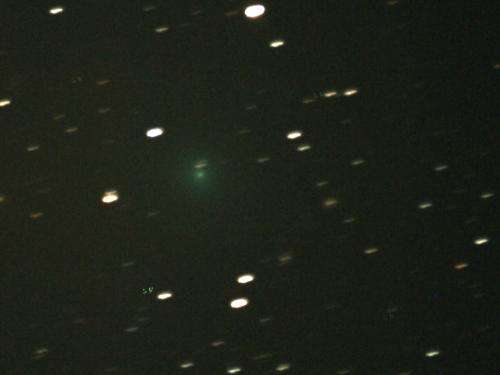
Image of Comet C/2012 C2 (Bruenjes) made from ten 60 sec. exposures on Feb. 11, 2012. Credit: Fred Bruenjes

“Friday, February 10th 2012 just felt like the perfect night for a comet to be discovered by an amateur astronomer,” writes Fred Bruenjes on his astronomy blog. And, this past Friday night, that’s exactly what Fred did.

Here’s how he did it:

Using custom-written software to operate a 14″ Meade LX200GPS telescope in his self-built observatory in Warrensburg, Missouri, Fred set his system up to capture images of the sky on that cold evening, not allowing himself to be chased inside by the low temperatures or the bright, rising moon. After some technical difficulties with his dSLR, Fred managed to acquire some quality images. While making a cursory look through the blink data, Fred was surprised to spot a faint burry object visible moving across three frames. A check of online databases of known objects brought up no positive hits — this was something that hadn’t been seen before.

Fred describes the “eureka” moment on his blog:

A check of known objects in the region had a lot of results in the area, but all were moving eastward while my fuzzy was moving westward. Rocks don’t make U-turns. This was really getting exciting. I had Jen, my better half, an accomplished astro imager, take a look at the images and before I could point out the faint smudge she exclaimed “That’s a !”

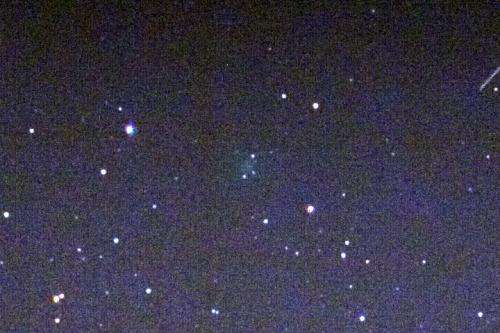
Still, Fred notes, “it wasn’t a slam-dunk.” The images were faint and there could have been other causes of blurry spots in digital images. But a check of the raw color data revealed a greenish coloration to the object’s glow, which is indicative of cyanogen and carbon emission — typical hallmarks of comets. “Very encouraging,” Fred added.

Another night’s observation was needed. If it was a comet, it would appear again along its expected trajectory. Of course, with an unidentified comet there would be no known orbit, so Fred had to manually extrapolate its position. When he trained his telescope onto his calculated coordinates the following evening and began taking images, there it was… the same faint, fuzzy green blur from the previous night, slowly appearing in the darkening sky right where it should be.

“Oh. Wow. It was dead nuts at where it was supposed to be,” Fred writes. “Wow. This thing is for real! It’s at about this time that it begins to sink in that a lifelong quest has just been fulfilled. I just crossed another thing off the bucket list!”
New comet discovered by amateur astronomer
Enlarge

Raw-color discovery image. Credit: Fred Bruenjes

Fred spent the next hour gathering images to send in to the IAU’s Minor Planet Center, in the hopes of having the object cataloged so that others could locate and observe it. He didn’t have to wait long; within five minutes the object was listed on the Near-Earth Object Confirmation Page, and dubbed C/2012 C2 (Bruenjes), in honor of its discoverer.

Now that’s just got to feel good.

Comet Bruenjes is an NEO currently about 0.555 AU away from Earth. Its exact size and orbital period isn’t known, and it may even be a returning comet or piece from a larger one… the official report isn’t out yet. It appears to have a fairly inclined orbit relative to the ecliptic, based on the current diagram created by JPL’s Small-Body Database.

The comet’s total magnitude is 16.6, so it is dim and not visible to the naked eye. Fred told Universe Today in an email: “it’s in the constellation Aries, about six degrees north of Jupiter. Just after sunset in the Northern hemisphere it’s high in the southwest, nearly overhead.”

Stay tuned for more updated information on this newly-discovered member of our solar system. And congratulations to Fred Bruenjes, comet-hunter extraordinaire!

Read Fred’s full story on his astronomy site here.

Source: Universe Today

Filter


Move the slider to adjust rank threshold, so that you can hide some of the comments.


Display comments: newest first

ChangBroot
Feb 14, 2012

Rank: not rated yet
Wow. Great job Fred. I love to watch a video about it. The universe always intrigues me.
PosterusNeticus
Feb 14, 2012

Rank: not rated yet
Well done, Fred!
Rank 5 /5 (6 votes)
Relevant PhysicsForums posts
  • Distance of planets from stars and revolution
    created11 hours ago
  • revamping general concept and cosmological principle
    createdMay 25, 2012
  • Transiting Exoplanet Light Curve
    createdMay 25, 2012
  • Math behind Theoretical Physics
    createdMay 24, 2012
  • Do we know whats at the center of galaxies yet?
    createdMay 23, 2012
  • Structure of the Milky Way?
    createdMay 20, 2012
  • More from Physics Forums - General Astronomy

More news stories

Yale study concludes public apathy over climate change unrelated to science literacy

Are members of the public divided about climate change because they don't understand the science behind it? If Americans knew more basic science and were more proficient in technical reasoning, would public consensus match ...

Space & Earth / Environment

created 11 hours ago | popularity 4.8 / 5 (6) | comments 27 | with audio podcast

Land and sea species differ in climate change response: study

(Phys.org) -- Marine and terrestrial species will likely differ in their responses to climate warming, new research by Simon Fraser University and Australia’s University of Tasmania has found.

Space & Earth / Environment

created 9 hours ago | popularity 4 / 5 (5) | comments 6 | with audio podcast

10 million years needed to recover from mass extinction

It took some 10 million years for Earth to recover from the greatest mass extinction of all time, latest research has revealed.

Space & Earth / Earth Sciences

created 11 hours ago | popularity 4.2 / 5 (5) | comments 2 | with audio podcast

Sophisticated simulations predict future warming

The chances of our planet being hit by a global warming of 3 degrees Celsius by 2050 is as likely as it being hit by an increase of 1.4 degrees, new research shows. Presented in the journal Nature Geoscience, the British study ...

Space & Earth / Earth Sciences

created May 22, 2012 | popularity 3.8 / 5 (11) | comments 51

Kyoto Protocol architect 'frustrated' by climate dialogue

UN climate talks are going nowhere, as politicians dither or bicker while the pace of warming dangerously speeds up, one of the architects of the Kyoto Protocol told AFP.

Space & Earth / Environment

created May 23, 2012 | popularity 3.4 / 5 (8) | comments 42


'Unzipped' carbon nanotubes could help energize fuel cells, batteries

Multi-walled carbon nanotubes riddled with defects and impurities on the outside could replace some of the expensive platinum catalysts used in fuel cells and metal-air batteries, according to scientists at ...

Change in developmental timing was crucial in the evolutionary shift from dinosaurs to birds: study

At first glance, it's hard to see how a common house sparrow and a Tyrannosaurus Rex might have anything in common. After all, one is a bird that weighs less than an ounce, and the other is a dinosaur that ...

Computer model used to pinpoint prime materials for efficient carbon capture

When power plants begin capturing their carbon emissions to reduce greenhouse gases – and to most in the electric power industry, it's a question of when, not if – it will be an expensive undertaking.

T cells 'hunt' parasites like animal predators seek prey, study shows

By pairing an intimate knowledge of immune-system function with a deep understanding of statistical physics, a cross-disciplinary team at the University of Pennsylvania has arrived at a surprising finding: T cells use a movement ...

Stunning image of smallest possible five-ringed structure

Scientists have created and imaged the smallest possible five-ringed structure – about 100,000 times thinner than a human hair – and you'll probably recognise its shape.

Browser wars flare in mobile space

The browser wars are heating up again, but this time the fight is for dominance of the mobile Internet.