Climate change: French researchers complete new simulations for the next IPCC report
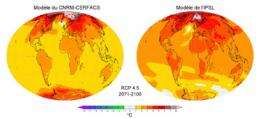
Changes in the Earth's surface temperature for the period 2071-2100 compared with the period 1971-2000, calculated using the CNRM-CERFACS and IPSL models for scenario RCP4.5 (moderate). Credit: Patrick Brockmann (LSCE/IPSL, CEA/CNRS/UVSQ)
The French climatology community, which includes CNRS, Météo-France, the CEA, UPMC and UVSQ, has just completed a major exercise in the simulation of past and future climate conditions on a global scale. This new body of data confirms the conclusions of the most recent report by the IPCC(2007) on future changes in temperature and rainfall. By 2100, average global temperatures are expected to rise by 3.5 to 5°C according to the most unfavorable scenario, or 2°C according to the most optimistic projections. This study has been made available to the international community, and will be used by the IPCC in its next report, to be released in 2013. It provides information on likely climate conditions and trends at the end of the century and, for the first time, over the next 30 years as well.
The IPCC was formed for the purpose of gathering and summarizing all the available scientific information on climate change, its impact and solutions for countering or adapting to it. The first section of its fifth report, to be published in mid-September 2013, will give an update on the new findings compiled in recent years. Just as for the 2007 edition, the international scientific community has joined forces, in particular through the WCRP, to define and carry out an exercise to simulate past and future climate conditions, called the CMIP-5 (Coupled Model Intercomparison Project).
This ongoing research effort, which requires vast resources in terms of manpower, computing power and data storage capacity, involves more than 20 climatology centers around the world and the development of some 50 digital models. In France, many organizations are contributing to the project, in particular through the CNRM, in association with CERFACS and IPSL.
The CMIP-5 project introduces a number of innovations in relation to the previous exercises:
The inclusion of scenarios that incorporate climate policies intended to reduce greenhouse gas emissions;
The use of models that are both more complex (for the better integration of factors like aerosols, the carbon cycle, etc.) and more precise (for better resolution);
An in-depth evaluation of the models' capacity to reproduce past climate conditions and the mechanisms that underlie their evolution;
A series of retrospective forecasts for the past 50 years, as well as a preliminary forecast exercise for the period between 2010 and 2035.
Findings of the French simulations
In keeping with the IPCC's conclusions of 2007, all scenarios predict a trend toward higher temperatures between now and 2100. The severity of the rise varies depending on the scenario under consideration, reaching 3.5 to 5°C for the most unfavorable but only 2°C for the most optimistic a scenario that depends on the successful implementation of policies to reduce greenhouse gas emissions. In addition, it seems that natural factors alone cannot explain the average global warming observed since the second half of the 20th century.
The new simulations confirm an intensification of the hydrological cycle and the rapid melting of the Arctic ice cap. According to the most pessimistic scenario, the Arctic Sea will be totally ice-free in the summer by 2040 or 2060, depending on the model.
Some new responses are offered by the simulations that link climate conditions to the carbon cycle. In particular, they make it clear that anthropogenic emissions must be rapidly reduced in order to reach negative emissions (i.e. a level of anthropogenic activity that makes it possible to draw CO2 directly from the atmosphere) by the end of the 21st century.
The analyses of this set of simulations, in combination with simulations by other international research groups, will shed new light on the link between human activity and climate change, both in the past several decades and, more importantly, in the decades and centuries to come.
Provided by
CNRS
-
From lemons to lemonade: Reaction uses carbon dioxide to make carbon-based semiconductor,
32 comments
-
Thioridazine kills cancer stem cells in human while avoiding toxic side-effects of conventional cancer treatments,
3 comments
-
SpaceX private rocket blasts off for space station (Update),
42 comments
-
Climate scientists say they have solved riddle of rising sea,
31 comments
-
Landmark calculation clears the way to answering how matter is formed,
55 comments
-
Hypothetical desert earth
May 26, 2012
-
More human population = greater mass?
May 25, 2012
-
Conversion from aircraft bearing to normal degrees
May 23, 2012
-
Interpretation/Analysis of the Lab results(HEPA filter)
May 22, 2012
-
Has anyone here attended the The Urbino Summer School in Paleoclimatology?
May 22, 2012
-
Earthquakes: Mag 6 N. Italy and Mag 5.6 W. Bulgaria
May 21, 2012
- More from Physics Forums - Earth
More news stories
Yale study concludes public apathy over climate change unrelated to science literacy
Are members of the public divided about climate change because they don't understand the science behind it? If Americans knew more basic science and were more proficient in technical reasoning, would public consensus match ...
11 hours ago |
4.8 / 5 (6) |
27
|
Land and sea species differ in climate change response: study
(Phys.org) -- Marine and terrestrial species will likely differ in their responses to climate warming, new research by Simon Fraser University and Australia’s University of Tasmania has found.
9 hours ago |
4 / 5 (5) |
6
|
10 million years needed to recover from mass extinction
It took some 10 million years for Earth to recover from the greatest mass extinction of all time, latest research has revealed.
Space & Earth / Earth Sciences
11 hours ago |
4.2 / 5 (5) |
2
|
Sophisticated simulations predict future warming
The chances of our planet being hit by a global warming of 3 degrees Celsius by 2050 is as likely as it being hit by an increase of 1.4 degrees, new research shows. Presented in the journal Nature Geoscience, the British study ...
Space & Earth / Earth Sciences
May 22, 2012 |
3.8 / 5 (11) |
51
Kyoto Protocol architect 'frustrated' by climate dialogue
UN climate talks are going nowhere, as politicians dither or bicker while the pace of warming dangerously speeds up, one of the architects of the Kyoto Protocol told AFP.
May 23, 2012 |
3.4 / 5 (8) |
42
'Unzipped' carbon nanotubes could help energize fuel cells, batteries
Multi-walled carbon nanotubes riddled with defects and impurities on the outside could replace some of the expensive platinum catalysts used in fuel cells and metal-air batteries, according to scientists at ...
Change in developmental timing was crucial in the evolutionary shift from dinosaurs to birds: study
At first glance, it's hard to see how a common house sparrow and a Tyrannosaurus Rex might have anything in common. After all, one is a bird that weighs less than an ounce, and the other is a dinosaur that ...
Computer model used to pinpoint prime materials for efficient carbon capture
When power plants begin capturing their carbon emissions to reduce greenhouse gases and to most in the electric power industry, it's a question of when, not if it will be an expensive undertaking.
T cells 'hunt' parasites like animal predators seek prey, study shows
By pairing an intimate knowledge of immune-system function with a deep understanding of statistical physics, a cross-disciplinary team at the University of Pennsylvania has arrived at a surprising finding: T cells use a movement ...
Stunning image of smallest possible five-ringed structure
Scientists have created and imaged the smallest possible five-ringed structure about 100,000 times thinner than a human hair and you'll probably recognise its shape.
Browser wars flare in mobile space
The browser wars are heating up again, but this time the fight is for dominance of the mobile Internet.
Feb 14, 2012
Rank: 4.2 / 5 (5)
http://thinkprogr...iththat/
Ordinarily I wouldn't link a personal opinion page, but he quotes Wieslaw Maslowski's work which, based on his credentials and track record for accuracy, make him a valid source.
Feb 15, 2012
Rank: 4.2 / 5 (5)
Perhaps our resident Libertarians can explain why there is so much rampant dishonesty coming from their trademark propaganda groups - Hertland, Cato, AEI, CEI, etc.
http://www.desmog...strategy
Feb 15, 2012
Rank: 4.2 / 5 (5)
Feb 15, 2012
Rank: 5 / 5 (4)
Here is a very good article on the subject;
http://arstechnic...well.ars
You now the freepers have hammer climate scientist with phoney charges with the leaked emails episode. The turn around seems like fair play to me, if not poetic justice.
The slime.
Feb 16, 2012
Rank: 5 / 5 (4)
Feb 16, 2012
Rank: 5 / 5 (3)
Damn, one of the skeptic physicist was paided to make scientific sounding shit up at $600,000 a year? That is over the top.
Feb 17, 2012
Rank: 5 / 5 (4)
600,000 grand a year? That is just stupid.