China water project to 'begin operating in 2013'
February 5, 2012

South-North Water Diversion Project is one of China's largest infrastructure projects

Enlarge

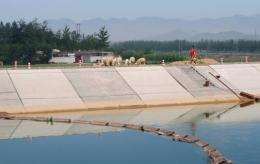
A farmer is seen following her flock of sheep near a fenced-off canal that is part of China's hugely ambitious South-North Water Diversion Project, in Yixian, in 2009, in northern China's Hebei province. The massive project to divert water from China's south to its drought-prone north will become partly operational in 2013, according to state media.

A massive project to divert water from China's south to its drought-prone north -- which has seen hundreds of thousands of people relocated -- will become partly operational next year, state media reported.

The South-North Water Diversion Project is one of the country's largest since the building of the Three Gorges Dam, which involved the relocation of more than one million people.

Sun Yifu, deputy water resources chief in the eastern province of Shandong -- who is also involved in the programme -- said his province's part of the project would be completed at the end of the year, the said.

He added that "the entire project" would become operational in the first half of 2013, and start supplying water to arid parts of the north, the report said late Saturday.

China's South-North Water Diversion project consists of three routes -- the eastern, middle and western routes -- and Sun was referring to the eastern portion of the project, or a 1,890-kilometre (1,170-mile) canal.

Construction on the 1,430-kilometre central route began in 2003 and will only be operational in 2014. The western section, meanwhile, has yet to see the light of day.

Chinese revolutionary leader Mao Zedong is credited with coming up with the idea for the massive diversion programme, which will feature a tunnel dug beneath the -- the second-largest in China.

But the project -- which will cost an estimated 500 billion yuan ($79 billion) -- was only approved in 2002.

Critics say it could be a huge waste of resources that risks creating new and sparking . They also point to the human cost of mass relocations to make way for the canals.

(c) 2012 AFP

3.8 /5 (6 votes)  

Filter


Move the slider to adjust rank threshold, so that you can hide some of the comments.


Display comments: newest first

bredmond
Feb 05, 2012

Rank: not rated yet
the city i used to live in was along the route of this diversion. It divided the old city from the new development zone. they are going to clear out a huge swath of 200 meters on both sides and make it parkland. (though i am sure some privileged chap will have a Hot Pot restaurant jutting out into prominence.) They claimed poor neighborhoods and will relocate the residents elsewhere, and bulldoze those neighborhoods to make the clearaway section. it was fun to watch them build too, and it looks like it will make that city much better aesthetically.
axemaster
Feb 05, 2012

Rank: 5 / 5 (1)
They claimed poor neighborhoods and will relocate the residents elsewhere, and bulldoze those neighborhoods to make the clearaway section.

I'm sure they were very happy about it too.

But wait a sec, I thought China was having a serious problem with the water table dropping. Is this supposed to be a fix? Or are they just draining the next region on the queue?
irjsiq
Feb 06, 2012

Rank: 1 / 5 (2)
axemaster,

Regarding 'Draining Aquifers' vs 'Re-locating Water', from Wet Zones to Drought Zones . . .
Both: "The 'Transfer' AND the 'Sequestration'(re-charging of 'aquifers')... are Very Compatible in their respective solutions!
Displacement of such 'huge' numbers of Citizens, are not Compatible!
"Regardless of 'How Far One may Roam!
"There's No Place like 'HOME'!"
With 'Water': It IS Possible 'store and transfer' this (H2O) molecule!
Thus 'enabling' Inhabitants to: "Have 'One's Cake, and Eat It(the Cake)!
More difficult!
Saying: "This is Where I lived!
" '50 Meters' beneath the surface of This Lake!"

Nothing is possible when the 'Dictum': "Mordida es Muerte!" Is Ignored!!!

Roy J Stewart,
Phoenix AZ
axemaster
Feb 06, 2012

Rank: 3 / 5 (3)
Both: "The 'Transfer' AND the 'Sequestration'(re-charging of 'aquifers')... are Very Compatible in their respective solutions!

Why? If the rate of water use is greater than the recharge rate of all aquifers in use, then it will run out eventually, regardless of the transfer systems they put in place.

Displacement of such 'huge' numbers of Citizens, are not Compatible!

It's perfectly compatible for an entity like the Chinese government. Maybe not for the citizens, but who cares about them anyway? Whiny meat is soon silenced.

I have no idea what your post is saying by the way, I was mostly guessing. It's written like some kind of bizarre ad.
Vendicar_Decarian
Feb 06, 2012

Rank: 2.3 / 5 (4)
Progress in China. Continued infrastructure degradation in America.
cdt
Feb 06, 2012

Rank: 5 / 5 (1)
If the rate of water use is greater than the recharge rate of all aquifers in use, then it will run out eventually, regardless of the transfer systems they put in place.


That assumes that all water use is coming from aquifers, which is a faulty assumption. For the water being diverted, I'm sure some of that would go toward recharging aquifers (no idea how much), but chances are a huge bulk of it would just end up in the ocean. It's that last part that you get as an increase in net water to be used for agriculture, manufacturing and the like. I believe what you intended was that if the rate of water being drawn from the aquifers is greater than that replenishing it then the aquifers will eventually run out, which is true. The open question is how the diversion affects the aquifer usage rate and the replenishing rate. Note that it could potentially lower the replenishing rate in the south, but there's no water shortage there. In the north it should lower the depletion rate.
antialias_physorg
Feb 06, 2012

Rank: 3.6 / 5 (5)
Progress in China. Continued infrastructure degradation in America.

Who. Cares.

This is an article about China. Not the US.
This is an international science site. Not a US site.
Keep you local politics out of this.
lengould100
Feb 09, 2012

Rank: not rated yet
It may be valid to worry about the hardships imposed on the people being displaced by such projects, but why does no-one then also consider the typically 300,000 people per year drowned in the spring runoff floods which used to happen prior to the construction of the three gorges dam and this diversion?

Shouldn't there be a "net balance" formula?
Rank 3.8 /5 (6 votes)
Relevant PhysicsForums posts

More news stories

Yale study concludes public apathy over climate change unrelated to science literacy

Are members of the public divided about climate change because they don't understand the science behind it? If Americans knew more basic science and were more proficient in technical reasoning, would public consensus match ...

Space & Earth / Environment

created 11 hours ago | popularity 4.8 / 5 (6) | comments 27 | with audio podcast

Land and sea species differ in climate change response: study

(Phys.org) -- Marine and terrestrial species will likely differ in their responses to climate warming, new research by Simon Fraser University and Australia’s University of Tasmania has found.

Space & Earth / Environment

created 9 hours ago | popularity 4 / 5 (5) | comments 6 | with audio podcast

10 million years needed to recover from mass extinction

It took some 10 million years for Earth to recover from the greatest mass extinction of all time, latest research has revealed.

Space & Earth / Earth Sciences

created 11 hours ago | popularity 4.2 / 5 (5) | comments 2 | with audio podcast

Sophisticated simulations predict future warming

The chances of our planet being hit by a global warming of 3 degrees Celsius by 2050 is as likely as it being hit by an increase of 1.4 degrees, new research shows. Presented in the journal Nature Geoscience, the British study ...

Space & Earth / Earth Sciences

created May 22, 2012 | popularity 3.8 / 5 (11) | comments 51

Kyoto Protocol architect 'frustrated' by climate dialogue

UN climate talks are going nowhere, as politicians dither or bicker while the pace of warming dangerously speeds up, one of the architects of the Kyoto Protocol told AFP.

Space & Earth / Environment

created May 23, 2012 | popularity 3.4 / 5 (8) | comments 42


'Unzipped' carbon nanotubes could help energize fuel cells, batteries

Multi-walled carbon nanotubes riddled with defects and impurities on the outside could replace some of the expensive platinum catalysts used in fuel cells and metal-air batteries, according to scientists at ...

Change in developmental timing was crucial in the evolutionary shift from dinosaurs to birds: study

At first glance, it's hard to see how a common house sparrow and a Tyrannosaurus Rex might have anything in common. After all, one is a bird that weighs less than an ounce, and the other is a dinosaur that ...

Computer model used to pinpoint prime materials for efficient carbon capture

When power plants begin capturing their carbon emissions to reduce greenhouse gases – and to most in the electric power industry, it's a question of when, not if – it will be an expensive undertaking.

T cells 'hunt' parasites like animal predators seek prey, study shows

By pairing an intimate knowledge of immune-system function with a deep understanding of statistical physics, a cross-disciplinary team at the University of Pennsylvania has arrived at a surprising finding: T cells use a movement ...

Stunning image of smallest possible five-ringed structure

Scientists have created and imaged the smallest possible five-ringed structure – about 100,000 times thinner than a human hair – and you'll probably recognise its shape.

Browser wars flare in mobile space

The browser wars are heating up again, but this time the fight is for dominance of the mobile Internet.