Chicago as urban microcosm
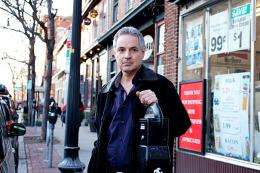
Quaint Boston can’t match Chicago’s bustle and sprawl, but the two cities are more alike than not in fundamental respects. In fact, they’re surprisingly similar to Los Angeles, New York, Washington, D.C., and other urban areas in how “neighborhood effects” work, according to sociologist Robert Sampson.
Sampson, the Henry Ford II Professor of the Social Sciences and director of the Social Sciences Program at the Radcliffe Institute for Advanced Study, has devoted his career to studying the metropolis. His new book, “Great American City: Chicago and the Enduring Neighborhood Effect,” details the results of a groundbreaking, 15-year study of the Second City’s people and neighborhoods.
Growing up in upstate New York, in “what I now realize was the massively declining industrial city of Utica,” Sampson witnessed the shedding of jobs and population dip. “Growing up, I didn’t think like a sociologist, obviously, but I was fascinated by issues that were apparent in my high school and in the city, things like population change, diversity, crime … ”
Eight years after finishing his doctorate, Sampson came to the University of Chicago, and in 1994 become scientific director of the Project on Human Development in Chicago Neighborhoods. “The early to mid-1990s was a time violence was spiking throughout the country. This was just after the crack cocaine epidemic. Homicide rates were hitting their peak, and violence and the death rate for juveniles were astronomical. Cities were thought to be dying,” said Sampson.
“The government was really concerned with community decline: What can we do, and how can we study it? The project was born of the confluence of social concern and scientific questions.”
Many cities were considered as a possible launching pad for the study, but Chicago got the nod for its composition of whites, blacks, and Latinos — the three largest groups in the United States — and for the access to the city’s extensive statistics on health, police, and more. “Chicago offered us a picture of American life that we thought was broadly representative,” Sampson said.
According to Sampson, a vast array of social activity is concentrated in place. “We studied crime, health, altruism, cynicism, disorder, collective efficacy, civic engagement, leadership networks — all of which are influenced and shaped by neighborhood effects.”
Sampson and his collaborators interviewed Chicago citizens and key leaders, from principals to politicians; they tracked the young from ages 3 to 18; they even studied pregnant women, following their infants and families over time.
They also observed public spaces. “We mounted cameras in the backseat of SUVs and filmed each side of the street, driving very slowly,” said Sampson, in what he dubs the early version of Google Street View. “We had people in the vehicle observing what was going on, and recording sound and information. These films were used to code detailed aspects of the physical and social structure of these neighborhoods.”
Even as the world is increasingly globalized, neighborhood structures remain local and important. “Neighborhoods have legacies,” he said. “Crime and poverty are durable over long periods of time. From the 1960s onwards, cities went through amazing social change — riots, crime — to one of the largest decreases in violence from the late 1990s to the present. Yet communities are persistent in rank ordering. People are moving in and out of neighborhoods, but the perceptions of neighborhoods stay largely the same.”
What’s more, he found, no community in Chicago transitioned from black to white, a pattern he shows is similar to the United States as a whole.
“The racial differences we encountered were surprising in their magnitude. The incarceration rate in the top African-American community was over 40 times higher than the highest incarceration rate in the white community. We often find differences — 50 percent higher, twice as high — but 40 times higher is a difference not of degree, but of kind.”
Similar factors are at work across the country, said Sampson. “Boston, too, is a city of neighborhoods,” he said. “All of the processes in this book are played out here in terms of spatial inequality, though there’s less segregation in Boston.”
Last semester Sampson taught a Gen Ed course called “Reinventing Boston,” and his students set out to observe the city’s inner workings. “And I’m involved in a new effort called the Boston Area Research Initiative, funded by the Radcliffe Institute, which seeks to promote a more extensive partnership with different city agencies. We’re hoping to establish Boston as a potential leader for this kind of research.”
Provided by Harvard University
This story is published courtesy of the Harvard Gazette, Harvard University's official newspaper. For additional university news, visit Harvard.edu.


