Chemists mimic nature to design better medical tests
Feb 14, 2012
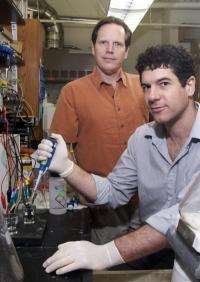
This is Kevin Plaxco (left) and Alexis Vallée-Bélisle. Credit: Rod Rolle

Over their 3.8 billion years of evolution, living organisms have developed countless strategies for monitoring their surroundings. Chemists at UC Santa Barbara and University of Rome Tor Vergata have adapted some of these strategies to improve the performance of DNA detectors. Their findings may aid efforts to build better medical diagnostics, such as improved HIV or cancer tests.

Their research is described in an article published this week in the .

Nature often serves as a source of inspiration for the development of new technologies. In the field of medical diagnostics, for example, scientists have long taken advantage of the high affinity and specificity of biomolecules such as antibodies and DNA to detect molecular markers in the blood. These molecular markers allow them to monitor health status and to guide treatments for diseases, including HIV, cancer, and diabetes.

Kevin W. Plaxco, a professor of chemistry at UCSB, whose group carried out the research, notes that despite their great attributes, a main limitation of such biosensors is their precision, which is confined to a fixed, well-defined "" of target concentrations. Specifically, the useful dynamic range of typical biomolecule binding events spans an 81-fold range of target concentrations
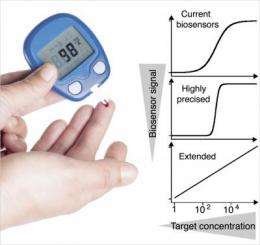
By mimicking natural sensors, Vallée-Bélisle, Ricci and Plaxco have created biosensors that are highly precise (ideal for monitoring the concentration of highly toxic drugs used to treat many cancers) or that can detect a very large change in target concentrations (ideal to monitor HIV virus progression). The researchers believe that these strategies can be applied to a wide range of biosensors, which may significantly impact efforts to build better point-of-care biosensors for the detection of disease biomarkers. Credit: UCSB

"This fixed dynamic range complicates –– or even precludes –– the use of biosensors in many applications," said Plaxco. "To monitor HIV progression and provide the appropriate medication, for example, physicians need to measure the levels of viruses over five orders of magnitude. Likewise, the two orders-of-magnitude range displayed by most biosensors is too broad to precisely monitor the concentrations of the highly toxic drugs used to treat many cancers. Our goal was, therefore, to create sensors with extended (for applications needing a broad dynamic range) or narrowed (for applications needing high measurement precision) dynamic ranges at will."

The key breakthrough underlying their new approach came from the simple observation of nature. "All living organisms monitor their environments in an optimized way by using sensing molecules that respond to either wide or narrow change in target concentrations," said Alexis Vallée-Bélisle, a postdoctoral fellow and the first author of the study. "Nature does so by combining in a very elegant way multiple receptors, each displaying a different affinity for their common target".

Inspired by the optimized behaviors of these natural sensors, the UCSB research group teamed up with Francesco Ricci, professor at the University of Rome Tor Vergata to do their own mixing and matching of biomolecules to manipulate biosensors' dynamic ranges. To validate their approach, they used a widely employed DNA-based biosensor used for detecting mutations in DNA called a "molecular beacon."

By combining sets of molecular beacons all binding the same target molecule but with differing affinities, the international team was able to create sensors with rationally "tuned" dynamic ranges. In one case, they developed a sensor that monitors DNA concentrations over a six orders of magnitude range. In another example, they developed an ultrasensitive sensor that precisely detects small changes in target concentration over only a five-fold dynamic range. Finally, they also built sensors characterized by complex, "custom-made" dynamic ranges in which the sensor is insensitive within a window of desired concentrations (e.g., the clinically "normal" concentration range of a drug) and very sensitive above or below this "appropriate" concentration range. The researchers believe that these strategies can be in principle applied to a wide range of biosensors, which may significantly impact efforts to build better point-of-care biosensors for the detection of disease biomarkers.

Explore further: Reading the unreadable

Related Stories

Chemists explain the switchboards in our cells

Aug 03, 2009

Our cells are controlled by billions of molecular "switches" and chemists at UC Santa Barbara have developed a theory that explains how these molecules work. Their findings may significantly help efforts to ...

Nano-tetherball biosensor precisely detects glucose

Jan 22, 2009

(PhysOrg.com) -- Researchers have created a precise biosensor for detecting blood glucose and potentially many other biological molecules by using hollow structures called single-wall carbon nanotubes anchored ...

Handheld DNA detector

Mar 10, 2008

A researcher at the National University at San Diego has taken a mathematical approach to a biological problem - how to design a portable DNA detector. Writing in the International Journal of Nanotechnology, he describes a math ...

Recommended for you

Attacking MRSA with metals from antibacterial clays

13 hours ago

In the race to protect society from infectious microbes, the bugs are outrunning us. The need for new therapeutic agents is acute, given the emergence of novel pathogens as well as old foes bearing heightened antibiotic resistance.

Beautiful 'flowers' self-assemble in a beaker

May 16, 2013

By simply manipulating chemical gradients in a beaker of fluid, materials scientists at Harvard have found that they can control the growth behavior of crystals to create precisely tailored structures—such ...

Reading the unreadable

May 16, 2013

Pioneering X-ray technology is making it possible to read fragile rolled-up historical documents for the first time in centuries.

Keeping fruit, vegetables and cut flowers fresh longer

May 15, 2013

New technology offers the promise of reducing billions of dollars of losses that occur each year from the silent, invisible killer of fruits, vegetables and cut flowers—a gas whose effects are familiar to everyone who has ...

User comments : 0

More news stories

Attacking MRSA with metals from antibacterial clays

In the race to protect society from infectious microbes, the bugs are outrunning us. The need for new therapeutic agents is acute, given the emergence of novel pathogens as well as old foes bearing heightened antibiotic resistance.

Beautiful 'flowers' self-assemble in a beaker

By simply manipulating chemical gradients in a beaker of fluid, materials scientists at Harvard have found that they can control the growth behavior of crystals to create precisely tailored structures—such ...

Making gold green: New non-toxic method for mining gold

Northwestern University scientists have struck gold in the laboratory. They have discovered an inexpensive and environmentally benign method that uses simple cornstarch—instead of cyanide—to isolate gold from raw materials ...

Alaska volcano shoots ash 15,000 feet into the air

(AP)—One of Alaska's most restless volcanoes has shot an ash cloud 15,000 feet into the air in an ongoing eruption that has drawn attention from a nearby community but isn't expected to threaten air traffic.

US seizes Bitcoin operator accounts

US authorities seized the accounts of a Bitcoin digital currency exchange operator, claiming it was functioning as an "unlicensed money service business," court documents showed Friday.

Chinese, Indian airlines face EU pollution fines

Eight Chinese and two Indian airlines face fines of up to several million euros for not paying for their greenhouse gas emissions during flights within the bloc, the European Commission said on Friday.