'Cell assay on a chip': solid results from simple means
February 8, 2012 By Michael E. Newman

New NIST 'Cell assay on a chip': solid results from simple means

Enlarge

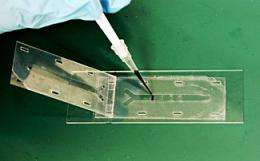
NIST researchers have combined a glass slide, plastic sheets and double-sided tape to create an inexpensive and simple-to-build microfluidic device for exposing an array of cells to different concentrations of a chemical. Credit: Cooksey/NIST

(PhysOrg.com) -- The great artist and inventor Leonardo da Vinci once said that "simplicity is the ultimate sophistication." National Institute of Standards and Technology (NIST) research engineer Javier Atencia certainly believes in the wisdom of what da Vinci preached; he has a reputation for creating novel microfluidic devices out of ordinary, inexpensive components. This time, he has combined a glass slide, plastic sheets and double-sided tape into a “diffusion-based gradient generator”—a tool to rapidly assess how changing concentrations of specific chemicals affect living cells.

Atencia’s latest innovation offers a simple and inexpensive way to expose an array of cultured cells to a chemical gradient—a solution where the chemical concentration changes gradually and predictably across the array. Such gradients are a rapid, high-throughput way to evaluate the effect on cell growth or toxicity.

This video is not supported by your browser at this time.

There are two distinct advantages to the new NIST system over traditional microfluidic cell assay devices. The first is that the gradient is created by diffusion—the gentle movement of matter from one point to another by random molecular motion. Conventional microfluidic systems usually mix fluids by pumping them in a circular motion or by twisting and folding them together. Diffusion greatly reduces the risk of cells being swept away or damaged by shearing forces in the test fluid.

The second big advantage is simplicity. The gradient generator is built in layers, with each section precisely positioned with an alignment tab. The base is a glass slide, upon which is attached a strip of double-sided tape cut to have a row of four micrometer-sized channels. Atop this goes a polystyrene strip cut to have two lines each of four tiny circular “wells” where each pair lines up with the ends of the channel below it. The next layer is another strip of double-sided tape, this time with a Y-shaped canal cut into it to serve as the flow path for the chemical gradient. Finally, a Mylar strip cut to have an identical Y-canal serves as the cover.

The hinged cover allows access to the wells for adding test cells. Once done, the cover is lowered and affixed, sealing the gradient generator. Fluid flow in and out of the system is accomplished using another Atencia innovation, magnetic connectors. Kept at constant pressure, this flow assures a steady-state stream through the device and creates a diffusion gradient in each buried channel. Cells in the channels are simultaneously exposed to a range of chemical concentrations from high to low.

To test the device, Atencia and his colleagues loaded it with cells genetically engineered to produce large amounts of green fluorescent protein (GFP) and then introduced cycloheximide (CHX), a chemical that shuts down ribosomes, the cell’s protein factories. Cells exposed to the toxin quickly stop synthesizing GFP, decreasing fluorescence by an amount directly related to the concentration of CHX.

This is exactly what the researchers observed in the gradient generator assays. The cells were exposed three times to CHX, and each time, the level of GFP fluorescence increased as the concentration of CHX in the gradient decreased, and vice versa.

In his previous microfluidics creations, Atencia turned a simple plastic dish into a “microfluidic palette” for exposing to multiple chemical concentrations in a single chamber and then merged donut-shaped magnets and plastic tubes to make a leak-free connector for getting fluids into and out of a microchannel.

More information: J. Atencia, et al. A robust diffusion-based gradient generator for dynamic cell assays. Lab on a Chip, Vol. 12, Pages 309-315 (2012). DOI: 10.1039/C1LC20829B

Journal reference: Lab on a Chip search and more info website

Provided by National Institute of Standards and Technology search and more info website

4.7 /5 (3 votes)  

Filter


Move the slider to adjust rank threshold, so that you can hide some of the comments.


Display comments: newest first

Lurker2358
Feb 08, 2012

Rank: not rated yet
When are we going to start seeing some of these new nanotech sensors and tests showing up in the medical field, instead of the same old shit that's been around for decades?
Rank 4.7 /5 (3 votes)
Relevant PhysicsForums posts

More news stories

Computer model used to pinpoint prime materials for efficient carbon capture

When power plants begin capturing their carbon emissions to reduce greenhouse gases – and to most in the electric power industry, it's a question of when, not if – it will be an expensive undertaking.

Chemistry / Materials Science

created 11 hours ago | popularity not rated yet | comments 0 | with audio podcast

Scientists develop ultra-sensitive test that detects diseases in their earliest stages

Scientists have developed an ultra-sensitive test that should enable them to detect signs of a disease in its earliest stages, in research published today in the journal Nature Materials.

Chemistry / Analytical Chemistry

created 11 hours ago | popularity not rated yet | comments 0 | with audio podcast

New CO2-removing catalyst can take the heat

(Phys.org) -- The current method of removing the greenhouse gas carbon dioxide (CO2) from the flues of coal-fired power plants uses so much energy that no one bothers to use it. So says Roger Aines, principal ...

Chemistry / Materials Science

created May 24, 2012 | popularity 5 / 5 (9) | comments 11 | with audio podcast

High-speed method to aid search for solar energy storage catalysts

Eons ago, nature solved the problem of converting solar energy to fuels by inventing the process of photosynthesis.

Chemistry / Materials Science

created May 25, 2012 | popularity 5 / 5 (3) | comments 4 | with audio podcast

Researchers demonstrate possible primitive mechanism of chemical info self-replication

(Phys.org) -- When scientists think about the replication of information in chemistry, they usually have in mind something akin to what happens in living organisms when DNA gets copied: a double-stranded molecule ...

Chemistry / Materials Science

created May 25, 2012 | popularity 5 / 5 (4) | comments 2 | with audio podcast


Stunning image of smallest possible five-ringed structure

Scientists have created and imaged the smallest possible five-ringed structure – about 100,000 times thinner than a human hair – and you'll probably recognise its shape.

'Unzipped' carbon nanotubes could help energize fuel cells, batteries

Multi-walled carbon nanotubes riddled with defects and impurities on the outside could replace some of the expensive platinum catalysts used in fuel cells and metal-air batteries, according to scientists at ...

Change in developmental timing was crucial in the evolutionary shift from dinosaurs to birds: study

At first glance, it's hard to see how a common house sparrow and a Tyrannosaurus Rex might have anything in common. After all, one is a bird that weighs less than an ounce, and the other is a dinosaur that ...

T cells 'hunt' parasites like animal predators seek prey, study shows

By pairing an intimate knowledge of immune-system function with a deep understanding of statistical physics, a cross-disciplinary team at the University of Pennsylvania has arrived at a surprising finding: T cells use a movement ...

Yale study concludes public apathy over climate change unrelated to science literacy

Are members of the public divided about climate change because they don't understand the science behind it? If Americans knew more basic science and were more proficient in technical reasoning, would public consensus match ...

Land and sea species differ in climate change response: study

(Phys.org) -- Marine and terrestrial species will likely differ in their responses to climate warming, new research by Simon Fraser University and Australia’s University of Tasmania has found.