Caught in the act: Study discovers microbes speciating
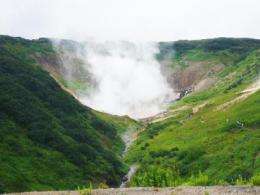
Not that long ago in a hot spring in Kamchatka, Russia, two groups of genetically indistinguishable microbes decided to part ways. They began evolving into different species – despite the fact that they still encountered one another in their acidic, boiling habitat and even exchanged some genes from time to time, researchers report. This is the first example of what the researchers call sympatric speciation in a microorganism.
The idea of sympatric speciation (one lineage diverging into two or more species with no physical or mechanical barriers keeping them apart) is controversial and tricky to prove, especially in microbes, said University of Illinois microbiology professor Rachel Whitaker, who led the study.
"One of the big questions, from Darwin on, is how do species diverge if they are living together?" she said. "That question really hasn't been answered very well, even in the macro-organisms that we've studied for hundreds of years."
Bacteria and their distantly related microbial cousins the archaea (are-KEY-uh) are even more difficult to study because they have so many ways to share genetic information, Whitaker said.
The microbes divide to conquer, producing exact or near-exact clones of themselves. If this were their only way of getting established, their genetic diversity would be quite low, the result of a few random copy errors and mutations, Whitaker said. But they also can link up with each other to pass genes back and forth, suck up random genetic elements from the environment and acquire new genes from the viruses that infect them and their neighbors.
Before scientists were able to dissect the genetic endowment of individual microbes, they had a hard time telling the bugs apart – so much so that they once confused bacteria and archaea. Researchers now know that the archaea belong to third domain of life – as different from bacteria as plants and animals are.
"Every time we look, everywhere we look we see variation in microbial populations using these molecular tools," Whitaker said. "You have to use these molecules, these DNA sequences, to tell the difference between species." But even with new sequencing technologies, the task of studying microbial evolution is daunting.
Whitaker and her colleagues focused on Sulfolobus islandicus, a heat-loving organism from the archaeal domain of life, because it is one of few microorganisms that live in distinct "island" populations created by geothermal hot springs.
"We're looking at an environment that's not very complex in microbial terms," Whitaker said. "There are not that many organisms that can handle it, and the ones that can don't successfully move around very often."
The researchers sequenced the genomes of 12 strains of S. islandicusfrom a single hot spring in the Mutnovsky Volcano region of Kamchatka. By comparing sequences at multiple sites on the microbes' single (circular) chromosome using the new software programs ClonalFrame and ClonalOrigin, the researchers were able to reconstruct the genetic history of each of the strains.
The analysis revealed two distinct groups of S. islandicusamong the 12 strains. The microbes were swapping genes with members of their own group more than expected, but sharing genes with the other group less than expected, Whitaker said. And the exchange of genetic material between the two groups was decreasing over time.
This indicates that the two groups are already separate species, even though they share the same habitat, Whitaker said. The differences between the two groups were slight, but speciation was clearly under way, she said.
Peering more closely at the patterns of change, the researchers saw a mosaic of differences along the chromosome, with vast "continents" of variation and smaller "islands" of stability. Those islands likely represent regions that are under selective pressure, Whitaker said; something in their environment is weeding out the microbes that don't have those genes or sets of genes. The variable regions are more fluid, with genes coming and going (a process called recombination) and mutations increasing diversity.
The findings provide the first evidence that sympatric speciation occurs in a microbe, Whitaker said.
"We caught them speciating," she said. "They do exchange some genes – just not very many. So now we know you don't have to have a (geographic or mechanical) barrier to recombination for speciation to occur. All you have to have is selection pulling the two groups apart, which nobody knew before."
This study provides a glimpse of the profound genetic diversity that likely occurs everywhere in wild microbial populations, Whitaker said.
"What we see as two different species are 0.35 percent different across the chromosome; that's about one-third of the distance between human and chimp," she said. The two distinct groups of microbes are "orders of magnitude" more similar to each other than groups normally considered separate species, she said.
"That means there are orders of magnitude more species of microbes than we ever thought there were," she said. "And that's kind of mind-boggling."
The study appears in the journal PLoS Biology.
More information: Cadillo-Quiroz H, Didelot X, Held NL, Herrera A, Darling A, et al. (2012) Patterns of Gene Flow Define Species of Thermophilic Archaea. PLoS Biol 10(2): e1001265. doi:10.1371/journal.pbio.1001265
Provided by University of Illinois at Urbana-Champaign


