Preventing bacteria from falling in with the wrong crowd could help stop gum disease
Feb 08, 2012
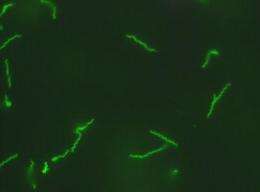
Twisting and turning spirals: cells of Treponema denticola are stained with a fluorescent dye and observed at 4,000x magnification. Credit: Caroline Bamford

Stripping some mouth bacteria of their access key to gangs of other pathogenic oral bacteria could help prevent gum disease and tooth loss. The study, published in the journal Microbiology suggests that this bacterial access key could be a drug target for people who are at high risk of developing gum disease.

Oral bacteria called Treponema denticola frequently gang up in communities with other pathogenic to produce destructive . This plaque, made up of bacteria, saliva and food debris, is a major cause of bleeding gums and . Later in life this can lead to periodontitis and loss of teeth. It is this interaction between different that is thought to be crucial to the development of periodontal disease.

Researchers from the University of Bristol have discovered that a molecule on the surface of Treponema called CTLP acts as the key pass that grants the bacterium access to the community, by allowing it to latch onto other oral bacteria. Once incorporated, CTLP in conjunction with other bacterial molecules can start to wreak havoc by inhibiting blood clotting (leading to continued bleeding of the gums) and causing .

Professor Howard Jenkinson, who led the study, said that periodontal disease and bleeding gums are common ailments, affecting many groups of people, including the elderly, pregnant women and diabetics. "Devising new means to control these infections requires deeper understanding of the microbes involved, their interactions, and how they are able to become incorporated into dental plaque," he said.

The study shows that CTLP could be a good target from which novel therapies could be developed. "CTLP gives Treponema access to other periodontal communities, allowing the bacteria to grow and survive. Inhibiting CTLP would deny Treponema access to the responsible for dental plaque, which in turn would reduce bleeding gums and slow down the onset of periodontal disease and tooth loss." The team is now working to find a compound that will inhibit CTLP. "If a drug could be developed to target this factor, it could be used in people who are at higher risk from developing gum disease," explained Professor Jenkinson.

The latest study backs up previous work in Professor Jenkinson's lab on the workings of harmful oral bacteria. "The overarching message from our latest study as well as previous work is that regular tooth brushing and maintaining a healthy mouth is vitally important to keep harmful mouth bacteria at bay," he stressed.

Explore further: X-ray tomography on a living frog embryo

Provided by Society for General Microbiology

5 /5 (1 vote)
add to favorites email to friend print save as pdf

Related Stories

'Jailbreak' bacteria can trigger heart disease

Sep 06, 2010

Plaque-causing bacteria can jailbreak from the mouth into the bloodstream and increase your risk of heart attack says a scientist at the Society for General Microbiology's autumn meeting in Nottingham.

Floss your teeth -- on the double!

Aug 06, 2008

In dental offices all over the world, patients are often told they are not flossing enough or instructed to floss more. As the old saying goes, you only need to floss the teeth you want to keep. After all, not flossing regularly ...

Periodontal diseases are blind to age

Jun 12, 2007

Two new studies in the June issue of the Journal of Periodontology (JOP) suggest that periodontal diseases are a threat to women of all ages due to hormonal fluctuations that occur at various stages of their lives.

New research aims to eliminate Streptococcus infections

Mar 06, 2008

Professor Howard Jenkinson in the Department of Oral & Dental Science (Dental School) has been awarded a grant of £285,000 from The Wellcome Trust to research ways to combat diseases caused by Streptococcus ...

Recommended for you

X-ray tomography on a living frog embryo

May 16, 2013

Classical X-ray radiographs provide information about internal, absorptive structures of organisms such as bones. Alternatively, X-rays can also image soft tissues throughout early embryonic development of ...

Novel probe for live human iPS cell imaging

May 16, 2013

Researchers from the National Institute of Advanced Industrial Science and Technology (AIST) have developed a highly sensitive lectin probe, rBC2LCN, for human induced pluripotent stem cells (iPS cells). ...

User comments : 0

More news stories

Front-row seats to climate change

By day, insects provide the white noise of the South, but the night belongs to the amphibians. In a typical year, the Southern air hangs heavy from the humidity and the sounds of wildlife.

Galaxy's Ring of Fire

Johnny Cash may have preferred this galaxy's burning ring of fire to the one he sang about falling into in his popular song. The "starburst ring" seen at center in red and yellow hues is not the product of ...

Morocco to harness the wind in energy hunt

Morocco is ploughing ahead with a programme to boost wind energy production, particularly in the southern Tarfaya region, where Africa's largest wind farm is set to open in 2014.

US psychiatry gets makeover in new manual

The latest makeover to a massive psychiatric tome honored by some, reviled by others and even called the "Bible" of mental disorders is being released Saturday with a host of new changes.