Archaeologists discover Jordan's earliest buildings
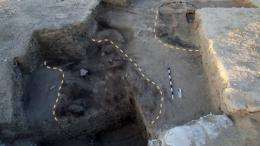
Two Early Epipalaeolithic structures. Credit: Lisa Maher
(PhysOrg.com) -- Some of the earliest evidence of prehistoric architecture has been discovered in the Jordanian desert, providing archaeologists with a new perspective on how humans lived 20,000 years ago.
Archaeologists working in eastern Jordan have announced the discovery of 20,000-year-old hut structures, the earliest yet found in the Kingdom. The finding suggests that the area was once intensively occupied and that the origins of architecture in the region date back twenty millennia, before the emergence of agriculture.
The research, published 15 February, 2012 in PLoS One by a joint British, Danish, American and Jordanian team, describes huts that hunter-gatherers used as long-term residences and suggests that many behaviours that have been associated with later cultures and communities, such as a growing attachment to a location and a far-reaching social network, existed up to 10,000 years earlier.
Excavations at the site of Kharaneh IV are providing archaeologists with a new perspective on how humans lived 20,000 years ago. Although the area is starkly dry and barren today, during the last Ice Age the deserts of Jordan were in bloom, with rivers, streams, and seasonal lakes and ponds providing a rich environment for hunter-gatherers to settle in.
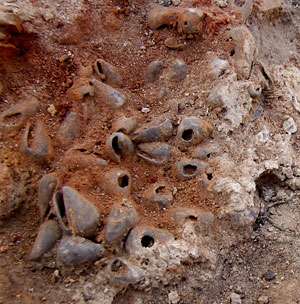
The archaeological site contains intentionally pierced sea shells from as far away as the Mediterranean and Red seas.
What we witness at the site of Kharaneh IV in the Jordanian desert is an enormous concentration of people in one place, explained Dr. Jay Stock from the Department of Archaeology and Anthropology at the University of Cambridge and co-author of the article.People lived here for considerable periods of time when these huts were built. They exchanged objects with other groups in the region and even buried their dead at the site. These activities precede the settlements associated with the emergence of agriculture, which replaced hunting and gathering later on. At Kharaneh IV we have been able to document similar behaviour a full 10,000 years before agriculture appears on the scene.
The archaeologists, who were funded by a grant from the Arts and Humanities Research Council UK, spent three seasons excavating at the large open-air site covering two hectares. They recovered hundreds of thousands of stone tools, animal bones and other finds from Kharaneh IV, which today appears as little more than a mound 3 m high rising above the desert landscape.
Based on the size and density of the site, the researchers had long suspected that Kharaneh IV was frequented by large numbers of people for long periods of time; these latest findings now confirm their theory. It may not look very impressive to the untrained eye, but it is one of the densest and largest Palaeolithic open-air sites in the region, said Dr. Lisa Maher, from the University of California, Berkeley, who spearheads the excavations.
The stone tools and animal bone vastly exceed the amounts recovered from most other sites of this time period in southwest Asia. In addition, the team also recovered rarer items, such as shell beads, bones with regularly incised lines and a fragment of limestone with geometric carved patterns.
So far, the team has fully excavated two huts; but there may be several more hidden beneath the deserts sands. Theyre not large by any means. They measure about 23 m in maximum length and were dug into the ground. The walls and roof were made of brush wood, which then burnt and collapsed leaving dark coloured marks, described Dr. Tobias Richter from the University of Copenhagen and one of the projects co-directors.
Radiocarbon dating suggests that the hut is between 19,300 and 18,600 years old. Although a team of archaeologists working at Ohalo II on the shore of the Sea of Galilee in 1989 found the regions oldest hut structures, which date from 23,000 years ago, the team working at the Kharaneh IV site believe their discovery is no less significant, as Dr. Maher explained:
Inside the huts, we found intentionally burnt piles of gazelle horn cores, clumps of red ochre pigment and a cache of hundreds of pierced marine shells. These shell beads were brought to the site from the Mediterranean and Red Sea over 250 km away, showing that people were very well linked to regional social networks and exchanged items across considerable distances.
Provided by
University of Cambridge
-
From lemons to lemonade: Reaction uses carbon dioxide to make carbon-based semiconductor,
32 comments
-
Thioridazine kills cancer stem cells in human while avoiding toxic side-effects of conventional cancer treatments,
3 comments
-
SpaceX private rocket blasts off for space station (Update),
42 comments
-
Climate scientists say they have solved riddle of rising sea,
31 comments
-
Landmark calculation clears the way to answering how matter is formed,
55 comments
-
osmotic pressure vs diffusion
3 hours ago
-
What would stain as translucent on light-coloured fabric?
May 26, 2012
-
How do I identify different bacteria on culture plates?
May 26, 2012
-
Why Do Dogs do Strange things...
May 25, 2012
-
What does exophillic and endophillic mean in terms of mosquito and their control?
May 24, 2012
-
Semen stains glows under black lights (uv light)?
May 23, 2012
- More from Physics Forums - Biology
More news stories
Change in developmental timing was crucial in the evolutionary shift from dinosaurs to birds: study
At first glance, it's hard to see how a common house sparrow and a Tyrannosaurus Rex might have anything in common. After all, one is a bird that weighs less than an ounce, and the other is a dinosaur that ...
Other Sciences / Archaeology & Fossils
11 hours ago |
5 / 5 (8) |
0
|
Social welfare cuts ultimately come with heavy price, researchers say
(Phys.org) -- Slashing government funding for Medicaid, food stamps and other programs that serve the poor while politically popular with some lawmakers and many conservatives may do more harm ...
Other Sciences / Social Sciences
May 24, 2012 |
4.1 / 5 (23) |
156
Ancient Bethlehem seal unearthed in Jerusalem
Israeli archaeologists have discovered a 2,700-year-old seal that bears the inscription "Bethlehem," the Israel Antiquities Authority announced Wednesday, in what experts believe to be the oldest artifact ...
Other Sciences / Archaeology & Fossils
May 23, 2012 |
3.3 / 5 (15) |
24
Dollars and sense: Why are some people morally against tax?
As the U.S. presidential election campaigns heat up, the economic debate is dominated by bailouts, austerity and, inevitably, taxation. Now a new study published in Symbolic Interaction asks why tax is such an important issue ...
Other Sciences / Social Sciences
May 23, 2012 |
2.3 / 5 (3) |
20
Oldest Jewish archaeological evidence on the Iberian Peninsula
German archaeologists of the Friedrich Schiller University Jena found one of the oldest archaeological evidence so far of Jewish Culture on the Iberian Peninsula at an excavation site in the south of Portugal, ...
Other Sciences / Archaeology & Fossils
May 25, 2012 |
4.2 / 5 (6) |
12
'Unzipped' carbon nanotubes could help energize fuel cells, batteries
Multi-walled carbon nanotubes riddled with defects and impurities on the outside could replace some of the expensive platinum catalysts used in fuel cells and metal-air batteries, according to scientists at ...
Computer model used to pinpoint prime materials for efficient carbon capture
When power plants begin capturing their carbon emissions to reduce greenhouse gases and to most in the electric power industry, it's a question of when, not if it will be an expensive undertaking.
T cells 'hunt' parasites like animal predators seek prey, study shows
By pairing an intimate knowledge of immune-system function with a deep understanding of statistical physics, a cross-disciplinary team at the University of Pennsylvania has arrived at a surprising finding: T cells use a movement ...
Yale study concludes public apathy over climate change unrelated to science literacy
Are members of the public divided about climate change because they don't understand the science behind it? If Americans knew more basic science and were more proficient in technical reasoning, would public consensus match ...
Land and sea species differ in climate change response: study
(Phys.org) -- Marine and terrestrial species will likely differ in their responses to climate warming, new research by Simon Fraser University and Australia’s University of Tasmania has found.
Stunning image of smallest possible five-ringed structure
Scientists have created and imaged the smallest possible five-ringed structure about 100,000 times thinner than a human hair and you'll probably recognise its shape.
Feb 20, 2012
Rank: not rated yet
Feb 20, 2012
Rank: not rated yet
You really think "cultures" exist for that long?
this is so long in the past that it predates even the alleged civilization of the legend of atlantis by another 10,000 years.