Apps for day-to-day work
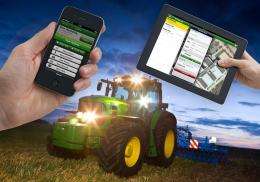
Games, e-mails and around-the-clock Internet access – smartphones are making the information culture an even more prominent part of everyday life. Businesses and employers are also increasingly relying on mobile companions with apps developed expressly for the task at hand. In the future, for instance, apps will help farmers in organizing harvest their crops or provide support for business travelers. Researchers will be presenting the new apps at CeBIT 2012 (March 6-10).
When it’s time to sow the seeds in the field, or if asparagus and wheat are ready to be harvested, farmers and agricultural subcontractors exhibit manager qualities: They coordinate numerous workers and machines, keep machinery working to capacity and see to it that everything is running smoothly. The workers usually keep their instructions written down on sheets of paper – depending on the size of the operation, a helper may be working in up to ten fields a day. If there is a sudden change of plan, the farmer calls the workers on their cellphones.
In the future, smartphones will become more and more popular in the field, making work easier for farmers and agricultural subcontractors alike: They will enter their work instructions on their computer or mobile tablet, and the harvest assistants will receive these updates on an app especially designed for the purpose on their smartphones. The benefits: The instructions can be adjusted to the situation at hand at any time. Employees can also use the app to document their work better than before, showing with just a few “touches,” for instance, when they began working on which tasks in which fields, and indicating where and why there were any delays.
Researchers at the Fraunhofer Institute for Experimental Software Engineering IESE in Kaiserslautern have developed the app in a project with their strategic partner John Deere. “First we analyzed workflows in the field,” notes Ralf Carbon, head of “Business goes mobile” research at IESE. How large are the fields tended, how much time do the workers need, and which seed and pest control do they use? What technological services does harvesting machinery provide? Where can mobile devices be put to good use?
The main challenge for researchers was to make the app as user-friendly as possible.
“To do this, we involved end users in the process at an early stage – farmers, agricultural subcontractors and workers. They tested the app at various times; this helped us tailor it to their requirements,” Carbon explains. At CeBIT researchers will be demonstrating the prototype of the app – as just one example of how they can help businesses develop apps to suit their needs.
Another newly developed app that the researchers are presenting at CeBIT is designed to simplify the management and recording of business travel expenses. Until now, either the traveler has had to have a good memory, noting when and where he arrived and departed, and how many hours were spent working during the trip, or else these key data had to be written down manually. In the future, this will be easier: When the traveler arrives at the place of employment, all it takes is a “touch” of the app and the smartphone stores the date, time and location – while assigning the data to the right business trip. It will even be possible to do this automatically: The app knows the business-travel destination through the travel authorization. Once the traveler arrives there, the smartphone notes this via GPS and makes a suggestion the user simply has to confi rm. Particularly for longer assignments, given that assigning receipts from public transportation or taxis to the right trip can often be a laborious process. But if the user simply takes a snapshot of the receipts, the app automatically assigns the photos, making the trip easier to process.
This will make foreign business travel easier, too: If a traveler has to make a note of when he or she passed through customs in the US, say, the smartphone uses the new app to log when the smartphone was turned back on – meaning the arrival time – and stores this information.
Provided by Fraunhofer-Gesellschaft


