Americans overestimate political polarization, according to new research
February 7, 2012 By Leaf Van Boven

Americans overestimate political polarization, according to new CU-Boulder research

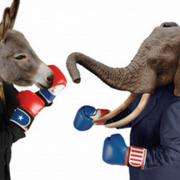
The misperception of American political polarization

(PhysOrg.com) -- Many Americans overestimate the degree of polarization between Democrats and Republicans, and this misconception is associated with citizens’ voting behavior and their involvement in political activities, according to new findings from the University of Colorado Boulder.

“It is clear that Americans see themselves as very sharply polarized,” said Professor Leaf Van Boven, who led the research efforts. “And that the extent of perceived polarization dramatically overstates the actual degree of polarization.”

Van Boven of CU-Boulder’s psychology and neuroscience department and Professor John Chambers of the University of Florida presented findings of two studies on political polarization last month at the annual meeting of the Society for Personality and Social Psychology in San Diego.

In one study, which included a nationally representative sample of 1,000 voting age respondents during the 2008 presidential campaign, Van Boven and his colleagues found that individuals with more extreme partisan attitudes perceived greater polarization than those with less extreme partisan attitudes. For example, in the 2008 presidential election, people who strongly supported either Obama or McCain perceived Americans as more divided than did those whose support of either candidate was more moderate.

In another study, which included an analysis using a subset of 26,000 respondents from three decades of surveys of Americans, the researchers determined that the average gap between Republicans and Democrats on five-point scales regarding different issues such as the death penalty and abortion was approximately three-quarters of a point. However, people believed there was a scale difference of two points or more between the two parties.

“The more strongly people feel about an issue, the more divided they see other Americans,” Van Boven said.

The data also suggest that the people who perceive the most division among Americans are also the most likely to vote in elections.

“It seems that the people who see the most polarization are also more likely to engage in various kinds of political activities, including joining campaigns, persuading other people and contributing to PACs,” Van Boven said. He expects that both major political parties may try to benefit from the perceived polarization of voters during the current presidential election year.

“If I were a strategist and I saw that maybe I could get a 5 percent increase in turnout on my side by increasing people’s perceptions of polarization, I know exactly what I would do,” he said. “I would push toward increased perceptions of polarization.

“There certainly is a sound scientific basis for the strategy of making the other side seem very strong, very extreme and very active,” he said. “If I think the other side is really fired up and they are going to turn out the vote, that becomes a threat to me. So that might motivate me to vote.”

CU-Boulder Professor Charles Judd of the psychology and neuroscience department and Professor David Sherman of the University of California, Santa Barbara, were co-authors with Van Boven on the paper titled “False polarization of the American electorate.” Van Boven, CU-Boulder doctoral candidate Jacob Westfall and Professor John Chambers of the University of Florida co-authored the other paper titled “Political polarization projection.”

Provided by University of Colorado at Boulder search and more info website

Filter


Move the slider to adjust rank threshold, so that you can hide some of the comments.


Display comments: newest first

AWaB
Feb 07, 2012

Rank: not rated yet
I think they're completely correct. There haven't been many people that I've ever met that I couldn't come to some sort of compromise with for almost any topic.

The 24 hour news channels haven't helped this problem, either!
Doug_Huffman
Feb 08, 2012

Rank: not rated yet
There haven't been many people that I've ever met that I couldn't come to some sort of compromise with for almost any topic.
Compromise is failure on the installment plan, especially with an intractable opponent like ignorance - the most powerful force in the universe (of discourse).
Rank 5 /5 (3 votes)
Relevant PhysicsForums posts

More news stories

Change in developmental timing was crucial in the evolutionary shift from dinosaurs to birds: study

At first glance, it's hard to see how a common house sparrow and a Tyrannosaurus Rex might have anything in common. After all, one is a bird that weighs less than an ounce, and the other is a dinosaur that ...

Other Sciences / Archaeology & Fossils

created 11 hours ago | popularity 5 / 5 (8) | comments 0 | with audio podcast

Social welfare cuts ultimately come with heavy price, researchers say

(Phys.org) -- Slashing government funding for Medicaid, food stamps and other programs that serve the poor – while politically popular with some lawmakers and many conservatives – may do more harm ...

Other Sciences / Social Sciences

created May 24, 2012 | popularity 4.1 / 5 (23) | comments 156

Ancient Bethlehem seal unearthed in Jerusalem

Israeli archaeologists have discovered a 2,700-year-old seal that bears the inscription "Bethlehem," the Israel Antiquities Authority announced Wednesday, in what experts believe to be the oldest artifact ...

Other Sciences / Archaeology & Fossils

created May 23, 2012 | popularity 3.3 / 5 (15) | comments 24

Dollars and sense: Why are some people morally against tax?

As the U.S. presidential election campaigns heat up, the economic debate is dominated by bailouts, austerity and, inevitably, taxation. Now a new study published in Symbolic Interaction asks why tax is such an important issue ...

Other Sciences / Social Sciences

created May 23, 2012 | popularity 2.3 / 5 (3) | comments 20

Oldest Jewish archaeological evidence on the Iberian Peninsula

German archaeologists of the Friedrich Schiller University Jena found one of the oldest archaeological evidence so far of Jewish Culture on the Iberian Peninsula at an excavation site in the south of Portugal, ...

Other Sciences / Archaeology & Fossils

created May 25, 2012 | popularity 4.2 / 5 (6) | comments 12


'Unzipped' carbon nanotubes could help energize fuel cells, batteries

Multi-walled carbon nanotubes riddled with defects and impurities on the outside could replace some of the expensive platinum catalysts used in fuel cells and metal-air batteries, according to scientists at ...

Computer model used to pinpoint prime materials for efficient carbon capture

When power plants begin capturing their carbon emissions to reduce greenhouse gases – and to most in the electric power industry, it's a question of when, not if – it will be an expensive undertaking.

T cells 'hunt' parasites like animal predators seek prey, study shows

By pairing an intimate knowledge of immune-system function with a deep understanding of statistical physics, a cross-disciplinary team at the University of Pennsylvania has arrived at a surprising finding: T cells use a movement ...

Yale study concludes public apathy over climate change unrelated to science literacy

Are members of the public divided about climate change because they don't understand the science behind it? If Americans knew more basic science and were more proficient in technical reasoning, would public consensus match ...

Land and sea species differ in climate change response: study

(Phys.org) -- Marine and terrestrial species will likely differ in their responses to climate warming, new research by Simon Fraser University and Australia’s University of Tasmania has found.

Stunning image of smallest possible five-ringed structure

Scientists have created and imaged the smallest possible five-ringed structure – about 100,000 times thinner than a human hair – and you'll probably recognise its shape.