World's most extreme deep-sea vents revealed
January 10, 2012

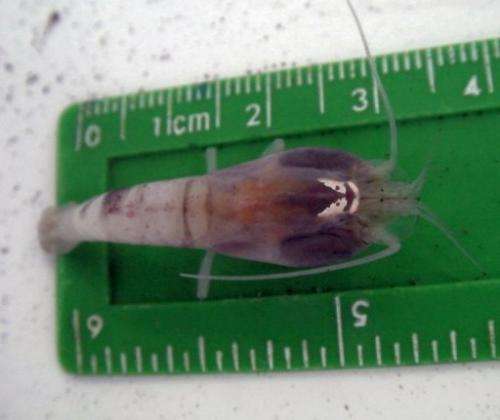
A newly discovered species of shrimp - Rimicaris hybisae, which lives in the world's deepest known vent

Enlarge

A National Oceanography Centre photo of Rimicaris hybisae, the world's deepest known sea vent shrimp. Situated at a depth of 5kms, in the oceanic pit of the Caymans, and with temperatres in excess of 450°C, the deepest submarine geysers in the world swarm with thousands of shrimps of a species unknown until now, a study released on January 10, 2012 reports.

Scientists have revealed details of the world's most extreme deep-sea volcanic vents, 5 kilometres down in a rift in the Caribbean seafloor.

The undersea , which lie 0.8 kilometres deeper than any seen before, may be hotter than 450 °C and are shooting a jet of mineral-laden water more than a kilometre into the ocean above.

Despite these extreme conditions, the vents are teeming with thousands of a new species of shrimp that has a light-sensing organ on its back. And having found yet more 'black smoker' vents on an undersea mountain nearby, the researchers suggest that deep-sea vents may be more widespread around the world than anyone thought.

Reporting in the scientific journal Nature Communications this week, a team led by marine geochemist Dr Doug Connelly at the National Oceanography Centre in Southampton and marine biologist Dr Jon Copley of the University of Southampton has revealed details of the world's deepest known 'black smoker' vents, so-called for the smoky-looking hot fluids that gush from them.

During an expedition in April 2010 aboard the Royal Research Ship James Cook, the used the National Oceanography Centre's robot submarine called Autosub6000 and a deep-diving vehicle, HyBIS, manufactured by the British firm, Hydro-Lek to locate and study the vents at a depth of five kilometres in the Cayman Trough, an undersea trench south of the Cayman Islands.

The vents, which the team named the Beebe after the first scientist to venture into the deep ocean, are gushing hot fluids that are unusually rich in copper, and shooting a jet of mineral-laden water four times higher into the ocean above than other deep-sea vents. Although the scientists were not able to measure the temperature of the vents directly, these two features indicate that the world's deepest known vents may be hotter than 450 ºC, according to the researchers. "These vents may be one of the few places on the planet where we can study reactions between rocks and 'supercritical' fluids at extreme temperatures and pressures," says Connelly.

The team found a new species of pale shrimp congregating in hordes (up to 2,000 shrimp per m2) around the six-metre tall mineral spires of the vents. Lacking normal eyes, the shrimp instead have a light-sensing organ on their backs, which may help them to navigate in the faint glow of deep-sea vents. The researchers have named the shrimp Rimicaris hybisae, after the deep-sea vehicle that they used to collect them.

The Cayman shrimp is related to a species called Rimicaris exoculata, found at other deep-sea vents 4,000 kilometres away on the Mid-Atlantic Ridge. Elsewhere at the Beebe Vent Field, the team saw hundreds of white-tentacled anemones lining cracks where warm water seeps from the sea bed. "Studying the creatures at these vents, and comparing them with species at other vents around the world; will help us to understand how animals disperse and evolve in the deep ocean," says Copley.

The researchers also found black smoker vents on the upper slopes of an undersea mountain called Mount Dent. Mount Dent rises nearly three kilometres above the of the Cayman Trough, but its peak is still more than three kilometres beneath the waves. The mountain formed when a vast slab of rock was twisted up out of the ocean floor by the forces that pull the plates of the Earth's crust apart.

"Finding black smoker vents on Mount Dent was a complete surprise," says Connelly. "Hot and acidic vents have never been seen in an area like this before, and usually we don't even look for vents in places like this." Because undersea mountains like Mount Dent may be quite common in the oceans, the discovery suggests that deep-sea vents might be more widespread around the world than previously thought.

The vents on Mount Dent, which the team has named the Von Damm Vent Field to commemorate the life of geochemist Karen Von Damm, are also thronged with the new species of shrimp, along with snake-like fish, and previously unseen species of snail and a flea-like crustacean called an amphipod. "One of the big mysteries of deep-sea vents is how animals are able to disperse from vent field to vent field, crossing the apparently large distances between them," says Copley. "But maybe there are more 'stepping stones' like these out there than we realised."

The UK expedition that revealed the vents followed a US expedition in November 2009, which detected the plumes of water from deep-sea vents in the Cayman Trough. A second US expedition is currently using a deep-diving remotely operated vehicle to investigate the further and the UK team also plans to return to the Cayman Trough in 2013 with Isis, the National Oceanography Centre's deep-diving remotely operated vehicle, which can work at depths of up to six kilometres.

Provided by National Oceanography Centre, Southampton

4.9 /5 (8 votes)  

Filter


Move the slider to adjust rank threshold, so that you can hide some of the comments.


Display comments: newest first

Shootist
Jan 10, 2012

Rank: 1.5 / 5 (19)
The undersea hot springs, which lie 0.8 kilometres deeper than any seen before, may be hotter than 450 °C and are shooting a jet of mineral-laden water more than a kilometre into the ocean above.


This is great, 450 degree water (think of the warming), laden with heavy metals (oooh PBOH2). Oh! The poor fishes, and algae and all the other wee burnt and poisoned beasties!

And this better, or at least not as bad as, the BP oil spill, HOW? Consider, as your bleating heart quakes at the comparison, black smokers have been around a geologic age, while oil spill are over in a comparative instant.
gurloc
Jan 10, 2012

Rank: 4.5 / 5 (8)
You're kidding right?

The creatures there are evolved to live in those conditions (and of course nothing lives in the 450C water stream). The problem with the BP oil spill is the same as the problem with global warming. Its a rapid change. Technically neither event is really a problem, unless of course you want the life that is living there now to actually stay alive...
ryggesogn2
Jan 10, 2012

Rank: 1.3 / 5 (12)
Oil continuously seeps out off the coast of CA.
Its a rapid change.

Adapt or die. That is nature's way.

What is the total heat output into the oceans from the smokers? No one knows as more are found everyday it seems.
Xbw
Jan 10, 2012

Rank: 1.3 / 5 (13)
Oil continuously seeps out off the coast of CA.
Its a rapid change.

Adapt or die. That is nature's way.

What is the total heat output into the oceans from the smokers? No one knows as more are found everyday it seems.


Correct. I am from the coast of which you speak. The local government frequently attempts to plug these holes/leaks to save the local wildlife. What happened to not getting in the way of nature's natural process? Bleeding heart morons run this state.
antialias_physorg
Jan 10, 2012

Rank: 4.3 / 5 (11)
What happened to not getting in the way of nature's natural process? Bleeding heart morons run this state.

Yeah...Why do they even bother to check your drinking water or food for safety. Adapt or die.

(/sarcasm)
MarkyMark
Jan 12, 2012

Rank: 5 / 5 (6)
Xbw is a new breed of Primate that has evolved to subsist on things like Fox 'News' and other *^ # sources of information creating the very first Brainless hive mind lifeform known as the Tea Party Cult!
Rank 4.9 /5 (8 votes)
Relevant PhysicsForums posts

More news stories

Land and sea species differ in climate change response: study

(Phys.org) -- Marine and terrestrial species will likely differ in their responses to climate warming, new research by Simon Fraser University and Australia’s University of Tasmania has found.

Space & Earth / Environment

created 4 hours ago | popularity 3.7 / 5 (3) | comments 5 | with audio podcast

Yale study concludes public apathy over climate change unrelated to science literacy

Are members of the public divided about climate change because they don't understand the science behind it? If Americans knew more basic science and were more proficient in technical reasoning, would public consensus match ...

Space & Earth / Environment

created 6 hours ago | popularity 4.8 / 5 (4) | comments 11 | with audio podcast

10 million years needed to recover from mass extinction

It took some 10 million years for Earth to recover from the greatest mass extinction of all time, latest research has revealed.

Space & Earth / Earth Sciences

created 6 hours ago | popularity 5 / 5 (3) | comments 1 | with audio podcast

Sophisticated simulations predict future warming

The chances of our planet being hit by a global warming of 3 degrees Celsius by 2050 is as likely as it being hit by an increase of 1.4 degrees, new research shows. Presented in the journal Nature Geoscience, the British study ...

Space & Earth / Earth Sciences

created May 22, 2012 | popularity 4.4 / 5 (9) | comments 51

Aliens don't want to eat us, says former SETI director

Alien life probably isn’t interested in having us for dinner, enslaving us or laying eggs in our bellies, according to a recent statement by former SETI director Jill Tarter.

Space & Earth / Space Exploration

created May 25, 2012 | popularity 4.4 / 5 (14) | comments 41


Stunning image of smallest possible five-ringed structure

Scientists have created and imaged the smallest possible five-ringed structure – about 100,000 times thinner than a human hair – and you'll probably recognise its shape.

'Unzipped' carbon nanotubes could help energize fuel cells, batteries

Multi-walled carbon nanotubes riddled with defects and impurities on the outside could replace some of the expensive platinum catalysts used in fuel cells and metal-air batteries, according to scientists at ...

Change in developmental timing was crucial in the evolutionary shift from dinosaurs to birds: study

At first glance, it's hard to see how a common house sparrow and a Tyrannosaurus Rex might have anything in common. After all, one is a bird that weighs less than an ounce, and the other is a dinosaur that ...

Computer model used to pinpoint prime materials for efficient carbon capture

When power plants begin capturing their carbon emissions to reduce greenhouse gases – and to most in the electric power industry, it's a question of when, not if – it will be an expensive undertaking.

T cells 'hunt' parasites like animal predators seek prey, study shows

By pairing an intimate knowledge of immune-system function with a deep understanding of statistical physics, a cross-disciplinary team at the University of Pennsylvania has arrived at a surprising finding: T cells use a movement ...

Scientists develop ultra-sensitive test that detects diseases in their earliest stages

Scientists have developed an ultra-sensitive test that should enable them to detect signs of a disease in its earliest stages, in research published today in the journal Nature Materials.