Uncertainty grows over Russia Mars probe crash site
January 13, 2012 by Dmitry Zaks

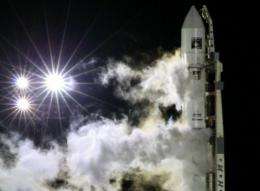
A rocket carrying the Phobos-Grunt spacecraft at Kazakhstan's Baikonur cosmodrome in November

A Zenit-2SB rocket carrying the Phobos-Grunt spacecraft stands at a launch pad of the Russian leased Kazakhstan's Baikonur cosmodrome just before its blasted off toward Mars in November 2011. Uncertainty over the location of the impending crash of Russia's failed Mars probe grew Friday, with an official saying it may end up in the Atlantic and not Pacific Ocean as suggested.

Uncertainty about where a doomed Russian Mars probe might crash back to Earth grew Friday when the Roscosmos space agency changed its prediction thousands of miles (kilometres) from the Pacific to the Atlantic Ocean.

Roscosmos said the 13.5-tonne Phobos-Grunt probe would probably begin its fatal descent on Sunday evening Moscow time rather than in the afternoon as initially thought.

This meant that "Phobos-Grunt will enter the atmosphere over Argentina and have its fragments splash down in the Atlantic Ocean," an unnamed space official told the Interfax news agency.

The latest estimate on a Roscosmos graphic showed the $165-million craft splashing down at 8:22 pm (1622 GMT) about 1,000 miles (1,600 kilometres) due south of Buenos Aires -- a spot within geographic proximity of the .

The previous Roscosmos map released on Thursday had shown fragments of the ill-fated craft coming down between the northwestern shores of Madagascar and the east coast of Africa.

"The change in the time and location of the landing ... is based on the diminishing altitude of the vessel's orbit, solar activity and atmospheric conditions," Roscosmos said.

The unmanned vessel -- stuck in orbit since its November 9 launch -- will be one of the largest objects to re-enter the atmosphere since Russia brought down the Soviet-era Mir space station in 2001.

It is loaded with enough toxic fuel to take it to the mysterious Mars moon and is weighed down further by a Chinese satellite it had been due to put in orbit around the Red Planet under a landmark deal with Beijing.

Both Roscosmos and US space officials at NASA have made great efforts to downplay the dangers posed by the crashing probe.

The Russian side predicts that only 20 or 30 segments weighing no more than 200 kilogrammes (440 pounds) combined will survive the fiery re-entry and actually hit the Earth's surface.

The chief NASA scientist on orbital space debris meanwhile dismissed the threat posed by the craft's toxic fuel.

Nicholas Johnson said the Russian craft's fuel tanks are made of aluminium rather than the much tougher titanium metal preferred by US space officials.

"According to Mr. Johnson, aluminium has a lower melting point than titanium and that significantly reduces the chances of the propellant reaching the surface of the Earth," NASA reported on its website.

But Russia's past inability to locate its own vessels and subsequent admission that it will not be able to steer Phobos-Grunt upon its return has raised some concern about how the descent might unfold.

The complex Roscosmos diagram shows the craft potentially crashing at any point on Earth south of London and north of the southernmost tip of New Zealand.

said it will be keeping both the United Nations "and interested countries on whose territory the Phobos-Grunt probe's fragments might fall" informed with regular updates.

The ambitious project had initially aimed to revive Russia's interplanetary programme and prepare the way for a manned mission to Mars.

But it instantly came to represent one of the more high-profile mishaps in a year littered with unprecedented setbacks in the Russian space programme.

The November accident struck less than three months after an unmanned Progress supply ship bound for the International Station crashed into Siberia.

Russia also lost three navigation satellites as well as an advanced military satellite and a telecommunications satellite in the past year.

(c) 2012 AFP

Filter


Move the slider to adjust rank threshold, so that you can hide some of the comments.


Display comments: newest first

Doug_Huffman
Jan 13, 2012

Rank: 2.1 / 5 (10)
The headline, "Uncertainty grows over Russia Mars probe crash site," is absolutely not true, but for being the work product of a headline-editor, a lie.

While the instant was completely unknown, then the whole surface of the earth beneath the inclination is at risk. As the instant time narrows then so does the location.
Isaacsname
Jan 13, 2012

Rank: 3 / 5 (4)
"According to Mr. Johnson, aluminum has a lower melting point than titanium and that significantly reduces the chances of the propellant reaching the surface of the Earth,"

...Wait, ...what ? ...wouldn't that make it prone to melting faster ?
Deathclock
Jan 13, 2012

Rank: 5 / 5 (8)
"According to Mr. Johnson, aluminum has a lower melting point than titanium and that significantly reduces the chances of the propellant reaching the surface of the Earth,"

...Wait, ...what ? ...wouldn't that make it prone to melting faster ?


Yes, that's the point. The fuel containment vessel will melt on reentry and burn up all the toxic fuel, meaning it won't reach the ground.
Telekinetic
Jan 13, 2012

Rank: 4 / 5 (1)
In the future, I can foresee space tow trucks on call for circumstances such as this, and still $50 for the initial hookup and $2 for subsequent miles.
Doug_Huffman
Jan 13, 2012

Rank: 1.6 / 5 (7)
@TeleK, WooHoo, you've never worked for or called for TowBoat US! That's a better analogy though still distant. You are paying them to surrender their salvage rights, otherwise they own your boat when you accept their tow line. A recreational boater on the ocean can owe thousands of dollars for running out of fuel or going aground.
Modernmystic
Jan 14, 2012

Rank: 1.6 / 5 (7)
Yet we've spent 1.5 trillion dollars in deficit AND we're hitching rides from these people into LEO for the foreseeable future...brilliant...
Vendicar_Decarian
Jan 15, 2012

Rank: not rated yet
Current best estimate.

15 JAN 2012 - 22:16 UTC (plus/minus) 9 hours

http://reentrynew...65a.html
Vendicar_Decarian
Jan 15, 2012

Rank: 0.2 / 5 (24)
"Yet we've spent 1.5 trillion dollars in deficit" - Modernmystic

What?

You have spend 15.3 Trillion dollars in deficits.

Rank 4 /5 (4 votes)
Relevant PhysicsForums posts
  • Distance of planets from stars and revolution
    created6 hours ago
  • revamping general concept and cosmological principle
    createdMay 25, 2012
  • Transiting Exoplanet Light Curve
    createdMay 25, 2012
  • Math behind Theoretical Physics
    createdMay 24, 2012
  • Do we know whats at the center of galaxies yet?
    createdMay 23, 2012
  • Structure of the Milky Way?
    createdMay 20, 2012
  • More from Physics Forums - General Astronomy

More news stories

Land and sea species differ in climate change response: study

(Phys.org) -- Marine and terrestrial species will likely differ in their responses to climate warming, new research by Simon Fraser University and Australia’s University of Tasmania has found.

Space & Earth / Environment

created 4 hours ago | popularity 3.7 / 5 (3) | comments 5 | with audio podcast

Yale study concludes public apathy over climate change unrelated to science literacy

Are members of the public divided about climate change because they don't understand the science behind it? If Americans knew more basic science and were more proficient in technical reasoning, would public consensus match ...

Space & Earth / Environment

created 6 hours ago | popularity 4.8 / 5 (4) | comments 11 | with audio podcast

10 million years needed to recover from mass extinction

It took some 10 million years for Earth to recover from the greatest mass extinction of all time, latest research has revealed.

Space & Earth / Earth Sciences

created 6 hours ago | popularity 5 / 5 (3) | comments 1 | with audio podcast

Sophisticated simulations predict future warming

The chances of our planet being hit by a global warming of 3 degrees Celsius by 2050 is as likely as it being hit by an increase of 1.4 degrees, new research shows. Presented in the journal Nature Geoscience, the British study ...

Space & Earth / Earth Sciences

created May 22, 2012 | popularity 4.4 / 5 (9) | comments 51

Aliens don't want to eat us, says former SETI director

Alien life probably isn’t interested in having us for dinner, enslaving us or laying eggs in our bellies, according to a recent statement by former SETI director Jill Tarter.

Space & Earth / Space Exploration

created May 25, 2012 | popularity 4.4 / 5 (14) | comments 41


Stunning image of smallest possible five-ringed structure

Scientists have created and imaged the smallest possible five-ringed structure – about 100,000 times thinner than a human hair – and you'll probably recognise its shape.

'Unzipped' carbon nanotubes could help energize fuel cells, batteries

Multi-walled carbon nanotubes riddled with defects and impurities on the outside could replace some of the expensive platinum catalysts used in fuel cells and metal-air batteries, according to scientists at ...

Change in developmental timing was crucial in the evolutionary shift from dinosaurs to birds: study

At first glance, it's hard to see how a common house sparrow and a Tyrannosaurus Rex might have anything in common. After all, one is a bird that weighs less than an ounce, and the other is a dinosaur that ...

Computer model used to pinpoint prime materials for efficient carbon capture

When power plants begin capturing their carbon emissions to reduce greenhouse gases – and to most in the electric power industry, it's a question of when, not if – it will be an expensive undertaking.

T cells 'hunt' parasites like animal predators seek prey, study shows

By pairing an intimate knowledge of immune-system function with a deep understanding of statistical physics, a cross-disciplinary team at the University of Pennsylvania has arrived at a surprising finding: T cells use a movement ...

Scientists develop ultra-sensitive test that detects diseases in their earliest stages

Scientists have developed an ultra-sensitive test that should enable them to detect signs of a disease in its earliest stages, in research published today in the journal Nature Materials.