Ultrafast magnetic processes observed 'live' using X-ray laser
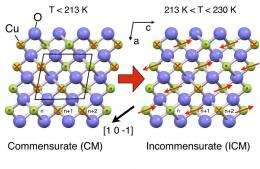
Detail of the structure of cupric oxide (CuO). The copper atoms (green) carry a magnetic moment, behaving like small compass needles. The direction of the magnetic moment is illustrated by a red arrow. A point means that the arrow is pointing out of the surface (we are looking at its sharp end), a cross shows that the arrow is pointing into the surface (we are looking at its tail end). The magnetic structure changes significantly as the temperature increases above 213 Kelvin (around -60°C). One aspect of this change is a difference in the period of the magnetic order. Unlike the ordering at low temperatures, the magnetic structure in the temperature range 213 K to 230 K is incommensurate: its period does not ‘fit’ with the period of the crystal structure of copper and oxygen atoms. To be precise, a full rotation of the direction of the magnetic moment does not require exactly four atomic separations, but a little more or a little less, depending on the direction.
In first-of-their-kind experiments performed at the American X-ray laser LCLS, a collaboration led by researchers from the Paul Scherrer Institute has been able to precisely follow how the magnetic structure of a material changes. The study was carried out on cupric oxide (CuO). The change of structure was initiated by a laser pulse, and then, with the help of short X-ray pulses, near-instantaneous images were obtained at different points in time for individual intermediate steps during the process. It appears as if the structure begins to change 400 femtoseconds after the laser pulse strikes.
Apparently, the fundamental magnets within the material need that much time to communicate with each other and then react. In addition to this scientific result, the work proves that it is actually possible with X-ray lasers to follow certain types of extremely rapid magnetic processes. This is another milestone, because such investigations will also be a major focus of research at the planned Swiss X-ray Laser, SwissFEL, at PSI. The results could contribute to the development of new technologies for magnetic storage media for the future. The researchers have reported on their work in the latest edition of Physical Review Letters.
Materials with particular magnetic properties are the basis of many current technologies, in particular, data storage on hard discs and in other media. For this, the magnetic orientation in the material is most often used: the atoms in the material behave to some extent like tiny rod magnets (spins). These mini-magnets can be oriented in different ways and information can be stored through their orientation. For efficient data storage, it is crucial that old data can be rapidly overwritten. This is possible if the magnetic orientation in a material can be altered in a very short time. To develop innovative materials which can store data quickly, it is therefore important to understand exactly how this change occurs as a function of time.
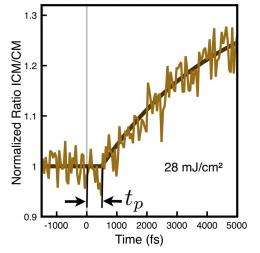
Change in the magnetic structure of CuO with time - at the initial value 1, significantly more of the low-temperature structure (CM) is present; as the value rises, so does the proportion of the second structure (ICM). The brown curve shows the actual measured values, the black one is a fit to a model of the magnetic order change. The zero of time indicates when the laser pulse hits the sample. The transition to the new structure starts 400 femtoseconds later (t_p).
In experiments performed at the X-ray laser LCLS at Stanford, California, a collaboration led by researchers from the Paul Scherrer Institute have been able to study the magnetic orientation in cupric oxide, CuO. This material demonstrates completely different magnetic orientations depending on temperature: Below -60°C, the spins, which function in the copper atoms (Cu) like magnets, point periodically in one direction and then the opposite; between -60°C and -43°C, they are arranged helically, as if they were forming a spiral staircase. Although the spin orientations for the two arrangements have been known for some time, the time required to move from one arrangement to the other has only now been shown by the experiment.
In our investigation, we began with a cold sample and then heated it with an intense flash of light from an optical laser, explains Steven Johnson, spokesman for the PSI experiment. Shortly after this, we determined the structure of the sample by illuminating it with an extremely short pulse from an X-ray laser. When we repeated this at different time intervals between the flash of light and the X-ray pulse, we were able to reconstruct the course of the change in the magnetic structure.
The results show that it takes about 400 femtoseconds before the magnetic structure begins to alter visibly. Then the structure gradually reaches its final state. The more intense the initiating flash of light, the faster the change of state. The spins of all copper atoms are involved in the magnetic structure. Thus the atoms at opposite ends of the material must be coordinated before the structure can change. This takes 400 femtoseconds, explains Urs Staub, one of the PSI researchers responsible. For cupric oxide, that is the fundamental limit; it simply cannot happen faster than that. This depends upon how strongly the spins are coupled between neighbouring atoms.
There is a good reason why the researchers were particularly interested in cupric oxide. Along with the screw-like magnetic orientation that occurs between -60°C and -43°C, the material is also multiferroic, a material where electrical and magnetic processes mutually influence one another. These materials have many different potential areas of application where magnetism and electronics interact.
The LCLS facility went into operation in 2009 as the first Free-Electron X-ray Laser in the world, and the PSI researchers were amongst the first to perform experiments at it. The extremely short pulses of only a few femtoseconds that it produces make it possible to follow the course of very rapid changes in materials, of which only the initial and final states have until now been known. The experiment on cupric oxide demonstrated that X-ray lasers can truly fulfil these expectations in studies on magnetic materials. Such investigations will also be a major focus of research at SwissFEL, the X-ray laser which is planned for PSI and which will begin operation in the year 2016, in the close vicinity of the existing PSI site.
More information: Femtosecond Dynamics of the Collinear-to-Spiral Antiferromagnetic Phase Transition in CuO, S. L. Johnson, R. A. de Souza, U. Staub et al. Phys. Rev. Lett. 108, 037203 (2012); DOI:10.1103/PhysRevLett.108.037203
Provided by Paul Scherrer Institute
-
From lemons to lemonade: Reaction uses carbon dioxide to make carbon-based semiconductor,
32 comments
-
Thioridazine kills cancer stem cells in human while avoiding toxic side-effects of conventional cancer treatments,
3 comments
-
SpaceX private rocket blasts off for space station (Update),
42 comments
-
Climate scientists say they have solved riddle of rising sea,
31 comments
-
SpaceX capsule has 'new car' smell, astronauts say (Update),
4 comments
-
Why does a boiled egg rotates while a raw egg doesn't?
1 hour ago
-
Lightning strike in mindair
1 hour ago
-
Why does light move?
3 hours ago
-
How to calculate the repulsion force between a permanent and an electromagnet?
4 hours ago
-
Why does light allow us to see things?
4 hours ago
-
Room temperature superconductivity
4 hours ago
- More from Physics Forums - General Physics
More news stories
Is a classical electrodynamics law incompatible with special relativity?
(Phys.org) -- The laws of classical electromagnetism that were developed in the 19th century are the same laws that scientists use today. They include Maxwell’s four equations along with the Lorentz la ...
Landmark calculation clears the way to answering how matter is formed
(Phys.org) -- An international collaboration of scientists, including Thomas Blum, associate professor of physics, is reporting in landmark detail the decay process of a subatomic particle called a kaon ...
May 25, 2012 |
4.3 / 5 (22) |
52
|
Lying in wait for WIMPs: Researchers seek to dramatically increase sensitivity of Large Underground Xenon detector
Although it's invisible, dark matter accounts for at least 80 percent of the matter in the universe. No one knows what it is, but most scientists would bet on weakly interacting massive particles, or WIMPs.
May 23, 2012 |
4 / 5 (7) |
17
|
Hawaii lab turns laser-powered bubbles into microrobots
(Phys.org) -- A team of scientists from the University of Hawaii are working on microrobots created from bubbles of air in a saline solution. The bubbles take on their title of robots as a laser ...
Sound increases the efficiency of boiling
Scientists at the Georgia Institute of Technology achieved a 17-percent increase in boiling efficiency by using an acoustic field to enhance heat transfer. The acoustic field does this by efficiently removing vapor bubbles ...
May 24, 2012 |
5 / 5 (2) |
2
Stunning image of smallest possible five-ringed structure
Scientists have created and imaged the smallest possible five-ringed structure about 100,000 times thinner than a human hair and you'll probably recognise its shape.
'Unzipped' carbon nanotubes could help energize fuel cells, batteries
Multi-walled carbon nanotubes riddled with defects and impurities on the outside could replace some of the expensive platinum catalysts used in fuel cells and metal-air batteries, according to scientists at ...
Change in developmental timing was crucial in the evolutionary shift from dinosaurs to birds: study
At first glance, it's hard to see how a common house sparrow and a Tyrannosaurus Rex might have anything in common. After all, one is a bird that weighs less than an ounce, and the other is a dinosaur that ...
Computer model used to pinpoint prime materials for efficient carbon capture
When power plants begin capturing their carbon emissions to reduce greenhouse gases and to most in the electric power industry, it's a question of when, not if it will be an expensive undertaking.
T cells 'hunt' parasites like animal predators seek prey, study shows
By pairing an intimate knowledge of immune-system function with a deep understanding of statistical physics, a cross-disciplinary team at the University of Pennsylvania has arrived at a surprising finding: T cells use a movement ...
Land and sea species differ in climate change response: study
(Phys.org) -- Marine and terrestrial species will likely differ in their responses to climate warming, new research by Simon Fraser University and Australia’s University of Tasmania has found.

Jan 24, 2012
Rank: not rated yet
Winfree's law is described in a Scientific American article, Dec 1993, by Steve Strogatz of Cornell (available on his cornell.edu web site). Winfree developed his law in math and biology, but did not apply it to physics. It does apply to physics, in my judgment, and usefully so.