UD study finds news coverage has shaped perceptions of GOP candidates
(PhysOrg.com) -- A new University of Delaware opinion study shows citizens' television news exposure can dramatically affect their perceptions of Republican primary candidates. News coverage could similarly affect voters in this weekend's South Carolina primary, where conservatives are narrowing their field of candidate to battle President Barack Obama for the presidency.
Before the Iowa caucus on Jan. 3, study participants were asked to watch coverage on ABC World News, the FOX News Channel’s Hannity with Sean Hannity, or Comedy Central’s The Daily Show with Jon Stewart. Another group of participants received no special viewing instructions. A post-caucus survey measured the effects of the coverage on participants’ perceptions of the candidates.
Results showed:
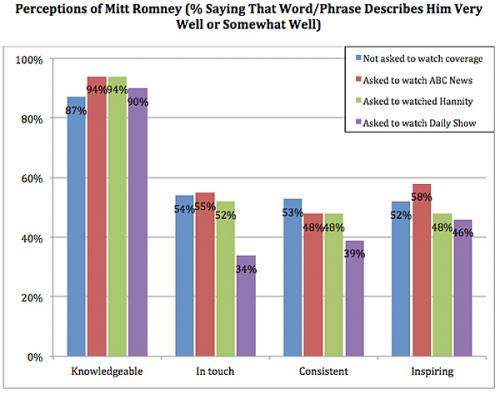
Romney perceptions
-- Citizens who followed the Iowa caucuses on ABC News or the Hannity show were more likely to come away thinking of Mitt -- Romney as “knowledgeable” than those not asked to watch any coverage.
-- Watching any of the three news programs led viewers to see Romney as more likely to capture the GOP nomination.
Santorum perceptions
-- Viewers who watched Hannity more often perceived Rick Santorum as “inspiring” and “in touch with average Americans” than those not asked to watch any coverage.
-- Viewers who watched The Daily Show on Comedy Central were more likely to see Santorum as “in touch” than those not asked to watch any coverage.
-- ABC News viewers were more likely to see Santorum as “taking consistent stands on issues” than those not asked to watch any coverage.
-- Those who watched coverage on ABC or Hannity were also more likely to see Santorum as having a strong chance of winning the nomination.
Other findings
-- Media reporting about the Iowa caucus also influenced perceptions of Romney’s and Santorum’s prospects in the general election. Watching ABC or Hannity led viewers to see each candidate as having a stronger chance of defeating President Barack Obama in November. On the other hand, watching The Daily Show did not influence viewers’ perceptions of either candidate’s chances in the general election.
-- Watching ABC or The Daily Show led to more positive perceptions of the news media. Watching Hannity, however, had no such impact.
-- ABC and Fox viewers came away more likely to know which candidate (Santorum) was most strongly supported by evangelical voters, compared to those not asked to watch any coverage.
About the study
The study was conducted by the University of Delaware’s Paul Brewer, professor of communication, Philip Jones, assistant professor of political science and international relations, and Dannagal Young, assistant professor of communication. The research was funded by UD’s Center for Political Communication and the UNIDEL Foundation.
Methods
Results are based on telephone interviews conducted by Survey Technology and Research Center, Allentown, Pa., using a panel of 1,060 Delaware residents. A pre-caucus survey took place from December 22, 2011 to January 2, 2012. Each of the 506 pre-caucus respondents was randomly assigned to one of four viewing groups. Those in the first group were asked to watch ABC World News; those in the second, Hannity; those in the third, The Daily Show. The final group was not given any special viewing instructions. The post-caucus survey took place from January 6 to January 10, 2012 (all surveys on January 10 were completed before 7:00PM ET). A total of 306 participants completed the post-caucus survey. Interviews were conducted by landline or cell phone, depending on the preferred contact number of the respondent. Analyses of candidate perceptions incorporated statistical controls for pre-caucus partisan identification.
Respondents for this survey were selected from among those who have agreed to participate in UD’s Center for Political Communication surveys. The data have not been weighted. Because the sample is based on those who initially self-selected for participation in the panel rather than a probability sample, no estimates of sampling error can be calculated. All sample surveys and polls may be subject to multiple sources of error, including, but not limited to sampling error, coverage error, and measurement error.
Provided by University of Delaware


