Tropical clouds hold clues for the global water cycle
January 16, 2012

Worldwide water in the balance

Enlarge

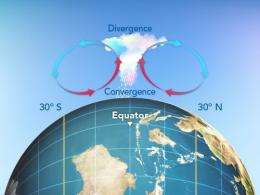
The atmospheric force called the Hadley Circulation hugs each side of the equator and is part of the global atmospheric movement of moisture and warm air, affecting climate and weather extremes around the globe.

(PhysOrg.com) -- To study the wellspring of atmospheric water, you have to start with tropical clouds. Scientists at Pacific Northwest National Laboratory showed that global climate models are not accurately depicting the true depth and strength of tropical clouds that have a strong hold on the general circulation of atmospheric heat and the global water balance. Their analysis points to the need for model improvements to project water cycle changes in the 21st century. The research was published in the Journal of Climate.

As the Earth's climate warms, the sources and availability of water are affected. But how well are those changes predicted in global climate models today? Scientists are working to understand how moisture "moves" through the atmosphere and causes precipitation around the world. Understanding how well climate models represent these processes will help reduce uncertainties in the model projections of the on the world's . Equipped with more accurate projection tools, policymakers can get a better grip on how the climate changes will impact future availability of water and .

Researchers Drs. Samson M. Hagos and L. Ruby Leung, at PNNL, surveyed tropical divergence in three global climate models, three global reanalyses (models corrected with ), and four sets of field campaign soundings. Their survey uncovered significant uncertainties in current climate projections of the intensity and vertical structure of the low-level convergence of moisture to and upper-level divergence of heat away from the tropics. These current uncertainties are also reflected in future climate projections by these models.

The research team divided the total circulation providing moisture for precipitation into three parts: deep-divergent, shallow-divergent, and non-divergent. They found that in the tropics and subtropics, deep divergent circulation is the largest contributor to net precipitation, or total precipitation minus evaporation. Further, all global circulation models studied portray this process as deeper and stronger than what is observed in field measurements.

"Inter-model differences in the present day climate simulations inevitably carry over to future projections of ," said Hagos, lead author of the study. "Identifying these uncertainties provides a strong basis for model improvements."

Understanding how well climate models depict net precipitation gain was the first step. Next, scientists will work on correcting the representation of tropical cloud depth in global climate models to better project future climate change.

More information: Hagos S and LR Leung. 2012. " On the Relationship Between Uncertainties in Tropical Divergence and the Hydrological Cycle in Global Models." Journal of Climate, 25 (1), 381-291. DOI:10.1175/JCLI-D-11-00058.1

Journal reference: Journal of Climate search and more info website

Provided by Pacific Northwest National Laboratory search and more info website

Filter


Move the slider to adjust rank threshold, so that you can hide some of the comments.


Display comments: newest first

Shootist
Jan 16, 2012

Rank: 1 / 5 (3)
As the Earth's climate warms, the sources and availability of water are affected.


What? Did the oceans turn to dust and blow away?

Equipped with more accurate projection tools, policymakers can get a better grip on how the climate changes will impact future availability of water


Again, did the oceans dry up and nobody told us?

The climate changes. There is little anyone can do, one way or the other. It is (much) cooler today than it was 1000 years ago. It is (a little) warmer today than it was 200 years ago.

If our policy makers (a nice PC term for dictators) are worried about rainfall in the next 30-50-70 years . . . build 100, 1000MW Fission plants and start flashing sea water to steam. Otherwise, STFU, there is nothing you can do, but make (any) situation worse (damn bureaucrats/statist/liberal/socialists).
Rank 5 /5 (3 votes)
Relevant PhysicsForums posts

More news stories

Land and sea species differ in climate change response: study

(Phys.org) -- Marine and terrestrial species will likely differ in their responses to climate warming, new research by Simon Fraser University and Australia’s University of Tasmania has found.

Space & Earth / Environment

created 4 hours ago | popularity 3.7 / 5 (3) | comments 5 | with audio podcast

Yale study concludes public apathy over climate change unrelated to science literacy

Are members of the public divided about climate change because they don't understand the science behind it? If Americans knew more basic science and were more proficient in technical reasoning, would public consensus match ...

Space & Earth / Environment

created 6 hours ago | popularity 4.8 / 5 (4) | comments 11 | with audio podcast

10 million years needed to recover from mass extinction

It took some 10 million years for Earth to recover from the greatest mass extinction of all time, latest research has revealed.

Space & Earth / Earth Sciences

created 6 hours ago | popularity 5 / 5 (3) | comments 1 | with audio podcast

Sophisticated simulations predict future warming

The chances of our planet being hit by a global warming of 3 degrees Celsius by 2050 is as likely as it being hit by an increase of 1.4 degrees, new research shows. Presented in the journal Nature Geoscience, the British study ...

Space & Earth / Earth Sciences

created May 22, 2012 | popularity 4.4 / 5 (9) | comments 51

Aliens don't want to eat us, says former SETI director

Alien life probably isn’t interested in having us for dinner, enslaving us or laying eggs in our bellies, according to a recent statement by former SETI director Jill Tarter.

Space & Earth / Space Exploration

created May 25, 2012 | popularity 4.4 / 5 (14) | comments 41


Stunning image of smallest possible five-ringed structure

Scientists have created and imaged the smallest possible five-ringed structure – about 100,000 times thinner than a human hair – and you'll probably recognise its shape.

'Unzipped' carbon nanotubes could help energize fuel cells, batteries

Multi-walled carbon nanotubes riddled with defects and impurities on the outside could replace some of the expensive platinum catalysts used in fuel cells and metal-air batteries, according to scientists at ...

Change in developmental timing was crucial in the evolutionary shift from dinosaurs to birds: study

At first glance, it's hard to see how a common house sparrow and a Tyrannosaurus Rex might have anything in common. After all, one is a bird that weighs less than an ounce, and the other is a dinosaur that ...

Computer model used to pinpoint prime materials for efficient carbon capture

When power plants begin capturing their carbon emissions to reduce greenhouse gases – and to most in the electric power industry, it's a question of when, not if – it will be an expensive undertaking.

T cells 'hunt' parasites like animal predators seek prey, study shows

By pairing an intimate knowledge of immune-system function with a deep understanding of statistical physics, a cross-disciplinary team at the University of Pennsylvania has arrived at a surprising finding: T cells use a movement ...

Scientists develop ultra-sensitive test that detects diseases in their earliest stages

Scientists have developed an ultra-sensitive test that should enable them to detect signs of a disease in its earliest stages, in research published today in the journal Nature Materials.