Origin of thermonuclear supernova discovered
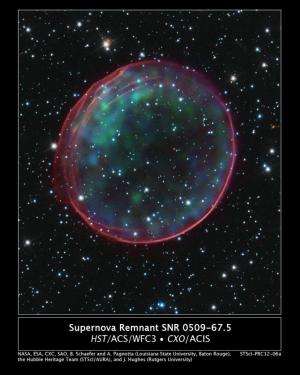
This image of Type Ia Supernova Remnant 0509-67.5 was made by combining data from two of NASA’s Great Observatories. The result shows soft green and blue hues of heated material from the X-ray data surrounded by the glowing pink optical shell, which shows the ambient gas being shocked by the expanding blast wave from the supernova. Credit: NASA, ESA, and B. Schaefer and A. Pagnotta (Louisiana State University, Baton Rouge); Image Credit: NASA, ESA, CXC, SAO, the Hubble Heritage Team (STScI/AURA), J. Hughes (Rutgers University)
(PhysOrg.com) -- Using NASAs Hubble Space Telescope, astronomers have solved a longstanding mystery on the type of star, or so-called progenitor, which caused a supernova seen in a nearby galaxy. The finding yields new observational data for pinpointing one of several scenarios that trigger such outbursts.
Based on previous observations from ground-based telescopes, astronomers knew that a kind of supernova called a Type Ia supernova created a remnant named SNR 0509-67.5, which lies 170,000 light-years away in the Large Magellanic Cloud galaxy.
The type of system that leads to this kind of supernova explosion has long been a high importance problem with various proposed solutions but no decisive answer. All these solutions involve a white dwarf star that somehow increases in mass to the highest limit.
Astronomers failed to find any companion star near the center of the remnant, and this rules out all but one solution, so the only remaining possibility is that this one Type Ia supernova came from a pair of white dwarfs in close orbit.
We know that Hubble has the sensitivity necessary to detect the faintest white dwarf remnants that could have caused such explosions, said lead investigator Bradley Schaefer of Louisiana State University (LSU) in Baton Rouge. The logic here is the same as the famous quote from Sherlock Holmes: when you have eliminated the impossible, whatever remains, however improbable, must be the truth.
The cause of SNR 0509-67.5 can be explained best by two tightly orbiting white dwarf stars spiraling closer and closer until they collided and exploded.
The results are being reported today at the meeting of the American Astronomical Society in Austin, Texas [presentation number 418.08D]. A paper on the results will be published in the Jan. 12 issue of the journal Nature.
For four decades, the search for Type Ia supernovae progenitors has been a key question in astrophysics. The problem has taken on special importance over the last decade with Type Ia supernovae being the premier tools for measuring the accelerating universe.
Type Ia supernovae are tremendous explosions of energy in which the light produced is often brighter than a whole galaxy of stars. The problem has been to identify the type of star system that pushes the white dwarfs mass over the edge and triggers this type of explosion. Many possibilities have been suggested, but most require that a companion star near the exploding white dwarf be left behind after the explosion.
Therefore, a possible way to distinguish between the various progenitor models has been to look deep in the center of an old supernova remnant to search for the ex-companion star.
In 2010, Schaefer and Ashley Pagnotta of LSU were preparing a proposal to look for any faint ex-companion stars in the center of four supernova remnants in the Large Magellanic Cloud when they discovered that the Hubble Space Telescope had already taken the desired image of one of their target remnants, SNR 0509-67.5, for the Hubble Heritage program, which collects images of especially photogenic astronomical targets.
In analyzing the central region, they found it to be completely empty of stars down to the limit of the faintest objects that Hubble can detect in the photos. Schaefer reports that the best explanation left is the so-called double degenerate model in which two white dwarfs collide.
There are no recorded observations of the star exploding. However, researchers at the Space Telescope Science Institute in Baltimore, Md., have identified light from the supernova that was reflected off of interstellar dust, delaying its arrival at Earth by 400 years. This delay, called a light echo of the supernova explosion also allowed the astronomers to measure the spectral signature of the light from the explosion. By virtue of the color signature, astronomers were able to prove it was a Type Ia supernova.
Because the remnant appears as a nice symmetric shell or bubble, the geometric center can be accurately determined. These properties make SNR 0509-67.5 an ideal target to search for ex-companions. The young age also means that any surviving stars have not moved far from the site of the explosion.
The team plans to look at other supernova remnants in the Large Magellanic Cloud to further test their observations.
Provided by
Louisiana State University
-
From lemons to lemonade: Reaction uses carbon dioxide to make carbon-based semiconductor,
32 comments
-
Thioridazine kills cancer stem cells in human while avoiding toxic side-effects of conventional cancer treatments,
3 comments
-
SpaceX private rocket blasts off for space station (Update),
42 comments
-
Climate scientists say they have solved riddle of rising sea,
31 comments
-
SpaceX capsule has 'new car' smell, astronauts say (Update),
4 comments
-
Distance of planets from stars and revolution
6 hours ago
-
revamping general concept and cosmological principle
May 25, 2012
-
Transiting Exoplanet Light Curve
May 25, 2012
-
Math behind Theoretical Physics
May 24, 2012
-
Do we know whats at the center of galaxies yet?
May 23, 2012
-
Structure of the Milky Way?
May 20, 2012
- More from Physics Forums - General Astronomy
More news stories
Land and sea species differ in climate change response: study
(Phys.org) -- Marine and terrestrial species will likely differ in their responses to climate warming, new research by Simon Fraser University and Australia’s University of Tasmania has found.
4 hours ago |
3.7 / 5 (3) |
5
|
Yale study concludes public apathy over climate change unrelated to science literacy
Are members of the public divided about climate change because they don't understand the science behind it? If Americans knew more basic science and were more proficient in technical reasoning, would public consensus match ...
6 hours ago |
4.8 / 5 (4) |
11
|
10 million years needed to recover from mass extinction
It took some 10 million years for Earth to recover from the greatest mass extinction of all time, latest research has revealed.
Space & Earth / Earth Sciences
6 hours ago |
5 / 5 (3) |
1
|
Sophisticated simulations predict future warming
The chances of our planet being hit by a global warming of 3 degrees Celsius by 2050 is as likely as it being hit by an increase of 1.4 degrees, new research shows. Presented in the journal Nature Geoscience, the British study ...
Space & Earth / Earth Sciences
May 22, 2012 |
4.4 / 5 (9) |
51
Aliens don't want to eat us, says former SETI director
Alien life probably isnt interested in having us for dinner, enslaving us or laying eggs in our bellies, according to a recent statement by former SETI director Jill Tarter.
Space & Earth / Space Exploration
May 25, 2012 |
4.4 / 5 (14) |
41
Stunning image of smallest possible five-ringed structure
Scientists have created and imaged the smallest possible five-ringed structure about 100,000 times thinner than a human hair and you'll probably recognise its shape.
'Unzipped' carbon nanotubes could help energize fuel cells, batteries
Multi-walled carbon nanotubes riddled with defects and impurities on the outside could replace some of the expensive platinum catalysts used in fuel cells and metal-air batteries, according to scientists at ...
Change in developmental timing was crucial in the evolutionary shift from dinosaurs to birds: study
At first glance, it's hard to see how a common house sparrow and a Tyrannosaurus Rex might have anything in common. After all, one is a bird that weighs less than an ounce, and the other is a dinosaur that ...
Computer model used to pinpoint prime materials for efficient carbon capture
When power plants begin capturing their carbon emissions to reduce greenhouse gases and to most in the electric power industry, it's a question of when, not if it will be an expensive undertaking.
T cells 'hunt' parasites like animal predators seek prey, study shows
By pairing an intimate knowledge of immune-system function with a deep understanding of statistical physics, a cross-disciplinary team at the University of Pennsylvania has arrived at a surprising finding: T cells use a movement ...
Scientists develop ultra-sensitive test that detects diseases in their earliest stages
Scientists have developed an ultra-sensitive test that should enable them to detect signs of a disease in its earliest stages, in research published today in the journal Nature Materials.
Jan 11, 2012
Rank: 3 / 5 (4)
Jan 11, 2012
Rank: 5 / 5 (1)
http://www.univer...-2011fe/
www.physorg.com/n...tar.html
Jan 11, 2012
Rank: 5 / 5 (4)
Most of the material won't be ejected into space, though: the gravity well is too intense, and 95% or more of the material winds up inside the resulting black hole, with the rest closely orbiting it at insanely high speeds. Most of that residual material will accrete back onto the black hole, but in the process some small fraction of it is spewed out in tight jets formed by the rapidly spinning black hole's tightly twisted, very powerful magnetic field; the very high energies involved result in a very bright gamma ray pulse mostly oriented along the axis of the jet, which by far outshines any -- yes, exothermic -- contributions from neutron decay or fission/fusion of any left-over nuclei still orbiting the black hole.
Here's some nice pictures from a recent supercomputer simulation of such an event:
http://www.nasa.g..._low.jpg
Video more text here:
http://www.nasa.g...nes.html
Jan 13, 2012
Rank: not rated yet