Low temperatures enhance ozone degradation above the Arctic
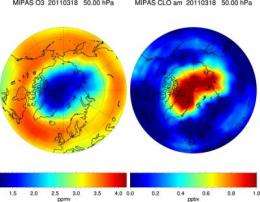
March 2011: This shows strongly reduced ozone values (left, dark blue) and significantly increased concentration of chlorine monoxide (right, red) that is directly involved in ozone degradation. Credit: Figure: IMK-ASF, KIT
Extraordinarily cold temperatures in the winter of 2010/2011 caused the most massive destruction of the ozone layer above the Arctic so far: The mechanisms leading to the first ozone hole above the North Pole were studied by scientists of the KIT Institute of Meteorology and Climate Research (IMK). According to these studies, further cooling of the ozone layer may enhance the influence of ozone-destroying substances, e.g. chlorofluorocarbons (CFC), such that repeated occurrence of an ozone hole above the Arctic has to be expected.
About a year ago, IMK scientists, together with colleagues from Oxford, detected that ozone degradation above the Arctic for the first time reached an extent comparable to that of the ozone hole above the South Pole. Then, the KIT researchers studied the mechanisms behind. Their results have now been published in the journal Geophysical Research Letters.
According to IMK studies, occurrence of the Arctic ozone hole was mainly due to the extraordinarily cold temperatures in the ozone layer that is located at about 18 km height in the stratosphere, i.e. the second layer of the earth's atmosphere. There, chlorine compounds originating from chlorofluorocarbons (CFC, e.g. greenhouse gases and refrigerants) and other pollutants are converted chemically at temperatures below -78°C. These chemical conversion products attack the ozone layer and destroy it partly. One of the main statements in the study: If the trend to colder temperatures in the stratosphere observed in the past decades will continue, repeated occurrence of an Arctic ozone hole has to be expected.
The team of IMK researchers analyzed measurements of the chemical composition of the atmosphere by the MIPAS satellite instrument developed by KIT. In addition, model calculations were made to determine concrete effects of further cooling of the ozone layer. "We found that further decrease in temperature by just 1°C would be sufficient to cause a nearly complete destruction of the Arctic ozone layer in certain areas," says Dr. Björn-Martin Sinnhuber, main author of the study. Observations over the past thirty years indicate that the stratosphere in cold Arctic winters cooled down by about 1°C per decade on the average. According to Sinnhuber, further development of the ozone layer will consequently be influenced also by climate change. He points out that the increase in carbon dioxide and other greenhouse gases will warm up the bottom air layers near the ground due to the reflection of part of the thermal radiation by the bottom layer of the atmosphere towards the earth's surface, but also result in a cooling of the air layers of the stratosphere above, where the ozone layer is located.
After the first discovery of the Antarctic ozone hole in the mid-1980s, CFCs were rapidly identified to be the cause and their use was prohibited by the Montreal Protocol of 1987. However, it will take decades until these substances will have been removed completely from the atmosphere. "Future cooling of the stratosphere would enhance and extend the impacts of these substances on the ozone layer," says Dr. Björn-Martin Sinnhuber. It is now necessary to study potential feedbacks on climate change.
The present study is embedded in long-term programs of IMK in this field. In December, the researchers started a new measurement campaign in the Arctic ozone layer in Northern Sweden using a high-altitude aircraft. Again, they encountered extraordinarily low temperatures. However, it is not yet possible to predict whether temperatures will be low enough over a longer term to cause a comparably large degradation of ozone in this winter.
More information: Geophysical Research Letters, volume 38, doi:10.1029/2011GL049784
Journal reference:
Geophysical Research Letters
Provided by
Helmholtz Association of German Research Centres
-
From lemons to lemonade: Reaction uses carbon dioxide to make carbon-based semiconductor,
32 comments
-
Thioridazine kills cancer stem cells in human while avoiding toxic side-effects of conventional cancer treatments,
3 comments
-
SpaceX private rocket blasts off for space station (Update),
42 comments
-
Climate scientists say they have solved riddle of rising sea,
31 comments
-
SpaceX capsule has 'new car' smell, astronauts say (Update),
4 comments
-
Hypothetical desert earth
20 hours ago
-
More human population = greater mass?
May 25, 2012
-
Conversion from aircraft bearing to normal degrees
May 23, 2012
-
Interpretation/Analysis of the Lab results(HEPA filter)
May 22, 2012
-
Has anyone here attended the The Urbino Summer School in Paleoclimatology?
May 22, 2012
-
Earthquakes: Mag 6 N. Italy and Mag 5.6 W. Bulgaria
May 21, 2012
- More from Physics Forums - Earth
More news stories
Land and sea species differ in climate change response: study
(Phys.org) -- Marine and terrestrial species will likely differ in their responses to climate warming, new research by Simon Fraser University and Australia’s University of Tasmania has found.
4 hours ago |
3.7 / 5 (3) |
5
|
Yale study concludes public apathy over climate change unrelated to science literacy
Are members of the public divided about climate change because they don't understand the science behind it? If Americans knew more basic science and were more proficient in technical reasoning, would public consensus match ...
6 hours ago |
4.8 / 5 (4) |
11
|
10 million years needed to recover from mass extinction
It took some 10 million years for Earth to recover from the greatest mass extinction of all time, latest research has revealed.
Space & Earth / Earth Sciences
6 hours ago |
5 / 5 (3) |
1
|
Sophisticated simulations predict future warming
The chances of our planet being hit by a global warming of 3 degrees Celsius by 2050 is as likely as it being hit by an increase of 1.4 degrees, new research shows. Presented in the journal Nature Geoscience, the British study ...
Space & Earth / Earth Sciences
May 22, 2012 |
4.4 / 5 (9) |
51
Aliens don't want to eat us, says former SETI director
Alien life probably isnt interested in having us for dinner, enslaving us or laying eggs in our bellies, according to a recent statement by former SETI director Jill Tarter.
Space & Earth / Space Exploration
May 25, 2012 |
4.4 / 5 (14) |
41
Stunning image of smallest possible five-ringed structure
Scientists have created and imaged the smallest possible five-ringed structure about 100,000 times thinner than a human hair and you'll probably recognise its shape.
'Unzipped' carbon nanotubes could help energize fuel cells, batteries
Multi-walled carbon nanotubes riddled with defects and impurities on the outside could replace some of the expensive platinum catalysts used in fuel cells and metal-air batteries, according to scientists at ...
Change in developmental timing was crucial in the evolutionary shift from dinosaurs to birds: study
At first glance, it's hard to see how a common house sparrow and a Tyrannosaurus Rex might have anything in common. After all, one is a bird that weighs less than an ounce, and the other is a dinosaur that ...
Computer model used to pinpoint prime materials for efficient carbon capture
When power plants begin capturing their carbon emissions to reduce greenhouse gases and to most in the electric power industry, it's a question of when, not if it will be an expensive undertaking.
T cells 'hunt' parasites like animal predators seek prey, study shows
By pairing an intimate knowledge of immune-system function with a deep understanding of statistical physics, a cross-disciplinary team at the University of Pennsylvania has arrived at a surprising finding: T cells use a movement ...
Scientists develop ultra-sensitive test that detects diseases in their earliest stages
Scientists have developed an ultra-sensitive test that should enable them to detect signs of a disease in its earliest stages, in research published today in the journal Nature Materials.
Jan 20, 2012
Rank: not rated yet