STAR TRAK for January 2012
January 5, 2012

Venus

Enlarge

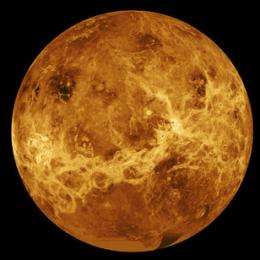
Venus. Photo courtesy of NASA

The planets Venus and Jupiter will dominate the sky as darkness falls during January. Jupiter will be twice as bright as any star, and Venus will be four times brighter than Jupiter.

Venus will be well up in the west-southwest an hour after sunset at the beginning of the month, a brilliant "evening star." By month's end it will be 10 degrees higher at the same stage of twilight and set more than three hours after the sun.

will blaze more than halfway up the southeastern sky as night falls in January. It will reach its highest point in the south several minutes earlier each night, and by month's end it will be at maximum elevation when it appears around sunset. It will remain visible throughout January until midnight local time.

Saturn will rise before 1 a.m. local time by the middle of January and appear halfway up the southern sky by daybreak. The best time to view it with a telescope will be just before the start of morning twilight, when it will be highest in the southeast. Its rings will be tilted 15 degrees to our line of sight, and details of the rings such as the Cassini Division will be visible with a telescope.

Mars will nearly double in brightness this month as Earth moves significantly closer to the red-orange planet. It will rise after 10 p.m. local time at the beginning of the month and two hours earlier by month's end. For the best telescopic views, wait until after 2 a.m., when Mars will be high in the .

Mercury will appear about 10 degrees above the southeastern horizon a half-hour before sunrise at the beginning of the month, to the lower left (east) of the bright orange star Antares. Binoculars will help you spot them in the . Mercury will sink lower each morning, disappearing by the middle of the month.

Meteor shower

The is active for the first week of January, having peaked during the hours before dawn on Jan. 4. The waxing gibbous moon will interfere with the display until it sets around 3 a.m. local time, when viewing conditions under a clear sky will be good for the rest of the night. The rate of this shower varies considerably and unpredictably from year to year, but observers may see up to 100 meteors per hour during the brief peak.

The Quadrantids will appear to come from a point called the radiant near the end of the handle of the Big Dipper, which will rise in the northeast. The radiant is in the constellation Bootes the Herdsman, which contains the bright orange star Arcturus as a conspicuous marker.

Try facing northeast toward the Big Dipper. If you extend the curve formed by the handle's three stars, it forms an "arc to Arcturus." Meteors should be visible in all parts of the sky, but the higher Arcturus is above the eastern horizon, the more meteors there will be. More information about viewing meteor showers, including the Quadrantids, is available from the American Meteor Society at http://www.amsmete … showers.html .

Perihelion

Earth will reach the closest point to the sun in its orbit, the position called perihelion, on Jan. 4 at 7 p.m. EST (0:00 Universal Time on Jan. 5). A common misconception is that our seasons are caused by Earth's changing distance from the sun. The actual cause is the tilt of Earth's axis. In the Northern Hemisphere, winter happens when the North Pole is tilted away from the sun, so sunlight must pass through a greater amount of Earth's atmosphere to reach the surface. We experience the coldest time of year when we are closest to the sun.

Provided by Indiana University search and more info website


Rank not rated yet
Related Stories
created Jan 05, 2010 comments 0

STAR TRAK for January

created Dec 01, 2011 comments 0

STAR TRAK for December

Relevant PhysicsForums posts
  • Distance of planets from stars and revolution
    created6 hours ago
  • revamping general concept and cosmological principle
    createdMay 25, 2012
  • Transiting Exoplanet Light Curve
    createdMay 25, 2012
  • Math behind Theoretical Physics
    createdMay 24, 2012
  • Do we know whats at the center of galaxies yet?
    createdMay 23, 2012
  • Structure of the Milky Way?
    createdMay 20, 2012
  • More from Physics Forums - General Astronomy

More news stories

Land and sea species differ in climate change response: study

(Phys.org) -- Marine and terrestrial species will likely differ in their responses to climate warming, new research by Simon Fraser University and Australia’s University of Tasmania has found.

Space & Earth / Environment

created 4 hours ago | popularity 3.7 / 5 (3) | comments 5 | with audio podcast

Yale study concludes public apathy over climate change unrelated to science literacy

Are members of the public divided about climate change because they don't understand the science behind it? If Americans knew more basic science and were more proficient in technical reasoning, would public consensus match ...

Space & Earth / Environment

created 6 hours ago | popularity 4.8 / 5 (4) | comments 11 | with audio podcast

10 million years needed to recover from mass extinction

It took some 10 million years for Earth to recover from the greatest mass extinction of all time, latest research has revealed.

Space & Earth / Earth Sciences

created 6 hours ago | popularity 5 / 5 (3) | comments 1 | with audio podcast

Sophisticated simulations predict future warming

The chances of our planet being hit by a global warming of 3 degrees Celsius by 2050 is as likely as it being hit by an increase of 1.4 degrees, new research shows. Presented in the journal Nature Geoscience, the British study ...

Space & Earth / Earth Sciences

created May 22, 2012 | popularity 4.4 / 5 (9) | comments 51

Aliens don't want to eat us, says former SETI director

Alien life probably isn’t interested in having us for dinner, enslaving us or laying eggs in our bellies, according to a recent statement by former SETI director Jill Tarter.

Space & Earth / Space Exploration

created May 25, 2012 | popularity 4.4 / 5 (14) | comments 41


Stunning image of smallest possible five-ringed structure

Scientists have created and imaged the smallest possible five-ringed structure – about 100,000 times thinner than a human hair – and you'll probably recognise its shape.

'Unzipped' carbon nanotubes could help energize fuel cells, batteries

Multi-walled carbon nanotubes riddled with defects and impurities on the outside could replace some of the expensive platinum catalysts used in fuel cells and metal-air batteries, according to scientists at ...

Change in developmental timing was crucial in the evolutionary shift from dinosaurs to birds: study

At first glance, it's hard to see how a common house sparrow and a Tyrannosaurus Rex might have anything in common. After all, one is a bird that weighs less than an ounce, and the other is a dinosaur that ...

Computer model used to pinpoint prime materials for efficient carbon capture

When power plants begin capturing their carbon emissions to reduce greenhouse gases – and to most in the electric power industry, it's a question of when, not if – it will be an expensive undertaking.

T cells 'hunt' parasites like animal predators seek prey, study shows

By pairing an intimate knowledge of immune-system function with a deep understanding of statistical physics, a cross-disciplinary team at the University of Pennsylvania has arrived at a surprising finding: T cells use a movement ...

Scientists develop ultra-sensitive test that detects diseases in their earliest stages

Scientists have developed an ultra-sensitive test that should enable them to detect signs of a disease in its earliest stages, in research published today in the journal Nature Materials.