Sky light sky bright - in the office
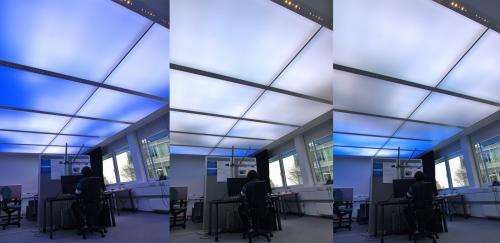
The dynamic luminous ceiling gives office staff the pleasant feeling that they are working under the open sky. © Fraunhofer IAO
Working under the open sky it sounds enticing, but its seldom really a practical option. Now, a dynamic luminous ceiling brings the sky into office spaces by creating the effect of passing clouds. This kind of lighting generates a pleasant working environment.
As the wind swiftly blows clouds across the sky, the light is in a constant state of change. The feeling of spaciousness and freedom we experience outdoors is exactly what researchers from the Stuttgart-based Fraunhofer Institute for Industrial Engineering IAO (Germany) replicate indoors: a luminous ceiling that extends across the entire room simulates lighting conditions which resemble those produced by passing clouds conveying the impression that you are sitting outdoors.
The innovative luminous ceiling, which was developed by the Fraunhofer researchers in close collaboration with their partners at LEiDs GmbH, consists of 50cm by 50cm tiles. Each tile comprises an LED board with 288 light emitting diodes (LEDs), states Dr. Matthias Bues, head of department at the IAO. The board is mounted on the ceiling. A diffuser film in matt white is attached approximately 30cm beneath the LEDs and ensures that the individual points of light are not perceived as such. This diffuser film creates homogenous lighting that illuminates the room throughout. The researchers use a combination of red, blue, green and white LEDs in order to produce the full light spectrum. This combination makes it possible to generate more than 16 million hues. Whats more, the white LEDs are more energy efficient than the colored lights, which keeps the energy costs to a minimum.
The main focus in developing the virtual sky was to simulate natural lighting conditions on a cloudy day. To achieve this goal, the researchers carefully examined natural light to find out how and how quickly the light spectrum changes when clouds move across the sky. The LEDs allow us to simulate these dynamic changes in lighting in a way that is not directly obvious to the naked eye. Otherwise the lighting might distract people from their work. But it does need to fluctuate enough to promote concentration and heighten alertness, says Bues. The results of a preliminary study indicate that users find this dynamic lighting to be extremely pleasant. The study involved ten volunteers who carried out their daily work over the course of four days under these lighting conditions with a lighting surface of 30cm by 60cm. Throughout the first day, the lighting remained static. On the second day, it fluctuated gently, and on the third day the fluctuations were rapid. On the fourth day, the participants could choose which type of lighting they wanted, and 80 percent opted for the fast, dynamic lighting.
A prototype of this virtual sky has now been developed that contains a total of 34,560 LEDs spanning an area of 34 square meters. At full power, the sky lights up with an intensity of more than 3,000 lux, but 500 to 1,000 lux is sufficient to create a comfortable level of lighting.
From March 6 -10, 2012 at the CeBIT trade fair in Hannover, the researchers will be exhibiting a 2.8m by 2.8m virtual sky at the joint Fraunhofer booth in Hall 9, Booth E 02. Initial inquiries regarding the new lighting have already come in, mainly for use in conference rooms. The virtual sky currently costs approximately 1,000 euros per square meter, but this price will come down, since the more units are produced, the more cost-effective each luminous ceiling will be.
Provided by
Fraunhofer-Gesellschaft
-
From lemons to lemonade: Reaction uses carbon dioxide to make carbon-based semiconductor,
32 comments
-
Thioridazine kills cancer stem cells in human while avoiding toxic side-effects of conventional cancer treatments,
3 comments
-
SpaceX private rocket blasts off for space station (Update),
42 comments
-
Climate scientists say they have solved riddle of rising sea,
31 comments
-
SpaceX capsule has 'new car' smell, astronauts say (Update),
4 comments
-
Need a rigid insulation material???
23 hours ago
-
magnets or EMF in car bumpers to protect from fender bender
May 26, 2012
-
length of wire in a coil of known dimensions?
May 25, 2012
-
India Engineering Powerhouse
May 25, 2012
-
electromagnet core dereference between hard and soft iron
May 25, 2012
-
Measuring water pressure in an open tank
May 24, 2012
- More from Physics Forums - General Engineering
More news stories
Browser wars flare in mobile space
The browser wars are heating up again, but this time the fight is for dominance of the mobile Internet.
16 hours ago |
3.7 / 5 (3) |
3
Probability of contamination from severe nuclear reactor accidents is higher than expected: study
Catastrophic nuclear accidents such as the core meltdowns in Chernobyl and Fukushima are more likely to happen than previously assumed. Based on the operating hours of all civil nuclear reactors and the number ...
Technology / Energy & Green Tech
May 22, 2012 |
3.6 / 5 (25) |
56
|
HyperSolar shows dirty water no barrier to power world
(Phys.org) -- The Santa Barbara, California, company, HyperSolar, is set to transparently share the ups and downs of its research experiences toward the companys ultimate vision, successfully producing ...
SpotterRF debuts Radar Backpack Kit (w/ Video)
(Phys.org) -- SpotterRF has announced a special radar backpack kit designed to enhance situational awareness for soldiers on the ground. The company says its special radar is designed for warfighters as part ...
Tesla to launch electric sedan in US on June 22
Tesla Motors said Tuesday it would begin deliveries of "the world's first premium electric sedan" on June 22, slightly ahead of schedule.
Technology / Energy & Green Tech
May 22, 2012 |
4.5 / 5 (12) |
18
Stunning image of smallest possible five-ringed structure
Scientists have created and imaged the smallest possible five-ringed structure about 100,000 times thinner than a human hair and you'll probably recognise its shape.
'Unzipped' carbon nanotubes could help energize fuel cells, batteries
Multi-walled carbon nanotubes riddled with defects and impurities on the outside could replace some of the expensive platinum catalysts used in fuel cells and metal-air batteries, according to scientists at ...
Change in developmental timing was crucial in the evolutionary shift from dinosaurs to birds: study
At first glance, it's hard to see how a common house sparrow and a Tyrannosaurus Rex might have anything in common. After all, one is a bird that weighs less than an ounce, and the other is a dinosaur that ...
Computer model used to pinpoint prime materials for efficient carbon capture
When power plants begin capturing their carbon emissions to reduce greenhouse gases and to most in the electric power industry, it's a question of when, not if it will be an expensive undertaking.
T cells 'hunt' parasites like animal predators seek prey, study shows
By pairing an intimate knowledge of immune-system function with a deep understanding of statistical physics, a cross-disciplinary team at the University of Pennsylvania has arrived at a surprising finding: T cells use a movement ...
Land and sea species differ in climate change response: study
(Phys.org) -- Marine and terrestrial species will likely differ in their responses to climate warming, new research by Simon Fraser University and Australia’s University of Tasmania has found.
Jan 03, 2012
Rank: not rated yet
Jan 03, 2012
Rank: not rated yet
Jan 04, 2012
Rank: not rated yet