Scorpions inspire scientists in making tougher surfaces for machinery
Jan 25, 2012
Scorpions inspire scientists in making tougher surfaces for machinery

Taking inspiration from the yellow fattail scorpion, which uses a bionic shield to protect itself against scratches from desert sandstorms, scientists have developed a new way to protect the moving parts of machinery from wear and tear. A report on the research appears in ACS' journal Langmuir.

Zhiwu Han, Junqiu Zhang, Wen Li and colleagues explain that "solid particle erosion" is one of the important reasons for material damage or equipment failure. It causes millions of dollars of damage each year to helicopter rotors, nozzles, , pipes and other mechanical parts. The damage occurs when particles of dirt, grit and other hard material in the air, water or other fluids strike the surfaces of those parts. Filters can help remove the particles but must be replaced or cleaned, while harder, erosion-resistant materials cost more to develop and make. In an effort to develop better erosion-resistant surfaces, Han and Li's group sought the secrets of the yellow fattail scorpion for the first time. The scorpion evolved to survive the abrasive power of harsh sandstorms.

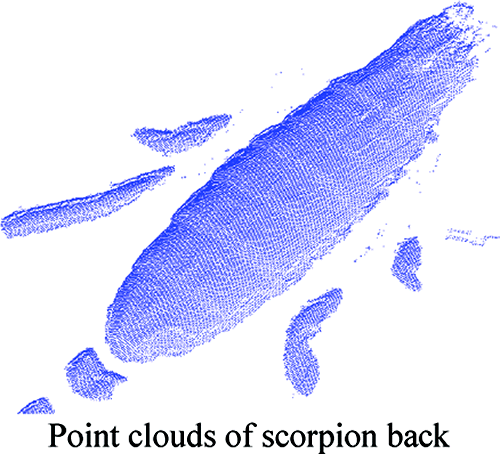
They studied the bumps and grooves on the scorpions' backs, scanning the creatures with a 3-D laser device and developing a computer program that modeled the flow of sand-laden air over the scorpions. The team used the model in to develop actual patterned surfaces to test which patterns perform best. At the same time, the erosion tests were conducted in the simple erosion for groove surface bionic samples at various impact conditions. Their results showed that a series of small grooves at a 30-degree angle to the flowing gas or liquid give steel surfaces the best protection from erosion.

Explore further: Unexpected behavior of well-known catalysts

More information: Erosion Resistance of Bionic Functional Surfaces Inspired from Desert Scorpions, Langmuir, Article ASAP. DOI:10.1021/la203942r

Abstract
In this paper, a bionic method is presented to improve the erosion resistance of machine components. Desert scorpion (Androctonus australis) is a typical animal living in sandy deserts, and may face erosive action of blowing sand at a high speed. Based on the idea of bionics and biologic experimental techniques, the mechanisms of the sand erosion resistance of desert scorpion were investigated. Results showed that the desert scorpions used special microtextures such as bumps and grooves to construct the functional surfaces to achieve the erosion resistance. In order to understand the erosion resistance mechanisms of such functional surfaces, the combination of computational and experimental research were carried out in this paper. The Computational Fluid Dynamics (CFD) method was applied to predict the erosion performance of the bionic functional surfaces. The result demonstrated that the microtextured surfaces exhibited better erosion resistance than the smooth surfaces. The further erosion tests indicated that the groove surfaces exhibited better erosion performance at 30° injection angle. In order to determine the effect of the groove dimensions on the erosion resistance, regression analysis of orthogonal multinomials was also performed under a certain erosion condition, and the regression equation between the erosion rate and groove distance, width, and height was established.

Related Stories

Redirection reduces impact of erosion

Oct 06, 2010

The life expectancy of cooling plates in heat exchangers at Rio Tinto Alcan’s Yarwun alumina refinery has increased from a few days to as long as 12 months with help from CSIRO’s slurry erosion researchers, ...

Scorpion venom -- bad for bugs, good for pesticides

Apr 27, 2011

Fables have long cast scorpions as bad-natured killers of hapless turtles that naively agree to ferry them across rivers. Michigan State University scientists, however, see them in a different light.

Genetic analysis reveals secrets of scorpion venom

Jul 01, 2009

Transcriptomic tests have uncovered the protein composition of venom from the Scorpiops jendeki scorpion. Researchers writing in the open access journal BMC Genomics have carried out the first ever venom analysis in this arach ...

Microscopic morphology adds to the scorpion family tree

Jan 12, 2009

Modern microscopy technology has allowed two scorpion biologists, Carsten Kamenz of the Humboldt University in Berlin and Lorenzo Prendini of the American Museum of Natural History, to study and document what ...

Recommended for you

Unexpected behavior of well-known catalysts

11 hours ago

Industrial palladium-copper catalysts change their structures before they get to work, already during the activation process. As a result, the reaction is catalysed by a catalyst that is different from the ...

Pearly perfection

19 hours ago

The mystery of how pearls form into the most perfectly spherical large objects in nature may have an unlikely explanation, scientists are proposing in a new study. It appears in ACS' journal Langmuir, named ...

DNA constructs antenna for solar energy

21 hours ago

Researchers at Chalmers University of Technology have found an effective solution for collecting sunlight for artificial photosynthesis. By combining self-assembling DNA molecules with simple dye molecules, ...

User comments : 3

Adjust slider to filter visible comments by rank

Display comments: newest first

diamonddriller
4 / 5 (1) Jan 25, 2012
I live in Arizona. Scorpions occupy the lowest level of hell (just below Arizona.)The little bastards are unbelievable in their survival skills.

You should also examine their uncanny ability to enter areas too small to be believed.

And their ability (in adults, anyway), to measure the amount of venom used according to the situation.

And, it should be noted, you have to stomp on them at least FIVE times to kill them.
Sonhouse
5 / 5 (1) Jan 25, 2012
I live in Arizona. Scorpions occupy the lowest level of hell (just below Arizona.)The little bastards are unbelievable in their survival skills.

You should also examine their uncanny ability to enter areas too small to be believed.

And their ability (in adults, anyway), to measure the amount of venom used according to the situation.

And, it should be noted, you have to stomp on them at least FIVE times to kill them.


A shovel works fine also. If you happen to have a shovel when you meet one of these buggers.
MarkyMark
5 / 5 (1) Jan 26, 2012
One good hard stomp and a one footed spin seems to work too.

More news stories

DNA constructs antenna for solar energy

Researchers at Chalmers University of Technology have found an effective solution for collecting sunlight for artificial photosynthesis. By combining self-assembling DNA molecules with simple dye molecules, ...

Unexpected behavior of well-known catalysts

Industrial palladium-copper catalysts change their structures before they get to work, already during the activation process. As a result, the reaction is catalysed by a catalyst that is different from the ...

Danish chemists in molecular chip breakthrough

Electronic components built from single molecules using chemical synthesis could pave the way for smaller, faster and more green and sustainable electronic devices. Now for the first time, a transistor made ...

Sony chief says time needed to study proposal

Sony Corp. needs more time to study a key proposal from a U.S. hedge fund to spin off a part of its entertainment unit as a way to propel its fledgling revival, the chief executive told shareholders Thursday.

China astronauts float water blob in kids' lecture

Astronauts struck floating martial arts poses, twirled gyroscopes and manipulated wobbling globes of water during a lecture Thursday from China's orbiting space station that's part of efforts to popularize ...