Science to help rice growers affected by Japan's tsunami
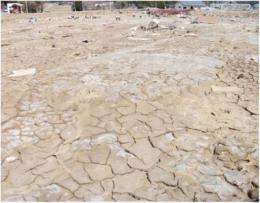
This is a salt covered paddy field. Credit: Iwate Biotechnology Research Center
Under a year since a huge tsunami inundated paddy fields in Japan with salty sludge, scientists are near to developing locally-adapted, salt-tolerant rice. Following a Japan-UK research collaboration, a new method for marker assisted breeding is being used to slash the time it takes to isolate new traits such as salt tolerance. Details of the new method, called MutMap, will be published in Nature Biotechnology on Sunday so they can be used by scientists and breeders worldwide to dramatically accelerate crop breeding.
"The beauty of the new method is its simplicity," said Professor Sophien Kamoun, co-author on the paper and Head of The Sainsbury Laboratory on Norwich Research Park.
"By working with cultivars favoured by farmers and already adapted to local conditions, the MutMap method will enable plant scientists and breeders to develop new crop varieties in nearer a year rather than five to ten years."
The new technique also takes advantage of the speed at which sequencing can now be done to screen plant mutants for valuable traits.
"Until now, plant breeding has not been able to take advantage of the genomics revolution," said lead author Professor Ryohei Terauchi from Japan's Iwate Biotechnology Research Centre.
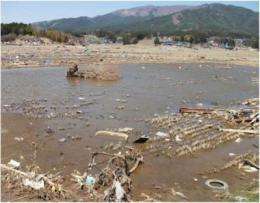
This is a tsunami hit paddy field. Credit: Iwate Biotechnology Research Center
"MutMap overcomes one of the greatest limitations, which has been the time it takes to identify genetic markers for desirable traits."Important traits such as drought and salt tolerance, semidwarfism, plant height and yield are often controlled by many genes each having a subtle effect. It is therefore difficult to identify the complete genetic basis for them.
Such traits are often bred in from wild relatives and without genetic engineering many years of back-crossing are required to breed out all the characteristics of the wild plant except the quality desired.
In the new method, scientists work with an elite rice cultivar and create mutants that harbour different traits. One mutant is identified with the desired trait and this is crossed with the original cultivar and grown in the field. The difference between the progeny of this cross and the elite cultivar can then be identified.
"The differences can be unequivocally observed even if they are small," said Professor Kamoun.
The changes detected are called single-nucleotide polymorphisms (SNPS) and insertion-deletions (indels) tiny genetic improvements that can be observed using genome sequencing.
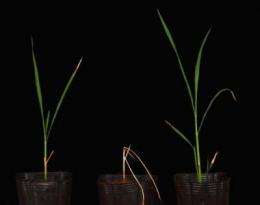
These are salt tolerant and salt intolerant rice plants. Credit: Iwate Biotechnology Research Center
In the study to be published on Sunday, the scientists focused on plant height because of its crucial role in yield. The introduction of this trait fuelled the Green Revolution in wheat, rice and other cereals from the 1960s, but has not been thoroughly exploited. The gene for semidwarfism was first identified in the model plant Arabidopsis at the John Innes Centre, and only discovered in rice in 2002.For the current study, they also measured six other traits of agricultural importance. Terauchi and his team have since established a mutant collection for salt tolerance which they are screening for markers. Once these have been identified, they will be used to develop rice cultivars that can be grown in paddy fields flooded by the tsunami last March.
The method will not work for all important traits, and further research is needed to establish how it can be applied to crops with larger genomes such as wheat, barley and maize.
More information: Genome sequencing reveals agronomically important loci in rice using MutMap, Nature Biotechnology, http://dx.doi.org/ … 038/nbt.2079
Journal reference:
Nature Biotechnology
Provided by Norwich BioScience Institutes
-
From lemons to lemonade: Reaction uses carbon dioxide to make carbon-based semiconductor,
32 comments
-
Thioridazine kills cancer stem cells in human while avoiding toxic side-effects of conventional cancer treatments,
3 comments
-
SpaceX private rocket blasts off for space station (Update),
42 comments
-
Climate scientists say they have solved riddle of rising sea,
31 comments
-
SpaceX capsule has 'new car' smell, astronauts say (Update),
4 comments
-
osmotic pressure vs diffusion
1 hour ago
-
What would stain as translucent on light-coloured fabric?
May 26, 2012
-
How do I identify different bacteria on culture plates?
May 26, 2012
-
Why Do Dogs do Strange things...
May 25, 2012
-
What does exophillic and endophillic mean in terms of mosquito and their control?
May 24, 2012
-
Semen stains glows under black lights (uv light)?
May 23, 2012
- More from Physics Forums - Biology
More news stories
Manufacturing genes to attack flu virus
An international research team has manufactured a new protein that can combat deadly flu epidemics.
8 hours ago |
not rated yet |
0
|
Scientist: Evolution debate will soon be history
(AP) -- Richard Leakey predicts skepticism over evolution will soon be history. Not that the avowed atheist has any doubts himself.
May 26, 2012 |
3.4 / 5 (21) |
97
More plant species responding to global warming than previously thought
(Phys.org) -- Far more wild plant species may be responding to global warming than previous large-scale estimates have suggested.
May 22, 2012 |
4.6 / 5 (14) |
18
|
For monogamous sparrows, it doesn't pay to stray (but they do it anyway)
It's quite common for a female song sparrow to stray from her breeding partner and mate with the male next door, but a new study shows that sleeping around can be costly.
May 22, 2012 |
5 / 5 (2) |
8
|
Thousands of shellfish found dead in Peru
Thousands of crustaceans were found dead off the coast of Lima following the mystery mass death of dolphins and pelicans, the Peruvian Navy said Friday.
May 26, 2012 |
4.7 / 5 (7) |
7
Stunning image of smallest possible five-ringed structure
Scientists have created and imaged the smallest possible five-ringed structure about 100,000 times thinner than a human hair and you'll probably recognise its shape.
'Unzipped' carbon nanotubes could help energize fuel cells, batteries
Multi-walled carbon nanotubes riddled with defects and impurities on the outside could replace some of the expensive platinum catalysts used in fuel cells and metal-air batteries, according to scientists at ...
Change in developmental timing was crucial in the evolutionary shift from dinosaurs to birds: study
At first glance, it's hard to see how a common house sparrow and a Tyrannosaurus Rex might have anything in common. After all, one is a bird that weighs less than an ounce, and the other is a dinosaur that ...
Computer model used to pinpoint prime materials for efficient carbon capture
When power plants begin capturing their carbon emissions to reduce greenhouse gases and to most in the electric power industry, it's a question of when, not if it will be an expensive undertaking.
T cells 'hunt' parasites like animal predators seek prey, study shows
By pairing an intimate knowledge of immune-system function with a deep understanding of statistical physics, a cross-disciplinary team at the University of Pennsylvania has arrived at a surprising finding: T cells use a movement ...
Land and sea species differ in climate change response: study
(Phys.org) -- Marine and terrestrial species will likely differ in their responses to climate warming, new research by Simon Fraser University and Australia’s University of Tasmania has found.


Jan 22, 2012
Rank: 4 / 5 (1)
The other problem I have is has this/these particular cultivar(s)been tested for allergy effects in the end consumers or are we to presume that the American industries term 'substantial equivalence' has now become the global norm and 'stuff the end consumer as long as the genetically modified plant gets out there post haste with our patent marker gene in it to raise maximum profits at minimal cost and no questions asked'? You know what I mean I'm sure about the style and charm they use to grease the palms of the regulators.
Either way the article is still substantially lacking in essential details and it is in the detail where the devil lies in wait.
Jan 23, 2012
Rank: 4 / 5 (1)