Russia blames radiation for space probe failure
January 31, 2012 By JIM HEINTZ , Associated Press

Russia blames radiation for space probe failure (AP)

Enlarge

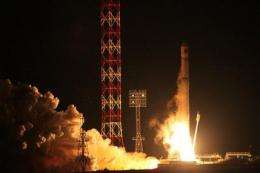
In this Wednesday, Nov. 9, 2011 file photo the Zenit-2SB rocket with the Phobos-Ground probe blasts off from its launch pad at the Cosmodrome Baikonur, Kazakhstan. The head of Russia's space agency Roscosmos Vladimir Popovkin said Tuesday, Jan. 31, 2012, cosmic radiation was the most likely cause of the failure of a Mars moon probe that crashed to Earth this month. (AP Photo/Russian Roscosmos space agency)

The head of Russia's space agency said Tuesday that cosmic radiation was the most likely cause of the failure of a Mars moon probe that crashed to Earth this month, and suggested that a low-quality imported component may have been vulnerable to the radiation.

Vladimir Popovkin also said a manned launch to the International Space Station is being postponed from March 30 because of faults found in the Soyuz capsule.

The statements underline an array of trouble that has afflicted the country's vaunted space program in recent months, including the August crash of a supply ship for the space station and last month's crash of a communications satellite.

Since the end of the U.S. space shuttle program last year, Russian craft are the only means to send crew to and from the ISS.

The unmanned Phobos-Ground probe was to have gone to the Mars moon of Phobos, taken soil samples and brought them back. But it became stuck in Earth orbit soon after its launch on Nov. 9. It fell out of orbit on Jan. 15, reportedly off the coast of Chile, but no fragments have been found.

The failure was a severe embarrassment to Russia, and Popovkin initially suggested it could have been due to foreign sabotage.

But on Tuesday he said in televised remarks that an investigation showed the probable cause was "localized influence of heavily radiated space particles."

Popovkin, speaking in the city of Voronezh where the report was presented to Deputy Prime Minister Dmitry Rogozin, said two units of the Phobos-Ground probe's onboard computer system went into an energy-saving "restart" mode, apparently due to the radiation, while the craft was in its second orbital circuit.

It was not immediately clear why the units could not be brought out of that mode.

Popovkin said that some microchips used on the craft were imported and possibly of inadequate quality to resist radiation. He did not specify where the chips were manufactured.

Yuri Koptev, a former space agency head who led the Phobos-Ground investigation, said 62 percent of the microchips used in the probe were "industrial" class, a less-sophisticated level than should be used in space flight.

Popovkin said the craft's builder, Moscow-based NPO Lavochkin, should have taken into account the possibility of radiation interfering with the operation and said Lavochkin officials would face punishment for the oversight.

Popovkin later announced that a March 30 planned launch of three astronauts to the space station will be postponed "likely until the end of April" because of problems with the capsule. He did not specify, but the state news agency RIA Novosti cited the director of Russia's cosmonaut-training program as saying leaks had been found in the capsule's seals.

It would be the second significant postponement of a manned Russian launch in the past year. The August crash of the supply ship pushed back a manned launch to the ISS because the booster rocket that failed in the crash was similar to the ones used in manned missions.

©2012 The Associated Press. All rights reserved. This material may not be published, broadcast, rewritten or redistributed.

Filter


Move the slider to adjust rank threshold, so that you can hide some of the comments.


Display comments: newest first

Doug_Huffman
Jan 31, 2012

Rank: 3 / 5 (2)
Marvin Martian has successfully tested his Eludium Q-42 space irradiater, source of "heavily radiated space particles."
tadchem
Jan 31, 2012

Rank: 2.7 / 5 (3)
How do "heavily radiated space particles" get radiated?
It is always easier to find someone else to blame than to directly grapple with failure, but you can never correct a mistake that you cannot admit you've made.
alfie_null
Feb 01, 2012

Rank: not rated yet
some microchips used on the craft were imported and possibly of inadequate quality

Maybe counterfeit? It's a concern to, e.g., the U.S. military.
Corruption, of course, will exacerbate the problem.
Hueight
Feb 01, 2012

Rank: not rated yet
Um, explosive space modulator does the radiating and E-Bay has Hong Kong ICs.
Rank 4 /5 (2 votes)
Relevant PhysicsForums posts
  • Distance of planets from stars and revolution
    created8 hours ago
  • revamping general concept and cosmological principle
    createdMay 25, 2012
  • Transiting Exoplanet Light Curve
    createdMay 25, 2012
  • Math behind Theoretical Physics
    createdMay 24, 2012
  • Do we know whats at the center of galaxies yet?
    createdMay 23, 2012
  • Structure of the Milky Way?
    createdMay 20, 2012
  • More from Physics Forums - General Astronomy

More news stories

Land and sea species differ in climate change response: study

(Phys.org) -- Marine and terrestrial species will likely differ in their responses to climate warming, new research by Simon Fraser University and Australia’s University of Tasmania has found.

Space & Earth / Environment

created 6 hours ago | popularity 3.8 / 5 (4) | comments 5 | with audio podcast

Yale study concludes public apathy over climate change unrelated to science literacy

Are members of the public divided about climate change because they don't understand the science behind it? If Americans knew more basic science and were more proficient in technical reasoning, would public consensus match ...

Space & Earth / Environment

created 8 hours ago | popularity 4.8 / 5 (5) | comments 20 | with audio podcast

10 million years needed to recover from mass extinction

It took some 10 million years for Earth to recover from the greatest mass extinction of all time, latest research has revealed.

Space & Earth / Earth Sciences

created 8 hours ago | popularity 4 / 5 (4) | comments 1 | with audio podcast

Sophisticated simulations predict future warming

The chances of our planet being hit by a global warming of 3 degrees Celsius by 2050 is as likely as it being hit by an increase of 1.4 degrees, new research shows. Presented in the journal Nature Geoscience, the British study ...

Space & Earth / Earth Sciences

created May 22, 2012 | popularity 3.8 / 5 (11) | comments 51

Aliens don't want to eat us, says former SETI director

Alien life probably isn’t interested in having us for dinner, enslaving us or laying eggs in our bellies, according to a recent statement by former SETI director Jill Tarter.

Space & Earth / Space Exploration

created May 25, 2012 | popularity 4.4 / 5 (15) | comments 41


Stunning image of smallest possible five-ringed structure

Scientists have created and imaged the smallest possible five-ringed structure – about 100,000 times thinner than a human hair – and you'll probably recognise its shape.

'Unzipped' carbon nanotubes could help energize fuel cells, batteries

Multi-walled carbon nanotubes riddled with defects and impurities on the outside could replace some of the expensive platinum catalysts used in fuel cells and metal-air batteries, according to scientists at ...

Change in developmental timing was crucial in the evolutionary shift from dinosaurs to birds: study

At first glance, it's hard to see how a common house sparrow and a Tyrannosaurus Rex might have anything in common. After all, one is a bird that weighs less than an ounce, and the other is a dinosaur that ...

Computer model used to pinpoint prime materials for efficient carbon capture

When power plants begin capturing their carbon emissions to reduce greenhouse gases – and to most in the electric power industry, it's a question of when, not if – it will be an expensive undertaking.

T cells 'hunt' parasites like animal predators seek prey, study shows

By pairing an intimate knowledge of immune-system function with a deep understanding of statistical physics, a cross-disciplinary team at the University of Pennsylvania has arrived at a surprising finding: T cells use a movement ...

Scientists develop ultra-sensitive test that detects diseases in their earliest stages

Scientists have developed an ultra-sensitive test that should enable them to detect signs of a disease in its earliest stages, in research published today in the journal Nature Materials.