Take two robots and call me in the morning
January 6, 2012 By Joel N. Shurkin

Take two robots and call me in the morning

Enlarge

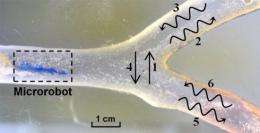
Researchers in South Korea demonstrated a microrobot moving through a structure intended to simulate the environment of a blood vessel. The microbot can move up and down (1 and 2), and wiggle through the simulated vessel in a helical motion (2, 3, 5, 6). Credit: S.M. Jeon, Hanyang University, et al

In the 1966 film "Fantastic Voyage," medical personnel board a submarine that shrinks to microscopic size and enters the bloodstream of a wounded diplomat to save his life.

The going is rough, with waves of blood that rock the sub with every heartbeat, and antibodies that attack it as an infection. They succeed in the end.

Physicians would love to produce microrobots capable of navigating through the body like that sub, delivering drugs, taking samples, moving things around. Shrinking doctors? Not so much.

Scientists are constructing devices fractions of an inch in size that would be navigated and powered from outside the body by magnetism.

In contrast, now, when someone's arteries clog with plaque, a process that could lead to a heart attack, physicians insert a into a vein in the arm or leg, shove the device to a target in the coronary arteries, and watch where it goes in an x-ray machine. Called an , the cardiac surgeons can forcibly unblock obstructions. While the process is not ordinarily painful, it is invasive and carries some risk.

What if you could insert a tiny robot into the and let it swim to the right place and either deliver medicine that would clear the obstruction or ream it out?

That's what scientists in Korea and at the University of California, Berkeley are developing. In their vision, a patient would lay inside an MRI machine and the doctors would guide the tiny device to the , watching where it goes all the time on a .

The MRI machine would drive the device, eliminating the need to provide internal power.

Gunhee Jang, professor of engineering at Hanyang University in Korea, said that previous attempts required one process to move the robot forward and back, another to take it around turns and still a third to make it corkscrew. Jang's team was able to create all the motions with one system, and reported the results in the IEEE Transactions on Magnetics in October and in a paper accepted for publication later this year in the Journal of Applied Physics.

"It has been tested on rabbits and then on pigs, and it looks quite promising," Jang said.

Swallow a Robot, Not a Pill

Researchers in Tel Aviv and Boston are working on a robotic endoscope.

Now, when doctors want to see what's inside the gastrointestinal system, they have to insert a tube down a patient's throat and push the end into the stomach and beyond, again not usually painful but uncomfortable and not as efficient as they would like.

Gabor Kosa, an engineering professor at Tel Aviv University, working with physicians and engineers Peter Jakab and Noby Hata at Boston's Brigham and Women's Hospital, is developing a potential replacement.

Kosa, who said as a science fiction fan he was inspired by the "Fantastic Voyage" movie and the Isaac Asimov novel that followed, admits the science in the screenplay (shrinking molecules) is impossible. His device uses more conventional physics.
Kosa's apparatus, reported in Biomedical Microdevices, also uses an MRI machine for power.

The MRI produces a field that makes a tail of the torpedo-shaped device wiggle, so it "swims" through the body. The patient swallows the endoscope and the physicians guide it to the stomach, or perhaps all the way to the small intestine. It would take images, snip out biopsy samples, or deliver drugs.

Kosa has so far tested the propulsion and navigation of a model in a water-filled aquarium, but he said he had no reason to think it would not work just as well in a human body.

The goal is a capsule about a third of an inch wide, about three-quarters of an inch long that would explore the stomach.

"We do not have a prototype yet," he said. "We developed the propulsive mechanisms of the robot which is a big step forward."

Kosa thinks it will be three to five years before such a device could be used in humans.

Jun Ueda, professor of mechanical engineering at Georgia Institute of Technology in Atlanta, who works on similar devices, said some robot prototypes have been tested in humans, but so far none has replaced current medical techniques.

Part of the delay is getting government approval for testing technology on humans, according to Ueda.

"Besides federal approval issues one of the issues in medical robotic devices is time. A procedure with a robotic device tends to take longer than conventional ones," Ueda said.

Journal reference: Journal of Applied Physics search and more info website

Source: Inside Science News Service search and more info website

4.8 /5 (5 votes)  

Filter


Move the slider to adjust rank threshold, so that you can hide some of the comments.


Display comments: newest first

Xbw
Jan 06, 2012

Rank: 2.3 / 5 (6)
Speaking of which yet pretty much unrelated, I wouldn't mind seeing a modern remake of "Fantastic Voyage" with all our wonderful computer technology.

Yeah yeah I know the science isn't sound but I don't go to the movies to be wowed by science.
bredmond
Jan 06, 2012

Rank: 5 / 5 (1)
Speaking of which yet pretty much unrelated, I wouldn't mind seeing a modern remake of "Fantastic Voyage" with all our wonderful computer technology.

Yeah yeah I know the science isn't sound but I don't go to the movies to be wowed by science.


yeah, they should remake it with all the bad science intact. That would really make it awesome.
HydraulicsNath
Jan 07, 2012

Rank: 5 / 5 (1)
theyve done remakes through many sitcom/animated tv shows.. eg Family guy, Futurama, the Simpsons etc.

plus originals are generally better.
RitchieGuy
Jan 07, 2012

Rank: 3 / 5 (2)
I usually prefer the originals too. . . ."The Day the World Stood Still" Michael Rennie and Pat Neal were excellent and the realism was awesome. The original "When Worlds Collide" was also better than the remake. So was "The Thing", the original was a lot scarier than the remake. Maybe some of it had to do with the original soundtracks and music, but the actors performed as though they believed the story line. The remakes are usually too stiff and unbelievable to be entertaining.
Anyway, tiny robots in the bloodstream cutting away at a blockage in an artery would be awesome, and the patient could probably go home the same day. I hope the technology for human usage is approved quickly once the prototype proves to be successful. A lot of people will be waiting for that life-saving device.
Giving all you guys a FIVE.
Rank 4.8 /5 (5 votes)
Relevant PhysicsForums posts

More news stories

Is a classical electrodynamics law incompatible with special relativity?

(Phys.org) -- The laws of classical electromagnetism that were developed in the 19th century are the same laws that scientists use today. They include Maxwell’s four equations along with the Lorentz la ...

Physics / General Physics

created May 24, 2012 | popularity 4.7 / 5 (18) | comments 43 | with audio podcast feature

Landmark calculation clears the way to answering how matter is formed

(Phys.org) -- An international collaboration of scientists, including Thomas Blum, associate professor of physics, is reporting in landmark detail the decay process of a subatomic particle called a kaon – ...

Physics / General Physics

created May 25, 2012 | popularity 4.3 / 5 (22) | comments 53 | with audio podcast

Lying in wait for WIMPs: Researchers seek to dramatically increase sensitivity of Large Underground Xenon detector

Although it's invisible, dark matter accounts for at least 80 percent of the matter in the universe. No one knows what it is, but most scientists would bet on weakly interacting massive particles, or WIMPs.

Physics / General Physics

created May 23, 2012 | popularity 4 / 5 (7) | comments 18 | with audio podcast

Hawaii lab turns laser-powered bubbles into microrobots

(Phys.org) -- A team of scientists from the University of Hawaii are working on microrobots created from bubbles of air in a saline solution. The bubbles take on their title of “robots” as a laser ...

Physics / General Physics

created May 23, 2012 | popularity 5 / 5 (4) | comments 2 | with audio podcast weblog

Sound increases the efficiency of boiling

Scientists at the Georgia Institute of Technology achieved a 17-percent increase in boiling efficiency by using an acoustic field to enhance heat transfer. The acoustic field does this by efficiently removing vapor bubbles ...

Physics / Soft Matter

created May 24, 2012 | popularity 5 / 5 (2) | comments 2


Stunning image of smallest possible five-ringed structure

Scientists have created and imaged the smallest possible five-ringed structure – about 100,000 times thinner than a human hair – and you'll probably recognise its shape.

'Unzipped' carbon nanotubes could help energize fuel cells, batteries

Multi-walled carbon nanotubes riddled with defects and impurities on the outside could replace some of the expensive platinum catalysts used in fuel cells and metal-air batteries, according to scientists at ...

Change in developmental timing was crucial in the evolutionary shift from dinosaurs to birds: study

At first glance, it's hard to see how a common house sparrow and a Tyrannosaurus Rex might have anything in common. After all, one is a bird that weighs less than an ounce, and the other is a dinosaur that ...

Computer model used to pinpoint prime materials for efficient carbon capture

When power plants begin capturing their carbon emissions to reduce greenhouse gases – and to most in the electric power industry, it's a question of when, not if – it will be an expensive undertaking.

T cells 'hunt' parasites like animal predators seek prey, study shows

By pairing an intimate knowledge of immune-system function with a deep understanding of statistical physics, a cross-disciplinary team at the University of Pennsylvania has arrived at a surprising finding: T cells use a movement ...

Land and sea species differ in climate change response: study

(Phys.org) -- Marine and terrestrial species will likely differ in their responses to climate warming, new research by Simon Fraser University and Australia’s University of Tasmania has found.