Pre-show CES buzz pegs LG as Intel phone partner
January 2, 2012 by Nancy Owano weblog

Pre-show CES buzz pegs LG as Intel phone partner

Enlarge

(PhysOrg.com) -- Techies flocking to this month’s CES in Las Vegas are growing curious over where and how the long awaited Intel “Medfield” system on a chip phones will be launched, but a report in The Korea Times offers more than a strong clue. According to the news report, LG Electronics will be the manufacturers to launch the first Android smartphone running on an Intel chip. The product may go on sale in March this year.

The partnership offers a chance to take on mobile device rivals and offers Intel the opportunity to take on its processor rivals AMD, the mobile frontrunners.

Intel and smartphone are two words that do not easily pair in consumer minds. In fact, Intel and mobile have been strange bedfellows as well, as AMD has had a larger share of the mobile market.

In Korea alone, AMD’s Korean unit more than doubled revenue last year compared with the previous year. LG’s rival Samsung adopted AMD’s processor technology for its notebooks further boosting AMD. IDC data show that AMD had 7 percent of the Korean market as of November 2011, up from 4 percent in 2010.

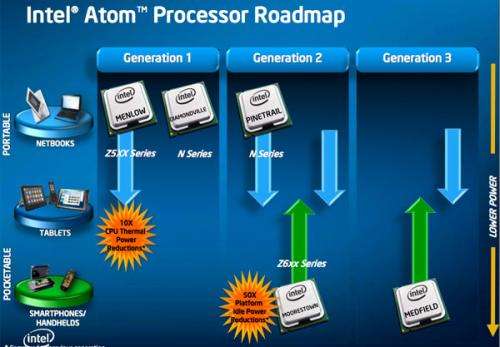
Intel has plans to strengthen its future in phones and tablets with its latest mobile chip, Medfield. While Intel may be a late mobile chip player, tests by MIT’s Technology Review indicate that impressive gains are in store for Intel. The tests resulted in substantial benchmark comparison data against NVIDIA’s Tegra 2 and Qualcomm’s Snapdragon MSM8260 SoCs.

The Medfield chip, departing from Intel’s previous designs, deploys the “system on a chip” method. Rather than splitting tasks between multiple chips, the system on a chip approach is promoted as working more efficiently by consolidating all functions onto a single chip.

It’s an important step for Intel because the reduction in power consumption with this method means more drawing power as a mobile device solution.

Intel executives are banking on Medfield in gaining on market awareness as a great chip to have in a mobile device.

This will actually be a second attempt on the part of LG Electronics and Intel to partner in trying to market a smartphone-that can stir up some excitement in the marketplace. Their first attempt fizzled.

At last year’s CES, a handset device made by LG and powered by Intel drew interest but the two powers never did commercialize the phone on display. The LG phone showcased at the CES 2011 ran Intel’s Atom Moorestown x86 architecture.

This time around, if pre-show reports prove true, then the latest LG-Intel launch could carry considerable weight.

Lee Hee-sung, Intel’s Korea chief, told The Korea Times that ’s chief executive Paul Otellini will release the LG Android at the CES event.

© 2011 PhysOrg.com


Rank 3 /5 (9 votes)
Relevant PhysicsForums posts

More news stories

Nvidia trumpets Tegra 3 phone design wins for 2012

(Phys.org) -- Nvidia’s competitive war paint has a name, Tegra 3. On the heels of Nvidia announcements about lowering costs of its Tegra 3 processors and Nvidia-enabled tablets running Android Ice Cream ...

Electronics / Hardware

created 15 hours ago | popularity 5 / 5 (2) | comments 1 | with audio podcast report

Dell tablet leak: 10.1-inch display, two-battery choice

(Phys.org) -- Headline after headline talks about vendors’ tablets in the wings as likely number-one contenders for the iPad. Such claims have justifiably been taken with a grain of salt, considering ...

Electronics / Consumer & Gadgets

created May 26, 2012 | popularity 4 / 5 (4) | comments 11 | with audio podcast report

Nvidia says Kai platform will turn price tide for tablets

(Phys.org) -- In March, Nvidia gave some signs that they were working to lower the cost of their Tegra 3 processors and they suggested consumers might see prices for Android tablets as low as $199. Connect ...

Electronics / Hardware

created May 24, 2012 | popularity 4.3 / 5 (4) | comments 3 | with audio podcast report

OmniVision tops up sensors for cameras, phones

(Phys.org) -- OmniVision has announced two high-resolution image sensors for the digital still and digital video camera market (DS/DVC) and higher end smartphones. In end-user language, it is a claim for superior ...

Electronics / Hardware

created May 25, 2012 | popularity 5 / 5 (6) | comments 3 | with audio podcast report

MIT researchers devise new means to synchronize a group of robots (w/ Video)

(Phys.org) -- For several years, roboticists have been working out ways to get a group of robots to perform synchronized activities as demonstrated most often in dance routines. It’s not just about trying ...

Electronics / Robotics

created May 25, 2012 | popularity 5 / 5 (1) | comments 1 | with audio podcast report


Stunning image of smallest possible five-ringed structure

Scientists have created and imaged the smallest possible five-ringed structure – about 100,000 times thinner than a human hair – and you'll probably recognise its shape.

'Unzipped' carbon nanotubes could help energize fuel cells, batteries

Multi-walled carbon nanotubes riddled with defects and impurities on the outside could replace some of the expensive platinum catalysts used in fuel cells and metal-air batteries, according to scientists at ...

Change in developmental timing was crucial in the evolutionary shift from dinosaurs to birds: study

At first glance, it's hard to see how a common house sparrow and a Tyrannosaurus Rex might have anything in common. After all, one is a bird that weighs less than an ounce, and the other is a dinosaur that ...

Computer model used to pinpoint prime materials for efficient carbon capture

When power plants begin capturing their carbon emissions to reduce greenhouse gases – and to most in the electric power industry, it's a question of when, not if – it will be an expensive undertaking.

T cells 'hunt' parasites like animal predators seek prey, study shows

By pairing an intimate knowledge of immune-system function with a deep understanding of statistical physics, a cross-disciplinary team at the University of Pennsylvania has arrived at a surprising finding: T cells use a movement ...

Land and sea species differ in climate change response: study

(Phys.org) -- Marine and terrestrial species will likely differ in their responses to climate warming, new research by Simon Fraser University and Australia’s University of Tasmania has found.