Physicists develop nano-level sound detector
January 12, 2012 by Bob Yirka report

Physicists develop nano-level sound detector

Enlarge

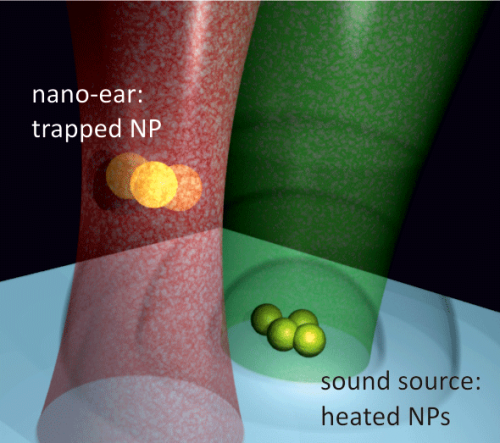
An optically trapped nanoparticle can act as an ultrasensitive detector of sound. Pressure waves from a nearby sound source are detected by tracking the small displacements of a trapped gold nanoparticle from its equilibrium position in the neck of a focused laser beam (red region). The sound waves are produced by an aggregate of nanoparticles that vibrate when heated by a laser (green region). Image: A. Ohlinger et al., Phys. Rev. Lett. (2012)

(PhysOrg.com) -- For a couple of decades now, physicists have known that if a very small laser beam is pointed at a microscopic particle, it could be held in place due to the very small electrical field that is generated. Because of that, the technique has been used to hold objects in place for close examination, sort of like using a pair of tweezers to hold a grain of sand for study under a magnifying glass. One truly nice feature of the technique is that it’s very gentle, thus no harm comes to the particle being examined.

Now, a team of German has found that the same technique can be used to measure minute amounts of vibration of objects near the particle held by the quasi nano-tweezers, allowing sound to be measured. The team, as they describe in their paper published in Physical Review Letters, has found that they can measure sound that is far below what the average person can hear.

Using lasers to hold objects still for study using a laser was first discovered back in the 1980’s and since that time, researchers have tried using smaller and smaller beams to allow for holding smaller and smaller . Recently, progress has led to the point where nanoparticles can be held steady while under review, and it’s these advances that have made the sound detector created by the German team possible.

To make their sound detector, the team set up two sound sources, both of which were placed in water. For the first, a tungsten needle was affixed to a speaker that generated vibrations at 300Hz. The second was a very tiny cluster of gold nanoparticles that were heated periodically by a laser to create vibrations at a frequency of 20Hz. Next a with 808 nm wavelength was fixed onto a 60 nm particle of gold, to hold it in place very near to the sound sources.

Once everything was set up, the researchers then measured the impact of the vibrations on the fixed nanoparticle. They found that they could very accurately measure the sound created by the sources by measuring how much the “fixed” nanoparticle was displaced by their vibrations.

The team writes that they believe their acoustical measuring technique could be used to record and measure sound created by bacteria or viruses, or in micro-electronics applications, all of which could lead to the field of so-called acoustic microscopy.

More information: Optically Trapped Gold Nanoparticle Enables Listening at the Microscale, Phys. Rev. Lett. 108, 018101 (2012) DOI:10.1103/PhysRevLett.108.018101

Abstract
We explore a new application of optical tweezers for ultrasensitive detection of sound waves in liquid media. Position tracking of a single gold nanoparticle confined in a three-dimensional optical trap is used to readout acoustic vibrations at a sound power level down to -60  dB, causing a ∼90  μeV increase in kinetic energy of the nanoparticle. The unprecedented sensitivity of such a nanoear is achieved by processing the nanoparticle’s motion in the frequency domain. The concept developed here will enable us to access the interior of biological microorganisms and micromechanical machines not accessible by other microscopy types.

via Physics Viewpoint: A Trapped Nanoparticle Listens In

Journal reference: Physical Review Letters search and more info website

© 2011 PhysOrg.com

Filter


Move the slider to adjust rank threshold, so that you can hide some of the comments.


Display comments: newest first

Infinite Fractal Consciousness
Jan 13, 2012

Rank: not rated yet
I was already thinking "wow," then I read:
"The team writes that they believe their acoustical measuring technique could be used to record and measure sound created by bacteria or viruses,..."

... and my jaw hit the floor.
Anatolij_Boychuk
Jan 15, 2012

Rank: not rated yet
"With these experimental settings we could confidently
detect sounds with a sound power level down to
-60 dB.....humans are able to hear down to power levels of Lhear = 0 dB [17]. This means that a nanoear based on a single
optically trapped gold nanoparticle serves as a sound detector
with an acoustic power sensitivity 6 orders of magnitude"

60dB means 6 orders or only 3 orders ?
higher than the human ear.
Rank 5 /5 (2 votes)
Relevant PhysicsForums posts

More news stories

Is a classical electrodynamics law incompatible with special relativity?

(Phys.org) -- The laws of classical electromagnetism that were developed in the 19th century are the same laws that scientists use today. They include Maxwell’s four equations along with the Lorentz la ...

Physics / General Physics

created May 24, 2012 | popularity 4.7 / 5 (18) | comments 43 | with audio podcast feature

Landmark calculation clears the way to answering how matter is formed

(Phys.org) -- An international collaboration of scientists, including Thomas Blum, associate professor of physics, is reporting in landmark detail the decay process of a subatomic particle called a kaon – ...

Physics / General Physics

created May 25, 2012 | popularity 4.3 / 5 (22) | comments 53 | with audio podcast

Lying in wait for WIMPs: Researchers seek to dramatically increase sensitivity of Large Underground Xenon detector

Although it's invisible, dark matter accounts for at least 80 percent of the matter in the universe. No one knows what it is, but most scientists would bet on weakly interacting massive particles, or WIMPs.

Physics / General Physics

created May 23, 2012 | popularity 4 / 5 (7) | comments 18 | with audio podcast

Hawaii lab turns laser-powered bubbles into microrobots

(Phys.org) -- A team of scientists from the University of Hawaii are working on microrobots created from bubbles of air in a saline solution. The bubbles take on their title of “robots” as a laser ...

Physics / General Physics

created May 23, 2012 | popularity 5 / 5 (4) | comments 2 | with audio podcast weblog

Sound increases the efficiency of boiling

Scientists at the Georgia Institute of Technology achieved a 17-percent increase in boiling efficiency by using an acoustic field to enhance heat transfer. The acoustic field does this by efficiently removing vapor bubbles ...

Physics / Soft Matter

created May 24, 2012 | popularity 5 / 5 (2) | comments 2


Stunning image of smallest possible five-ringed structure

Scientists have created and imaged the smallest possible five-ringed structure – about 100,000 times thinner than a human hair – and you'll probably recognise its shape.

'Unzipped' carbon nanotubes could help energize fuel cells, batteries

Multi-walled carbon nanotubes riddled with defects and impurities on the outside could replace some of the expensive platinum catalysts used in fuel cells and metal-air batteries, according to scientists at ...

Change in developmental timing was crucial in the evolutionary shift from dinosaurs to birds: study

At first glance, it's hard to see how a common house sparrow and a Tyrannosaurus Rex might have anything in common. After all, one is a bird that weighs less than an ounce, and the other is a dinosaur that ...

Computer model used to pinpoint prime materials for efficient carbon capture

When power plants begin capturing their carbon emissions to reduce greenhouse gases – and to most in the electric power industry, it's a question of when, not if – it will be an expensive undertaking.

T cells 'hunt' parasites like animal predators seek prey, study shows

By pairing an intimate knowledge of immune-system function with a deep understanding of statistical physics, a cross-disciplinary team at the University of Pennsylvania has arrived at a surprising finding: T cells use a movement ...

Land and sea species differ in climate change response: study

(Phys.org) -- Marine and terrestrial species will likely differ in their responses to climate warming, new research by Simon Fraser University and Australia’s University of Tasmania has found.