Researchers model potential of toxic algae photoreceptors
January 26, 2012

Olivucci models potential of toxic algae photoreceptors

Enlarge

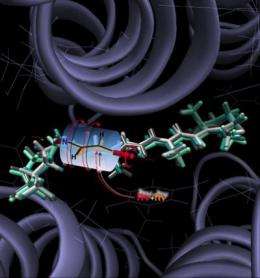
In a simulation created at the Ohio Supercomputer Center by Bowling Green State's Massimo Olivucci, a short fragment of the long retinal chromophore backbone of Anabaena Sensory Rhodopsin undergoes a complete clockwise rotation powered by the energy carried by two photons. Credit: Olivucci/BGSU

Blue-green algae is causing havoc in Midwestern lakes saturated with agricultural run-off, but researchers in a northwest Ohio lab are using supercomputers to study a closely related strain of the toxic cyanobacteria to harness its beneficial properties.

Massimo Olivucci, Ph.D., a research professor of chemistry at Bowling Green State University (BGSU), is focusing on Anabaena sensory (ASR) bacteria, which has served as a model for studies of most cyanobacteria since its genome was fully mapped in 1999.

"An in-depth understanding of light sensing, harvesting and in Anabaena may allow us to engineer this and related organisms to thrive in diverse illumination conditions," said Olivucci. "Such new properties would contribute to the field of alternative energy via the microbial conversion of light energy into biomasses, oxygen and hydrogen. Biophysical studies of the bacterial and its underlying can help us to understand its biotechnological potentials and the associated ."

Using sunlight as an energy source, a sensory protein within ASR detects light of two different colors and behaves like the "eye" of Anabaena, using its green-light sensitivity to activate a cascade of reactions. In sophisticated computer simulations Olivucci created at the Ohio Supercomputer Center (OSC), he found that a short fragment of the long retinal chromophore backbone of ASR undergoes a complete clockwise rotation powered by the energy carried by two photons of light.

"We are constructing quantum-mechanical and molecular-mechanical models on systems," Olivucci explained. "Past simulations have revealed that light induces a molecular-level rotary motion in the protein interior.

"Now, the same computer models will be used to engineer hundreds of mutants that display programmed spectroscopic, photochemical and photobiological properties and identify which mutants should be prepared in the laboratory. This new approach constitutes a unique opportunity for developing computational tools useful for understanding the molecular factors that control the spectra of proteins and their photo-responsive properties in general."

Olivucci's research is expected to lead to an unprecedented tool by which hundreds to thousands of mutant models can be screened for wanted properties, such as color, excited state lifetime or photochemical transformations. This will provide tailored genetic materials for generating organisms that, for instance, can thrive under alternative light conditions and modulate biomass production or be used in engineering applications.

"Ohio is an international player in the biosciences and energy/environmental issues, which is why OSC focuses many of its resources and services on those areas to support important research like this cyanobacteria study," said Ashok Krishnamurthy, Ph.D., interim co-executive director of OSC. "Dr. Olivucci's computational investigations into the potential uses of Anabaena are a great example of how modeling, simulation and analysis can advance research into subjects only imagined just a few short years ago."

More information: Olivucci's research project, "Computational engineering and predictions of excited state properties of bacterial photoreceptor mutants," is supported by the Ohio Board of Regents and BGSU. Initial computational work relating to the project was published in the prestigious Proceedings of the National Academy of Sciences in 2010.

Journal reference: Proceedings of the National Academy of Sciences search and more info website

Provided by Ohio Supercomputer Center


Rank not rated yet
Relevant PhysicsForums posts

More news stories

Computer model used to pinpoint prime materials for efficient carbon capture

When power plants begin capturing their carbon emissions to reduce greenhouse gases – and to most in the electric power industry, it's a question of when, not if – it will be an expensive undertaking.

Chemistry / Materials Science

created 8 hours ago | popularity not rated yet | comments 0 | with audio podcast

Scientists develop ultra-sensitive test that detects diseases in their earliest stages

Scientists have developed an ultra-sensitive test that should enable them to detect signs of a disease in its earliest stages, in research published today in the journal Nature Materials.

Chemistry / Analytical Chemistry

created 8 hours ago | popularity not rated yet | comments 0 | with audio podcast

New CO2-removing catalyst can take the heat

(Phys.org) -- The current method of removing the greenhouse gas carbon dioxide (CO2) from the flues of coal-fired power plants uses so much energy that no one bothers to use it. So says Roger Aines, principal ...

Chemistry / Materials Science

created May 24, 2012 | popularity 5 / 5 (9) | comments 11 | with audio podcast

High-speed method to aid search for solar energy storage catalysts

Eons ago, nature solved the problem of converting solar energy to fuels by inventing the process of photosynthesis.

Chemistry / Materials Science

created May 25, 2012 | popularity 5 / 5 (3) | comments 4 | with audio podcast

Researchers demonstrate possible primitive mechanism of chemical info self-replication

(Phys.org) -- When scientists think about the replication of information in chemistry, they usually have in mind something akin to what happens in living organisms when DNA gets copied: a double-stranded molecule ...

Chemistry / Materials Science

created May 25, 2012 | popularity 5 / 5 (4) | comments 2 | with audio podcast


Stunning image of smallest possible five-ringed structure

Scientists have created and imaged the smallest possible five-ringed structure – about 100,000 times thinner than a human hair – and you'll probably recognise its shape.

'Unzipped' carbon nanotubes could help energize fuel cells, batteries

Multi-walled carbon nanotubes riddled with defects and impurities on the outside could replace some of the expensive platinum catalysts used in fuel cells and metal-air batteries, according to scientists at ...

Change in developmental timing was crucial in the evolutionary shift from dinosaurs to birds: study

At first glance, it's hard to see how a common house sparrow and a Tyrannosaurus Rex might have anything in common. After all, one is a bird that weighs less than an ounce, and the other is a dinosaur that ...

T cells 'hunt' parasites like animal predators seek prey, study shows

By pairing an intimate knowledge of immune-system function with a deep understanding of statistical physics, a cross-disciplinary team at the University of Pennsylvania has arrived at a surprising finding: T cells use a movement ...

Land and sea species differ in climate change response: study

(Phys.org) -- Marine and terrestrial species will likely differ in their responses to climate warming, new research by Simon Fraser University and Australia’s University of Tasmania has found.

Yale study concludes public apathy over climate change unrelated to science literacy

Are members of the public divided about climate change because they don't understand the science behind it? If Americans knew more basic science and were more proficient in technical reasoning, would public consensus match ...