Older, cheaper vacuum cleaners release more bacteria and dust: study
January 4, 2012

Older, cheaper vacuum cleaners release more bacteria and dust: study

Some vacuum cleaners — those basic tools for maintaining a clean indoor environment in homes and offices — actually contribute to indoor air pollution by releasing into the air bacteria and dust that can spread infections and trigger allergies, researchers report in a new study. It appears in ACS' journal Environmental Science & Technology.

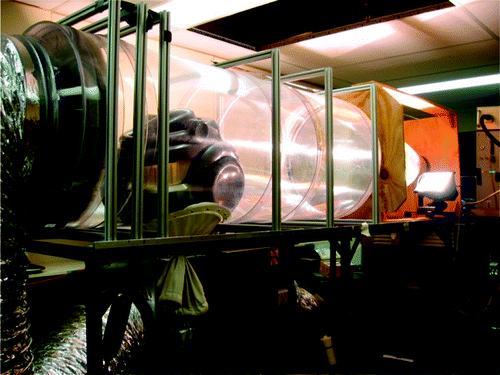
Lidia Morawska and colleagues explain that previous studies showed that vacuum cleaners can increase levels of very small particles and bacteria in indoor spaces, where people spend about 90 percent of their time. In an effort to provide more information about emission rates of bacteria and small dust particles, the scientists tested 21 vacuum cleaners sold in Australia. The vacuums came from 11 manufacturers, included those marketed for household and commercial use, ranged in age from six months to 22 years and cost from less than $100 to almost $800. They looked at the effects that age, brand and other factors had on the amount of small particles and bacteria released into air.

All of the vacuums released some fine dust and bacteria into the air. Surprisingly, vacuums with so-called High-Efficiency Particulate Air (HEPA) filters in some cases released only slightly lower levels of dust and . Newer and more expensive vacuum cleaners were generally less polluting than older or less expensive models.

More information: Vacuum Cleaner Emissions as a Source of Indoor Exposure to Airborne Particles and Bacteria, Environ. Sci. Technol., 2012, 46 (1), pp 534–542. DOI: 10.1021/es202946w

Abstract
Vacuuming can be a source of indoor exposure to biological and nonbiological aerosols, although there are few data that describe the magnitude of emissions from the vacuum cleaner itself. We therefore sought to quantify emission rates of particles and bacteria from a large group of vacuum cleaners and investigate their potential determinants, including temperature, dust bags, exhaust filters, price, and age. Emissions of particles between 0.009 and 20 μm and bacteria were measured from 21 vacuums. Ultrafine (<100 nm) particle emission rates ranged from 4.0 × 10⁶ to 1.1 × 10¹¹ particles min–1. Emission of 0.54–20 μm particles ranged from 4.0 × 10⁴ to 1.2 × 10⁹ particles min–1. PM2.5 emissions were between 2.4 × 10⁻¹ and 5.4 × 10³ μg min–1. Bacteria emissions ranged from 0 to 7.4 × 10⁵ bacteria min–1 and were poorly correlated with dust bag bacteria content and particle emissions. Large variability in emission of all parameters was observed across the 21 vacuums, which was largely not attributable to the range of determinant factors we assessed. Vacuum cleaner emissions contribute to indoor exposure to nonbiological and biological aerosols when vacuuming, and this may vary markedly depending on the vacuum used.

Provided by American Chemical Society search and more info website

Filter


Move the slider to adjust rank threshold, so that you can hide some of the comments.


Display comments: newest first

Doug_Huffman
Jan 04, 2012

Rank: 1 / 5 (12)
In my career HEPA filters had to be tested at certified effective. Components using them had to produce less than 1 inch-H20 differential pressure.
Rank 3 /5 (2 votes)
Relevant PhysicsForums posts

More news stories

Land and sea species differ in climate change response: study

(Phys.org) -- Marine and terrestrial species will likely differ in their responses to climate warming, new research by Simon Fraser University and Australia’s University of Tasmania has found.

Space & Earth / Environment

created 6 hours ago | popularity 3.8 / 5 (4) | comments 5 | with audio podcast

Yale study concludes public apathy over climate change unrelated to science literacy

Are members of the public divided about climate change because they don't understand the science behind it? If Americans knew more basic science and were more proficient in technical reasoning, would public consensus match ...

Space & Earth / Environment

created 8 hours ago | popularity 4.8 / 5 (5) | comments 20 | with audio podcast

10 million years needed to recover from mass extinction

It took some 10 million years for Earth to recover from the greatest mass extinction of all time, latest research has revealed.

Space & Earth / Earth Sciences

created 8 hours ago | popularity 4 / 5 (4) | comments 1 | with audio podcast

Sophisticated simulations predict future warming

The chances of our planet being hit by a global warming of 3 degrees Celsius by 2050 is as likely as it being hit by an increase of 1.4 degrees, new research shows. Presented in the journal Nature Geoscience, the British study ...

Space & Earth / Earth Sciences

created May 22, 2012 | popularity 3.8 / 5 (11) | comments 51

Aliens don't want to eat us, says former SETI director

Alien life probably isn’t interested in having us for dinner, enslaving us or laying eggs in our bellies, according to a recent statement by former SETI director Jill Tarter.

Space & Earth / Space Exploration

created May 25, 2012 | popularity 4.4 / 5 (15) | comments 41


Stunning image of smallest possible five-ringed structure

Scientists have created and imaged the smallest possible five-ringed structure – about 100,000 times thinner than a human hair – and you'll probably recognise its shape.

'Unzipped' carbon nanotubes could help energize fuel cells, batteries

Multi-walled carbon nanotubes riddled with defects and impurities on the outside could replace some of the expensive platinum catalysts used in fuel cells and metal-air batteries, according to scientists at ...

Change in developmental timing was crucial in the evolutionary shift from dinosaurs to birds: study

At first glance, it's hard to see how a common house sparrow and a Tyrannosaurus Rex might have anything in common. After all, one is a bird that weighs less than an ounce, and the other is a dinosaur that ...

Computer model used to pinpoint prime materials for efficient carbon capture

When power plants begin capturing their carbon emissions to reduce greenhouse gases – and to most in the electric power industry, it's a question of when, not if – it will be an expensive undertaking.

T cells 'hunt' parasites like animal predators seek prey, study shows

By pairing an intimate knowledge of immune-system function with a deep understanding of statistical physics, a cross-disciplinary team at the University of Pennsylvania has arrived at a surprising finding: T cells use a movement ...

Scientists develop ultra-sensitive test that detects diseases in their earliest stages

Scientists have developed an ultra-sensitive test that should enable them to detect signs of a disease in its earliest stages, in research published today in the journal Nature Materials.