Ohio quakes probably triggered by waste disposal well, say seismologists
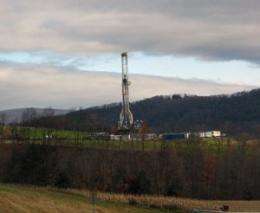
(PhysOrg.com) -- Earthquakes that have shaken an area just outside Youngstown, Ohio in the last nine months—including a substantial one on New Year’s Eve—are likely linked to a disposal well for injecting wastewater used in the hydraulic fracturing process, say seismologists at Columbia University’s Lamont-Doherty Earth Observatory who were called in to study the quakes. Ohio Gov. John Kasich has shut down the injection well and put four other proposed wells on hold. In the meantime, steps have been taken to ease pressure in the well to avert further rumblings.
The concern comes as natural gas drilling in shale formations that underlie much of the Northeast grows. To extract the gas, a mix of water, sand and chemicals is pumped under high pressure into shale rocks, in a process called hydraulic fracturing, or fracking. Once the gas has been removed, wastewater is either recycled or trucked off-site and injected deep underground. As the pressurized water seeps through cracks deep below ground, it can sometimes cause earthquakes on ancient fault lines.
Ohio is home to 177 such disposal wells, including the Youngstown well, which lies in a seismically dormant region bordering Pennsylvania. The first rumblings surfaced in March, several months after injection of fracking waste from Pennsylvania began. Nine small temblors followed. In late November, Ohio authorities asked Lamont scientists to monitor the area with mobile instruments that could provide a more accurate location of subsequent earthquakes. On Dec. 24, the four instruments recorded a magnitude 2.7 quake 2.2 miles below the surface–a half-mile away and about 2,000 feet below the 1.7 mile deep well.
“The location of the earthquake was sufficient evidence that there could be a link,” Lamont seismologist John Armbruster told NPR’s All Things Considered. Later in the week, D&L Energy, which owns the site, agreed to shut down the well. Then, on Dec. 31, a magnitude 4.0 quake struck. The Lamont instruments located it at about 300 feet east, and some 500 feet under the previous event. A 4.0 is about 40 times more powerful than a 2.7. At that point, the state put a moratorium on activity on four other wells within a five-mile radius, all of them already inactive.
Hydrofracking by its nature causes tiny earthquakes, because it involves fracturing of rock—but these are largely imperceptible, as the process takes place in relatively weak, shallow shales that crack before building up much strain. Quakes triggered by waste injection wells can be potentially more powerful because more fluid is usually being pumped underground at a site for longer periods, said Roger Anderson, an energy geophysicist at Lamont-Doherty who is not involved in the study. Once fluid enters a preexisting fault, it can pressurize the rocks enough to move; the more stress placed on the rock formation, the more powerful the earthquake. The Lamont data suggests that the Dec. 31 movement near the Ohio well was a strike-slip motion, in which one rock face slides across the other horizontally.
The chance of triggering an ancient fault by injecting fluid underground is relatively slim—maybe one in 200, said Lamont seismologist Won-Young Kim, who heads the Lamont-Doherty Cooperative Seismic Network. But, he said, the potential damage and injuries from an earthquake could far outweigh the cost of closing the well. “Once you get one earthquake, it’s better to stop then, because you may get another,” he said. That point was echoed by Armbruster on NPR: “I would advocate monitoring of wells to know when triggering of earthquakes first begins,” he said. “Then you can decide whether to continue using that well.”
Seismologists have known about the potential for injection wells to trigger earthquakes since the 1960s, when injected wastewater from weapons production at the Rocky Mountain Arsenal in Colorado was tied to a series of earthquakes including several of magnitude 5.0 or greater that caused minor damage in Denver and other cities. Earthquakes in Arkansas, Texas, Oklahoma and the United Kingdom have been linked in recent years to disposal of fracking fluids. In 2001, scientists linked a magnitude 4.2 quake in Ashtabula, Ohio to a waste disposal well there, a “carbon copy” of the recent activity near Youngstown, said Kim.
After the New Year’s quake, Kim said that the risk could continue for another year or two, as it could take that long for pressurized fluid to dissipate. To minimize that risk, Ohio officials announced Jan. 5 that they would start letting the injected fluids bubble back into storage tanks at the surface rather than capping the well under standard procedures.
The Lamont-Doherty scientists will continue to monitor the area with colleagues from Youngstown State University and Ohio Geological Survey. They are also talking with the university about upgrading its own seismic station.
Provided by Columbia University


