NASA Goddard spacecraft cleanroom goes green
When it launches in 2014, NASA's new Magnetospheric Multiscale (MMS) mission will give scientists unprecedented insights into a little-understood physical process at the heart all space weather. This process, known as magnetic reconnection, sparks solar flares, coronal mass ejections, and other phenomena that can imperil Earth-orbiting spacecraft and even power grids on terra firma.
MMS's assignment is to study this mysterious process that occurs when magnetic fields cross and reconnect, releasing magnetic energy in the form of heat and charged particle kinetic energy. But this is just part of the story.
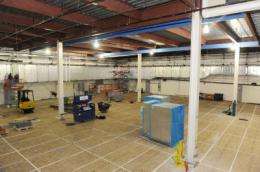
MMS requires a technologically advanced system of four identically equipped with spacecraft, which will fly in a tight, tetrahedral formation in Earth's magnetic environment – the magnetosphere — considered the best laboratory for studying magnetic reconnection. But the technological advances needed for MMS start long before the spacecraft are put together. Such advances are also found inside the brand new, 4,200-square-foot, environmentally friendly facility where engineers and scientists at NASA's Goddard Space Flight Center in Greenbelt, Md., will assemble and integrate the four spacecraft.
"Everyone can get very excited about the science MMS will gather. That's the cool part," says Dave Richardson, the Goddard facilities project manager who managed the facility's development. "But what people may not appreciate is that a lot of state-of-the-art technology went into enabling this mission."
Warehouse Transformed
The new high-tech facility resides in former warehouse space that a team of contractors and Goddard employees transformed into a "smart cleanroom." The air inside the space is relatively free of dust, aerosol particles, and chemical vapors — contaminants that can damage highly sensitive science instruments and hardware. To give perspective, outdoor air in a typical urban area contains one million particles per cubic foot. But the MMS cleanroom will have no more than 10,000 particles per cubic foot. These particles are small, too, measuring less than half a micron in diameter or about half the width of a human hair.
Although cleanrooms are ubiquitous in manufacturing and research facilities, the MMS facility stands out because it features state-of-the-art technology that not only filters air to remove contaminants but also performs this job with 30 percent less energy under low-load conditions.
"This effort will save NASA tens of thousands of dollars in electric bills each year," Richardson said, "and will pave the way for the Goddard team to revolutionize the way we run our facilities."
Planning began nearly two years ago and presented challenges for the team, said Scott Clough of Libration Systems Management, Inc., a Goddard contractor who led the facility's design. "The biggest requirement was space. The MMS mission needed a single location from which to assemble the four spacecraft. If we hadn't found a suitable location, the mission would have had to use four different locations, requiring technicians to move equipment around. This would have slowed down spacecraft assembly. With one large space we were able to save money and time."
The size of the MMS cleanroom is notable, second only to Goddard's other cleanroom – one of the world's largest -- where technicians are assembling the James Webb Space Telescope.
For the energy misers, though, the size requirements made their jobs harder. The larger the facility, the more energy it uses. "Cleanrooms aren't very efficient," says project manager Bill Bond, of QinetiQ North America, a contractor that operates cleanroom facilities for Goddard. "Airflow is always moving, and that takes energy."
Energy Savings and Flexibility
The team worked hard to build in energy savings into everything they could. One of the largest aids to efficiency comes from a computer-controlled sensing system that switches off lights when no one is using the facility and orders the facility's 153 High Efficiency Particulate Air (HEPA) fans to slow down if the particle monitors sense the cleanroom has reached the required cleanliness levels. Should someone enter the facility, the system turns on the lights. When the particulate count reaches higher levels, it commands the fans to operate at higher speeds, filtering and distributing the air inside the voluminous space.
Another efficient design choice is treating just 10 percent of the air to maintain the proper air conditions, Bond says. The other 90 percent represents already-filtered air that the system has recycled.
Even the cleanroom's massive 20-by-19-foot roll-up access door contributes to the energy savings. The door offers a large opening to accommodate spacecraft parts and components as they are moved inside the facility. Despite its size, the door takes just a couple seconds to roll up, unlike similar doors at other clean rooms that can take up to a minute or more to open. In addition, the door rolls inside a spiral track, preventing the inside surface from touching the outside surface. The room, therefore, is exposed to contaminated, unfiltered air for shorter periods of time, drastically reducing the energy needed to treat large quantities of fresh air. Outside contaminates aren't transferred to the inside just by opening the door, either. Those particulates that do enter are then filtered and redistributed.
Engineering Feat
While MMS needed a relatively large space, other missions in the future may not. Therein lies another advantage of the new cleanroom, designed and constructed by CleanAir Solutions of Fairfield, Calif.
"It's versatile," says company president Kathie Kalafatis. Unlike fans in traditional cleanrooms that run at full throttle at all times — regardless of the cleanliness of the air — this cleanroom senses particulates in the air stream and can modulate the fan speed up and down depending on the particle readings to make sure the room always stays in specification. This level of control allows technicians to partition off parts of the room to accommodate different missions. "I call it the room-in-a-room concept," she says.
"This really is a creative design, and I really appreciate what the design team came up with. They looked at many, many ways we could maximize the cleanroom size, make it versatile, and meet performance and energy-reduction goals," Richardson says. "This is a darn interesting engineering feat."
Final Test
Before the cleanroom could open for business it had to pass the required Latent and Sensible Heat Load Test. Members of the MMS project were called upon to gown up in special cleanroom suits and walk around in the cleanroom to generate heat and move particles around. Some participated in an impromptu exercise session, while others power walked around the room.
"The test results verified that the heating, ventilating and air conditioning (HVAC) system is capable of keeping the cleanroom within specific temperature and humidity requirements," said integration and test manager Joanne Baker of Goddard.
The new cleanroom passed with flying colors and is now ready for MMS spaceflight hardware.
Provided by NASA's Goddard Space Flight Center


